Zhejiang ZUCH Technology Co., Ltd.
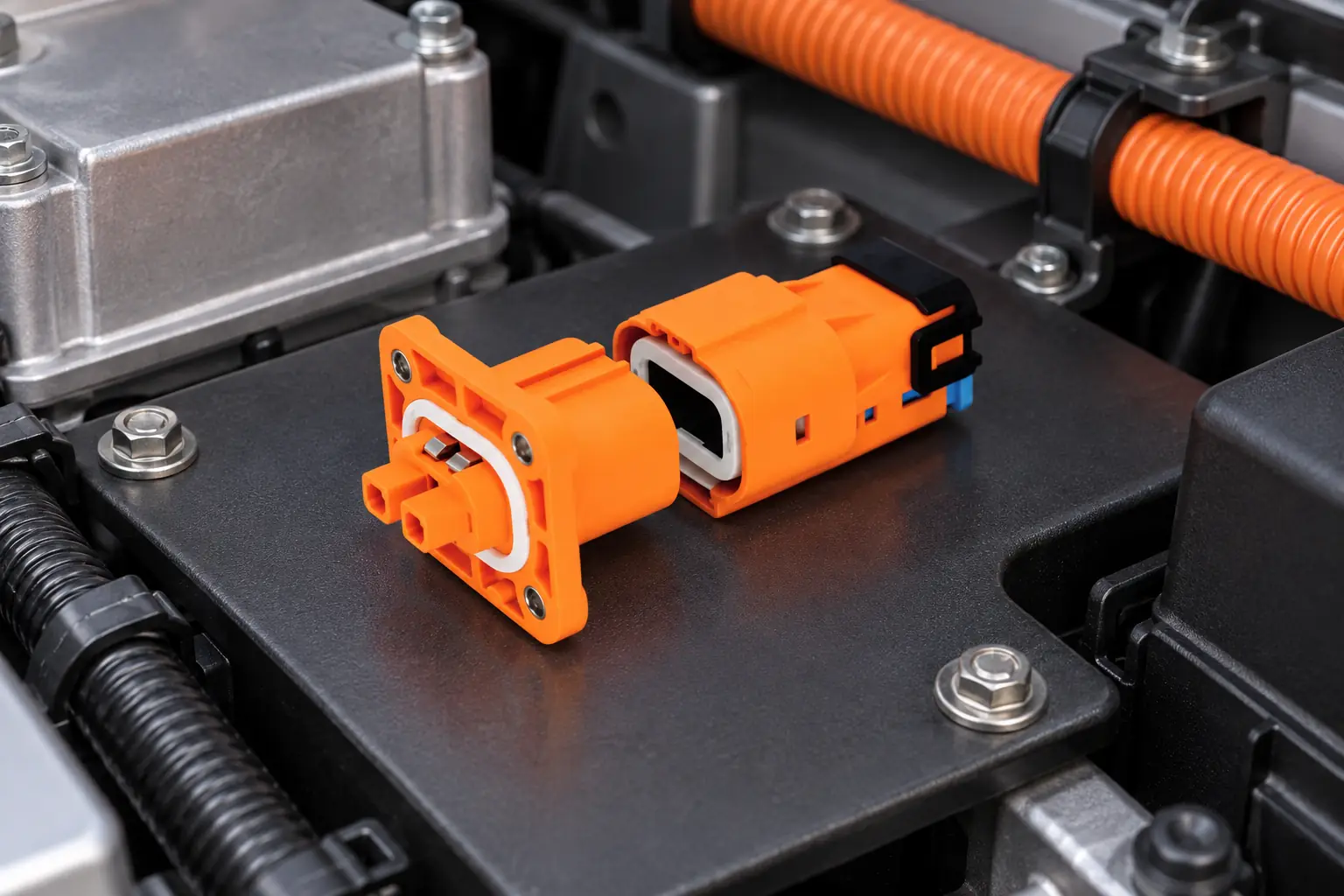
When a harness technician in Toronto encountered intermittent sensor faults, he replaced a damaged plug with a visually similar two-pin unit. The warning disappeared briefly, then returned after vibration and moisture exposure. The new plug was not simply defective: its key, interface seal and terminals did not match the device or wire. The root cause was connector selection and specification.
Zusammenfassung: Choose among 2 pin automotive connector types by complete interface—not by cavity count or appearance. Verify both housings, key code, terminal family, wire and insulation range, sealing components and circuit polarity. SAE/USCAR-2 and ISO 8092-2 provide automotive performance frameworks, while IEC 61984 has a broader, voltage-defined connector scope. Before release, test a representative mated assembly for continuity, retention and the actual environment.
What actually distinguishes one two-pin connector from another?
A two-pin connector provides two electrical paths, but that is where the similarity may end. It can be wire-to-wire or wire-to-device, sealed or unsealed. Contacts differ in geometry, plating, retention and current capability; housings vary by key, latch and mating depth.
Market labels are inconsistent. “Male” and “female” may refer to contacts, housings or the mating side, while “2 prong automotive connector” is search language rather than a controlled description. Use part numbers and interface drawings.
Before comparing samples, use this guide to identify automotive electrical connectors. Record markings, cavity numbers, latch, keys, terminals, seals and the viewing face. ISO 8092-2:2023 supplies automotive definitions, tests and performance requirements for single- and multi-pole harness connections, but the intended configuration still requires evaluation.
Which two-pin construction fits the application?
First consider exposure. An unsealed connection may suit a protected cabin, while exposed locations usually call for a validated sealed system. “Waterproof” is not an automatic rating: performance depends on both housings, wire seals, plugs, insulation diameters and assembly.
Next consider duty. A compact sealed sensor connector may serve a switch, sensor or solenoid, but function alone does not establish compatibility. The device drawing, schematic and mating specification must agree on interface and polarity.
| Two-pin construction | Typical application fit | Selection priority | Unit-cost tendency | Total-cost risk if misapplied |
|---|---|---|---|---|
| Unsealed wire-to-wire | Protected cabin or enclosed equipment | Key, latch, terminal and strain relief | Usually lower | Corrosion or fretting if exposed to moisture |
| Sealed wire-to-wire | Engine bay, exterior or other exposed routing after validation | Interface seal, wire seals, plugs and drainage | Moderate | Leaks, intermittent resistance or rework if seals are mismatched |
| Sealed wire-to-device or sensor | Sensor, switch, actuator or solenoid connection | Device header geometry, key, polarity and terminal overlap | Moderate | False signals or damaged device pins from a look-alike interface |
| Higher-current two-way system | Two power circuits where documented ratings support the load | Contact size, temperature rise, voltage drop and conductor capacity | Usually higher | Heating, loss of function or connector damage if undersized |
Low initial price can hide sorting, repinning and warranty costs. Illustratively, if 2% of 5,000 harnesses need 15 minutes of diagnosis and repair, that consumes 25 labour-hours before retesting or disruption. This is not a forecast; it shows the total-cost value of a documented matched system.
How do you match housings, seals and terminals?
Why must buyers match the exact interface rather than only male to female?
Start with the manufacturer-defined mating pair and drawing revision. Confirm key, cavity pattern, latch, polarization and any connector-position assurance feature. A housing can click yet provide inadequate contact overlap or seal compression; never remove a key to force a match.
Because supplier terminology differs, list both housing and terminal part numbers—not simply “male half” and “female half.” For a broader family view, see these types of automotive wire connectors.
Why must every seal be treated as an engineered component?
For sealed sensor connectors, verify the interface seal, wire seals, blank-cavity plugs and any rear cover. A wrong-size seal may lack compression or be damaged during insertion. Validate the complete mated assembly to the agreed OEM, SAE/USCAR-2 or ISO 8092-2 plan.
Why must wire, terminal and seal application ranges overlap?
Wire gauge alone is insufficient. The terminal specification must cover conductor area, construction and insulation diameter; the seal must fit that insulation. Use the drawing and applicator data, then review the controls for crimping automotive connectors.
Current capacity belongs to the assembled system. Load, duty cycle, ambient temperature, wire length, bundle loading and contact resistance affect temperature rise and voltage drop; even a low-current sensor can be sensitive to resistance change.
What evidence should procurement release and verify?
A useful request for quotation turns selected 2 pin automotive connector types into controlled line items, defining the mating set and required evidence. SAE/USCAR-2 covers mechanical, electrical and environmental performance tests for automotive connector systems; it is not a blanket certificate for any two-way plug.
| Release item | What to record | Why it prevents faults | Representative verification |
|---|---|---|---|
| Application | Device, vehicle zone, mounting, fluids, temperature and vibration exposure | Stops a protected-area connector being used in an exposed zone | Application review and agreed environmental conditioning |
| Mating interface | Both housing numbers, revisions, key and connector-face view | Eliminates visual look-alike substitutions | Gauge or approved-sample comparison; mating and retention checks |
| Terminal system | Contact numbers, plating, wire range, insulation range and tooling | Controls contact overlap and crimp quality | Crimp measurement, pull test, retention and voltage-drop test |
| Sealing system | Interface seal, wire seals, plugs and assembly instructions | Prevents incomplete or wrongly compressed seals | Visual inspection plus application-specific ingress test |
| Electrical definition | Cavity map, polarity, load, duty cycle and acceptance limits | Prevents reversed sensor or actuator circuits | 100% continuity and polarity test; loaded test where required |
Build samples with production wire, seals, terminals and tooling. Check retention, mating force, continuity, polarity and voltage drop before and after specified conditioning. Programme-required vibration, thermal and moisture testing can reveal faults that static continuity misses.
How do SAE/USCAR-2, ISO 8092 and IEC 61984 apply?
- SAE/USCAR-2 is a performance specification for automotive electrical connector systems. State the contracted revision, test category, sample construction and customer additions; citing the name alone does not certify a product.
- ISO 8092-2:2023 addresses single- and multi-pole connections for on-board road-vehicle wiring harnesses in voltage class A, including definitions, test methods and general performance requirements. Confirm the applicable part, edition and OEM limits.
- IEC 61984:2008 gives safety requirements and tests for connectors above 50 V and up to 1,000 V AC or DC, with rated currents up to 125 A per contact; it may be used as guidance at or below 50 V. It is not an automotive-specific replacement for vehicle validation.
These documents do not grant universal interchangeability, waterproof status or OEM approval. Unsupported claims can trigger retesting, shipment containment or a rejected approval package. Tie each claim to the exact assembly, wires, report and programme.
Which decision path rules in—or rules out—a two-pin connector?
- Start with the environment. For a dry, protected cabin, an unsealed system may be appropriate if vibration, temperature and contamination limits are satisfied. For splash, wash, condensation or fluid exposure, move to a sealed family validated in the complete mated condition. Exclude any option sold only as “waterproof” when the supplier cannot identify seals, wire ranges and test conditions.
- Choose the interface form. Use wire-to-wire inline housings where two harness branches must disconnect; use a compatible device/header interface for a sensor, actuator or control unit; use a panel-mount design only when its mounting and sealing method matches the enclosure. Do not adapt an inline pair to a header merely because both have two cavities.
- Separate signal duty from switched load or power. For a low-level sensor signal, prioritize stable contact resistance, compatible plating and protection against moisture or fretting. For a solenoid, motor, lamp or other switched load, check inrush, duty cycle, voltage drop and temperature rise using supplier data and programme limits. Exclude a small signal connector from power duty unless the documented assembled-system rating supports that exact condition.
- Lock polarity and keying before release. Record connector-face orientation, cavity numbers and circuit polarity, then select the correct key or polarization. “Male” and “female” may describe the contacts, the housings or the perceived mating side; confirm both housing and terminal part numbers against controlled drawings rather than using gender labels as the specification.
- Account for service frequency. A rarely disconnected production joint can prioritize retention and environmental robustness. A diagnostic or frequently serviced interface also needs accessible latching, appropriate mating-cycle evidence and a repair process that does not damage seals or terminals. Exclude a connector that requires pulling wires or defeating locks during normal service.
- Close the wire-terminal-seal compatibility loop. Approve conductor area and construction, insulation diameter, terminal, plating, wire seal, tooling and cavity plug as one combination. Freeze the complete bill of material, including housings, locks and rear covers, then validate production-representative assemblies for crimp quality, retention, continuity, polarity, voltage drop and the agreed environmental sequence.
ZUCH can support selection of 2 pin automotive connector types when buyers provide interface details, wire dimensions, circuit duty, application zone and required evidence. This is more useful than a photo or a request for “a waterproof two-pin plug.”
Frequently Asked Questions
What are the common types of 2-pin automotive connectors?
Common categories include unsealed wire-to-wire connectors, sealed wire-to-wire connectors, sealed wire-to-device or sensor connectors, and larger-contact two-way power connectors. Select by interface drawing, environment, terminal system and circuit duty rather than by the two-cavity label.
How do I match a 2-pin male and female automotive connector?
Confirm the manufacturer-defined mating housing numbers, key code, latch, cavity layout, terminals and seals. Because male and female can describe either contacts or housings, approve the part numbers and connector-face drawing instead of relying on the label.
Are all 2-pin automotive connectors wired the same way?
No. Cavity numbering, viewing direction and polarity vary, and some loads are polarity-sensitive. Use the device drawing and harness schematic, then perform continuity and polarity checks on the finished harness.
When should I use a waterproof 2-pin connector?
Use a validated sealed connector where the location faces water, condensation, dust, road contamination or vehicle fluids. Specify the exposure and test method; “waterproof” is incomplete without the mated configuration, wire seals, cavity plugs and acceptance conditions.
What wire gauge works with a 2-pin automotive connector?
There is no universal gauge. Use only a conductor size and insulation diameter listed for the selected terminal, seal and application tooling, then verify crimp geometry, pull force and electrical performance under the intended current and temperature.
Can I replace only one terminal in a 2-pin connector?
Often yes, if the housing, retention feature and sealing surfaces are undamaged and an approved replacement terminal is available. Follow the correct process for depinning an automotive connector, use a new correctly crimped terminal and seal, then verify retention, continuity, polarity and sealing; replace the housing if it is cracked, distorted or no longer retains the contact.
Which sources define the relevant test framework?
- SAE International, SAE/USCAR-2: Performance Specification for Automotive Electrical Connector Systems
- ISO 8092-2:2023, Road vehicles—Connections for on-board electrical wiring harnesses—Part 2
- IEC 61984:2008, Connectors—Safety requirements and tests
The dependable rule is simple: a two-pin connector is only correct when its interface, terminals, wires, seals and test evidence agree.
To compare sourcing options, explore the ZUCH product range and contact the team with your mating drawings, wire data, circuit requirements, environmental conditions and validation plan.