Zhejiang ZUCH Technology Co., Ltd.
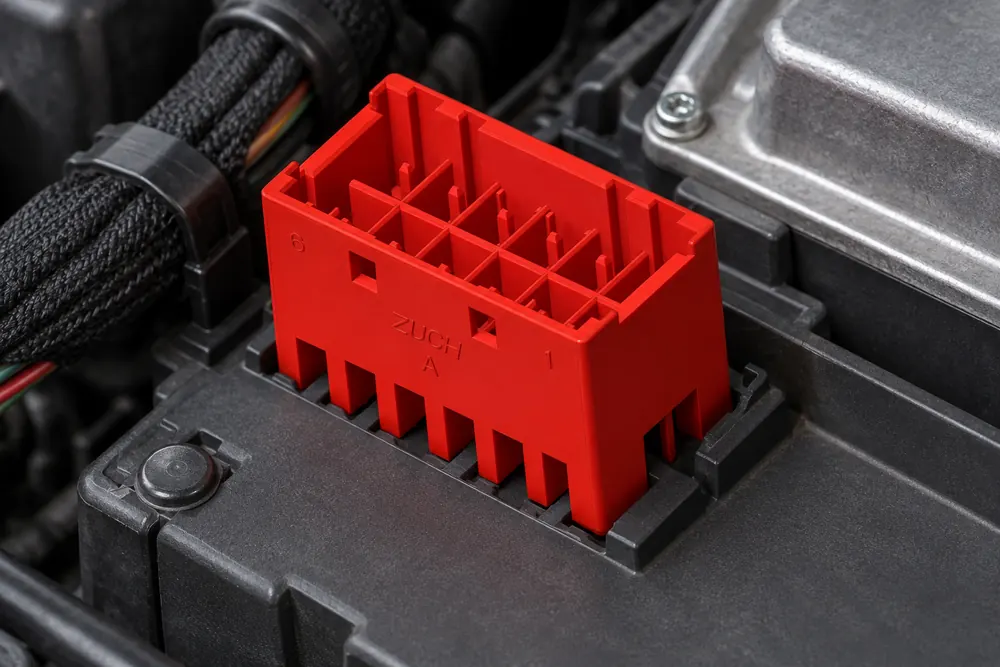
When a procurement engineer in Toronto specified a 12-circuit connector for a sensor and accessory harness, the mating geometry fit but the sealing and wire gauge did not; the root cause was incomplete interface verification rather than a bad product.
Summary: A 12-pin automotive connector is a 12-circuit interface, not a universal replacement. Before buying, verify cavity layout and keying, terminal system, wire-size range, current and voltage requirements, environmental seal, locking features, and the mating half. Use the applicable drawing and validation plan, with SAE USCAR-2 as a useful performance reference and IEC 61984 where connector safety tests apply. A ten-minute interface checklist can prevent harness rework, water ingress, terminal heating, and a costly field return.
In larger sensor, lighting, body-control, and accessory harnesses, twelve positions can carry a mixture of power, ground, low-level signals, communication lines, and spare circuits. That mix makes the connector system—housing, terminals, seals, backshell, and wire termination—more important than the pin count printed on a catalogue page. The following checks help engineering and purchasing teams compare like with like.
Why pin count is not enough to compare 12-pin connector suppliers
Start with the vehicle or equipment interface drawing. Record the exact cavity count, row arrangement, polarization key, latch location, mounting features, and mating direction. Two products described as a 12 pin automotive connector may have different cavity numbering or a mirror-image key; forcing a near match can reverse circuits or leave terminals partially engaged.
Request a 2D drawing and, when possible, a neutral CAD model. Check the connector envelope against harness bend radius, bracket clearance, and service access. A connector that mates on a workbench may interfere with a clip, a heat shield, or a sensor body once installed. Also confirm whether the specification calls for a wire-to-wire pair, wire-to-board plug, or a header with a separate retainer.
Build a pin map that names every circuit, expected load, signal type, and cavity. Include unused positions and any terminal-position assurance (TPA) or secondary lock. For background on housing and terminal terminology, see automotive connectors and terminals.
What interface evidence should be included in the RFQ?
- Geometry and keying: drawing, cavity numbering, key code, and mating dimensions.
- Electrical load: current per circuit, voltage, duty cycle, and derating curve.
- Terminal system: terminal part number, plating, crimp range, and retention data.
- Environment: seal architecture, IP test report, temperature, and fluid exposure.
- Serviceability: TPA instructions, depinning method, and replacement-terminal policy.
How terminal family, wire gauge, and populated cavities affect electrical performance
The terminal is the current-carrying element, so check its approved wire range—not simply the cable’s outside diameter. Automotive harnesses commonly use metric conductor areas such as 0.35, 0.50, 0.75, 1.0, 1.5, and 2.5 mm², while North American programs may specify AWG equivalents. The supplier should state the exact crimp wings, insulation support, and seal size for each range.
Ask for current capacity at the actual ambient temperature, number of loaded cavities, and wire bundle condition. A terminal rated at a headline current in isolation may require derating when all twelve circuits are populated. Review voltage drop and contact resistance limits, then confirm these values through the planned test method. USCAR-2 provides a recognized framework for connector-system performance testing, including electrical and mechanical durability; it is not a blanket certification for every part.
For mixed circuits, specify separate terminal variants if needed: a larger power terminal for supply and ground, and smaller signal terminals for sensors or CAN/LIN communication. Verify polarization and terminal-position assurance so a smaller contact cannot be inserted into the wrong cavity. A complete automotive electrical connector guide can help teams align terminology before issuing an RFQ.
Also ask whether all twelve positions are intended to be populated. Unused cavities in a sealed connector normally need approved plugs or seals, while unpopulated positions in an unsealed cabin connector still affect the cavity map and future service records. This is why the buyer should send both a circuit matrix and clear photos of the wire-entry face and mating face.
When does a 12-pin connector need sealing and material evidence?
Choose a sealed 12-pin automotive electrical connector when the interface may see splash, wash-down, mud, salt, condensation, or engine-bay fluids. In procurement records, the phrase 12 pin automotive electrical connector should resolve to a specific housing and terminal family, not a generic category. Confirm whether sealing is cavity-by-cavity, a perimeter gasket, or a combination, and identify the wire-seal diameter range. An IP rating describes a defined test condition; it does not guarantee performance after an incorrect crimp, a nicked seal, or an unlatched TPA.
Specify operating and storage temperatures, vibration exposure, chemical contact, and UV location. Material declarations should identify the housing resin, terminal base metal, plating, and any halogen or recycling requirements in your market. If the connector sits near a heat source, request temperature-rise and thermal-aging evidence at the loaded current rather than relying on a generic “automotive grade” label.
Use a documented validation plan: visual and dimensional inspection, mating/unmating force, terminal retention, continuity, insulation resistance, dielectric withstand where applicable, and environmental cycling. IEC 61984 defines safety requirements and tests for connectors within its scope; it should be treated as a test and safety reference, not assumed product approval. For practical sealing decisions, link your engineering review to this waterproof connector guide.
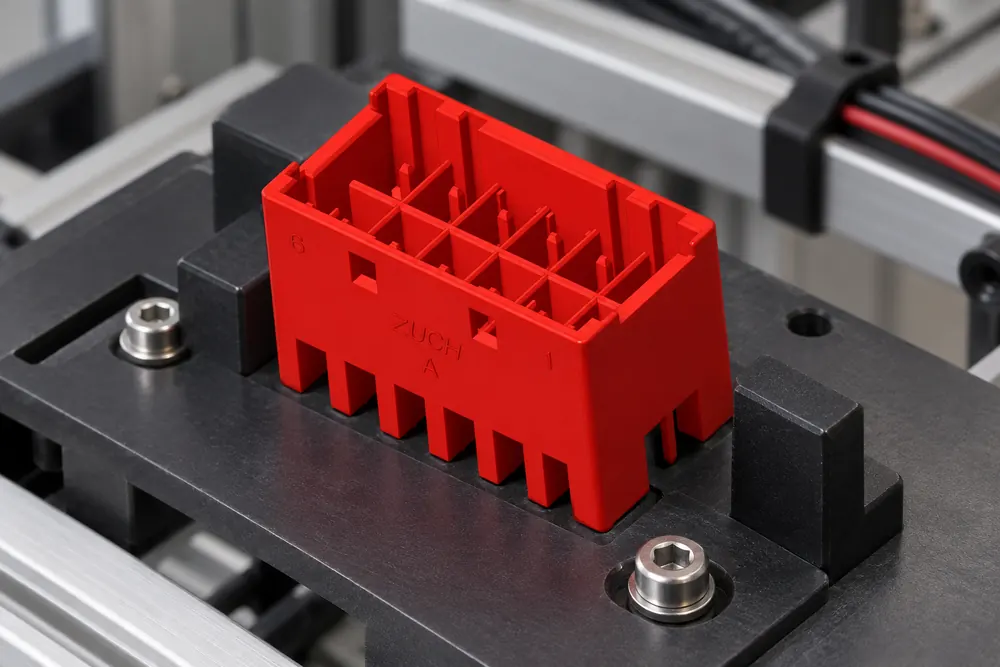
How design choices affect reliability, service, and lifecycle cost
| Design choice | Performance and fit | Efficiency and maintenance | TCO consideration |
|---|---|---|---|
| Unsealed housing | Suitable for protected interiors with controlled humidity | Simple assembly; requires enclosure-level protection | Lower unit-cost tendency, but higher risk if exposure changes. |
| Sealed housing | Better resistance to splash and contaminants when correctly terminated | More parts and crimp controls; easier to specify for exposed harnesses | Often reduces moisture-related returns and rework. |
| Single terminal size | Simplifies tooling when all circuits share a load range | Streamlined kitting and replacement stock | May oversize signal circuits or constrain future power changes. |
| Mixed terminal sizes | Optimizes power and signal circuits independently | Requires clear cavity and tool controls | Can lower copper and harness mass while improving electrical margin. |
| Integrated CPA/TPA | Provides visible lock assurance and retention control | Adds an assembly step but supports mistake-proofing | Usually worthwhile where incomplete mating would trigger field service. |
What supply and compliance evidence should be reviewed before approval?
For each candidate, request a controlled datasheet, revision status, terminal and seal cross-reference, sample inspection report, and change-notification process. Samples should be built with the proposed wire, crimp tooling, and mating half; loose housings can conceal a poor termination window. Ask how the supplier controls lot traceability and what happens when a terminal or resin formulation changes.
Standards and regulations have different scopes. SAE USCAR-2 is an industry performance specification; IEC 61984 covers connector safety requirements and tests; NHTSA’s vehicle-safety resources explain the regulatory context for vehicles sold in the United States. Destination market, intended use, and the exact claim in your literature determine which approvals or declarations are needed. Never turn a test report into a certification claim without confirming its scope.
Which procurement dimensions should be expanded in the RFQ?
| Dimension | Questions for the supplier | Decision signal |
|---|---|---|
| Application | Cabin, exterior, engine bay, trailer, or industrial vehicle? | Drives sealing, temperature, vibration, and materials. |
| Performance level | What current mix, mating cycles, retention, and environmental tests are required? | Separates a catalogue fit from a validated system. |
| Geography | Which vehicle market and regulatory regime apply? | Sets documentation, labeling, and compliance obligations. |
| Cost driver | Are tooling, terminal variants, seals, packaging, and inspection included? | Reveals landed cost and avoids false unit-price comparisons. |
| Continuity | What are MOQ, lead time, lifecycle status, and PCN practices? | Protects production continuity beyond the first order. |
What must be checked before releasing a 12-pin connector?
Before approving a 12 pin connector automotive package, complete these actions:
- Freeze the pin map, keying, mating half, mounting envelope, and wire bend requirements.
- Match every circuit to terminal, wire-gauge, seal, plating, and crimp-tool references.
- Run sample builds and record continuity, contact resistance, retention, mating force, and seal checks.
- Review temperature, vibration, fluid, and connector-cycle evidence against the vehicle duty profile.
- Approve drawings, revision control, traceability, and change-notification terms before production release.
ZUCH can support this evidence-led process with configurable automotive connector options, component references, and sourcing discussion. Share the application, mating reference, circuit mix, environment, and documentation requirements so the proposed automotive 12 pin connector is evaluated as a complete interface.
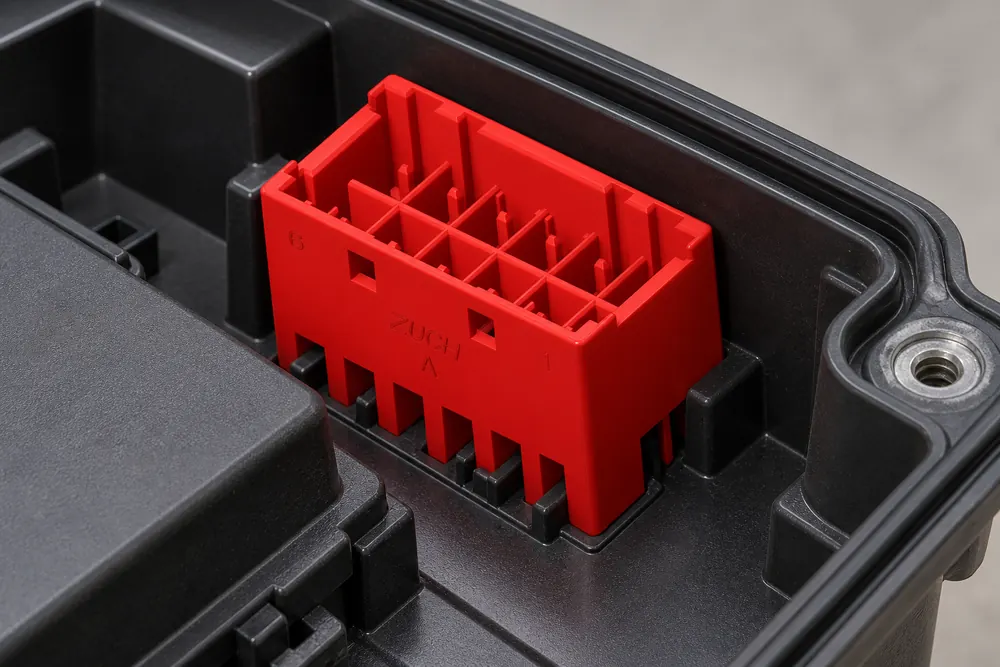
Frequently asked questions
What is a 12-pin automotive connector typically used for in larger sensor and accessory circuits?
It commonly combines several sensor signals, grounds, low-current controls, communication lines, and accessory power in one harness interface. The actual assignment depends on the vehicle architecture, so confirm the pin map and terminal ratings rather than inferring function from the twelve-position count.
How do I confirm that a 12-pin automotive connector matches my vehicle wiring?
Compare the OEM or equipment drawing with the housing key, cavity numbering, mating half, terminal family, wire range, and mounting envelope. Build a sample using the intended wire and crimp process, then verify continuity and retention before approving production.
Do 12-pin automotive connectors need a matching male and female housing?
Wire-to-wire systems require a compatible plug and receptacle, while wire-to-board systems mate to a header. “Male” and “female” descriptions alone are insufficient; the key code, terminal gender, polarization, and lock geometry must be matched as a system.
What terminal and wire-gauge options are common for a 12-pin automotive connector?
Common conductor areas include 0.35 to 2.5 mm², with terminal sizes selected for signal or power duty; AWG equivalents may be used in North American programs. Confirm the manufacturer’s approved insulation diameter, crimp wings, seal size, and current derating for the exact terminal.
When should I choose a sealed 12-pin automotive connector?
Choose sealing when the connector is exposed to splash, wash-down, dirt, salt, condensation, or engine-bay fluids. Validate the complete assembly—including wire seals, plugs, crimp quality, and latch state—because an IP test result does not compensate for an incorrectly terminated connector.
Can I replace one terminal in a 12-pin connector without replacing the full housing?
Often, if the housing cavity, lock, and seal remain within the manufacturer’s acceptance criteria and a service terminal is available. Follow the approved depinning and repinning procedure; replace the housing when retention, sealing, or cavity geometry has been compromised.
Sources for 12-pin connector purchasing and validation
- SAE USCAR-2: Performance Specification for Automotive Electrical Connector Systems
- IEC 61984: Connectors — Safety requirements and tests
- NHTSA: Vehicle Safety
The reliable connector is the one whose interface, circuit load, environment, and service path were verified together—not the one that merely clicks into place.
For connector selection and sourcing support, review ZUCH automotive connector products and contact the team with your application and validation requirements.