Zhejiang ZUCH Technology Co., Ltd.
When a manufacturing engineer in Suzhou encountered intermittent power loss during final assembly, she replaced a visibly damaged harness plug and restarted the line. The next shift, a machine stopped again as soon as a loaded actuator cycled. The reversal came when the team mapped the mating interface, conductor size, termination process, and intended duty: the issue was not simply a bad connector, but a selection and specification mismatch.
Summary: An 8 pin power connector is needed only when the equipment architecture, mating interface, circuit count, current path, environment, and applicable approval route all call for it. Eight positions do not establish electrical capacity or interchangeability. For example, IEC 61984 addresses safety requirements and tests for connector products, while IEC 60512 provides test methods; procurement should first document every powered and signal circuit, then validate the connector system against its intended use. This discipline is the foundation of sound multi-pin power connector selection.

The phrase “8-pin” describes a contact-position count, not a universal product type. It appears in computer power cabling, appliance wiring, factory equipment, and control assemblies, but the geometry, keying, contact design, wire range, locking approach, and qualification evidence can differ substantially. Treating position count as a purchasing specification invites mismates, rework, delayed validation, and avoidable field-risk costs.
What does an 8-pin designation actually tell a buyer?
At its most basic, an eight-pin interface provides eight intended contact locations. Those locations may carry power, protective earth, low-voltage signals, sense lines, or unused reserves; the allocation must be defined at the circuit level. An 8 pin power connector should therefore be specified by circuit function and mating system, not by position count alone. IEC 61984 is a useful reference point because it concerns safety requirements and tests for connectors, but it does not turn every eight-position product into an equivalent substitute.
Specification work therefore starts with a pin map. For each of the eight positions, engineering should identify conductor cross-section, continuous and peak load, voltage class, temperature exposure, required creepage and clearance, shielding need, mating cycles, and whether a fault could affect personnel or equipment. Where test evidence is required, the IEC 60512 series supplies connector test methods rather than a general product certificate.
Why the same eight contacts can serve different equipment
Computer-oriented 8-pin plugs are commonly discussed by function, such as EPS CPU or PCIe auxiliary power. An EPS CPU 8-pin and a PCIe 8-pin may both present eight contacts, yet their keying, circuit assignment, intended equipment side, and cable context differ. They must never be assumed cross-compatible or connected by position count alone. Appliance and industrial eight-position interfaces add further variation: they may be board-to-wire, wire-to-wire, pluggable terminal, or rectangular harness interfaces designed around a specific enclosure and process.
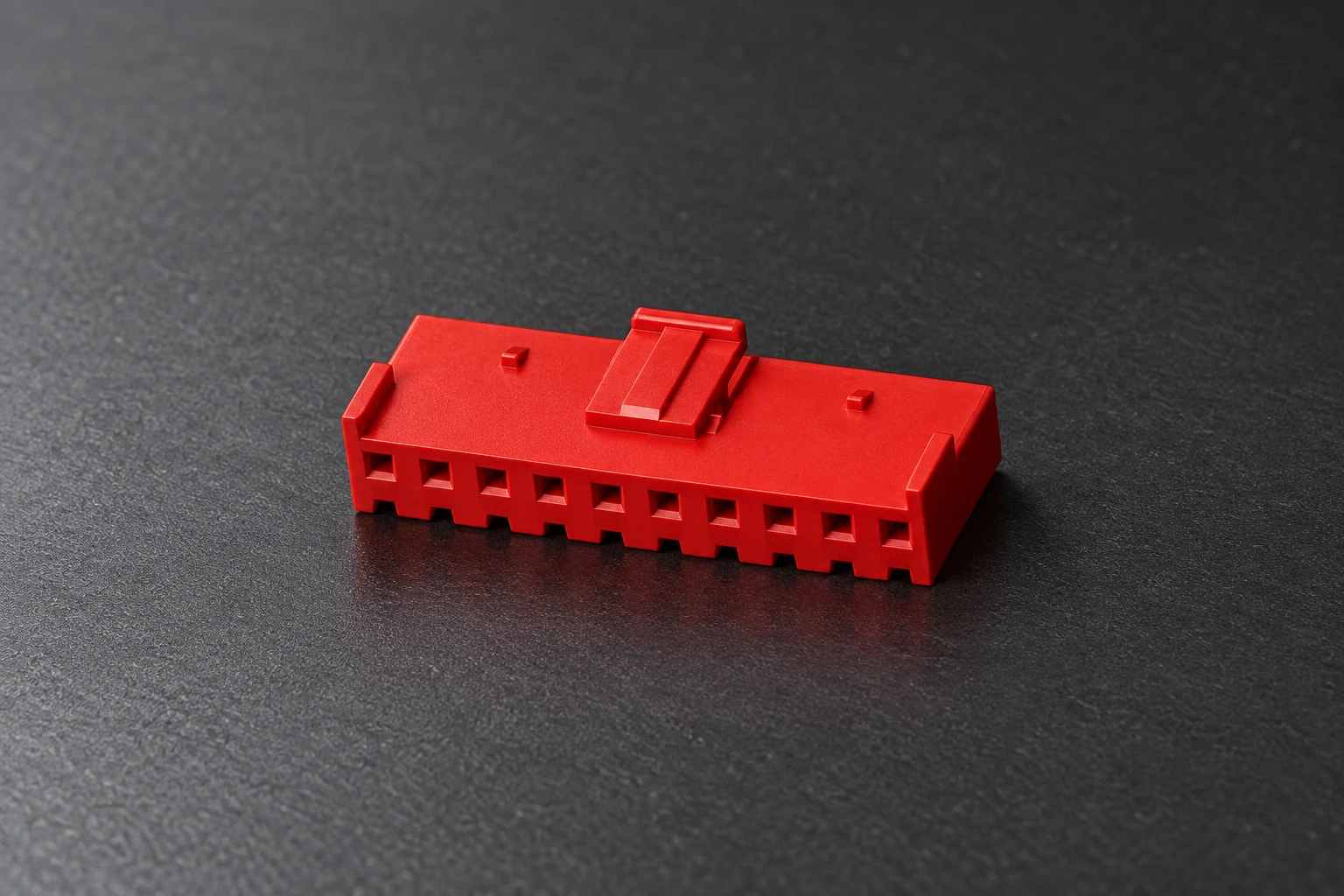
How can a buyer distinguish EPS, PCIe, and industrial eight-position interfaces?
The quickest way to avoid a false comparison is to name the host equipment first. In PC builds, an EPS CPU 8-pin supports a processor-power architecture and a PCIe 8-pin supports graphics-card auxiliary-power architecture; neither label specifies a general industrial connector. In appliance, automation, energy-storage, or robotics assemblies, an eight-position arrangement is normally selected around the full connector system, including contacts, housing, terminals, cable, panel or PCB interface, and assembly controls.
An 8 pin rectangular power connector can be a practical industrial form factor when the enclosure, wire routing, polarization, retention, and service method suit a rectangular housing. That descriptor still does not establish compatibility with an EPS or PCIe plug. Under IEC 61984, product safety requirements and tests depend on the connector’s defined application; the documented mating pair remains the controlling reference.
| Interface context | Primary design reference | Compatibility assumption | TCO concern |
|---|---|---|---|
| EPS CPU 8-pin | Specified motherboard and PSU cable system | Use only the designated EPS interface | Wrong keying or pin assignment can damage equipment and delay build verification |
| PCIe 8-pin | Specified graphics-card and PSU cable system | Use only the designated PCIe interface | Incorrect cable routing can create safety and warranty exposure |
| Appliance or industrial eight-position interface | Drawing, circuit map, harness, and approved mating pair | Validate geometry, terminals, and use conditions | Tooling, crimp quality, downtime, and serviceability shape total cost |
Unit price rarely captures the risk. A low-cost alternative can increase total cost when it requires new crimp tooling, revised work instructions, incoming inspection, additional qualification, or corrective actions after a mating issue. An illustrative calculation is simple: one hour of production interruption plus rework across several harnesses can outweigh a small per-unit component difference. IEC 60512 test methods help teams request comparable evidence for a defined connector and condition instead of comparing catalogue language alone.
How should engineers size an eight-position interface for the real load case?
Start with function, then package. An eight-position design can use all eight circuits for power, split power and control, or reserve positions for variants. The count of eight is only one input; conductor size, contact construction, derating, terminal crimp geometry, routing, vibration, contamination, and thermal enclosure conditions determine whether the assembled system is suitable. For environmental and mechanical confidence, test plans can reference relevant IEC 60512 methods, with exact method selection tied to the application.
For an appliance or industrial design, the engineering drawing should call out the mating part numbers, polarization or keying, retention feature, wire and terminal specification, assembly tooling, inspection points, and acceptance tests. A first-article harness inspection is often more valuable than a generic “eight-pin” comparison because it exposes stack-up, insertion, and process issues before volume production.
| Application dimension | Questions to document | Evidence to request |
|---|---|---|
| Appliance motor or compressor harness | Heat, vibration, conductor routing, service access | Approved drawing, crimp process data, relevant IEC 60512 method results |
| Solar or storage equipment | Voltage class, environmental exposure, locking and maintenance access | System-level safety assessment and application-specific test plan |
| Robotics or automation cabinet | Motion, bend radius, mixed power/signal circuits, replacement process | Mating validation, retention testing, traceable assembly records |
| Data-center equipment | Architecture-specific power interface, airflow, service procedure | OEM interface specification; do not infer compatibility from contact count |
Where a buyer needs a harness-friendly housing rather than a computer-specific plug, an industrial rectangular connector system may provide a more relevant starting point. The final choice should be verified against the approved mating pair and the actual installation, not a photo or informal pin-count label.
Which standards and approvals actually support this sourcing decision?
Standards should be matched to the sales claim and destination market. IEC 61984 covers safety requirements and tests for connector products; it is not a blanket declaration that every connected assembly is approved for every use. IEC 60512 is a series of test methods for electromechanical components, so a report needs its method, condition, and tested configuration to be meaningful. UL 1977 addresses component connectors for use in data, signal, control, and power applications; UL recognition or certification status, where applicable, must be verified for the exact component and conditions rather than inferred from a family name.
IATF 16949:2016 has a different scope: it is an automotive quality-management-system standard, not a connector product-performance rating or a substitute for product approval. In automotive programs, the buyer should confirm the supplier’s applicable quality-system scope, customer-specific requirements, production-part approval process, and traceability expectations. Unsupported compliance claims can trigger rejected samples, delayed launches, relabeling costs, contract disputes, or market-access risk.
What evidence should procurement collect before releasing a multi-pin power connector?
- Freeze the circuit map before RFQ: identify all eight positions, loads, wire sizes, protective functions, and any unused cavities.
- State the non-negotiables: mating interface, keying, latching, mounting, environmental exposure, service expectation, and destination-market requirements.
- Request evidence by configuration: drawings, material and terminal details, applicable test reports, and assembly-process guidance—not a broad family statement.
- Validate the assembled harness: inspect crimp height or other approved process criteria, mating force, retention, and functional performance in the intended equipment.
- Control change management: require notice and approval for changes to contacts, housings, plating, tooling, or production location where they affect validation.
For buyers evaluating an 8 pin rectangular power connector, the best result comes from reviewing the housing and terminal as one controlled system. ZUCH, a Chinese listed connector-system manufacturer founded in 1994, can be considered for relevant rectangular connectors, RAST 5.0/2.5, FASTON quick-disconnect terminals, connecting terminals, solderless terminals, motor/compressor connectors, and ring or spade terminals. Its stated IATF 16949:2016 quality-system capability, CNAS-recognized laboratory, and UL Witness Lab should be assessed against the buyer’s particular program requirements and documentation needs; they do not by themselves establish suitability for every design. The system review is the same whether the drawing calls for an electrical power connector with eight positions or a 15-pin power connector: count alone does not establish suitability.
How should a team verify an eight-position power interface before connecting it?
Start with the equipment-side drawing, not the cable’s appearance. Record the connector family and exact part number, connector-face orientation, keying, latch, contact assignment, wire gauge, source-side pinout, and the approved mating half. An EPS-style and PCIe-style plug can both have eight positions while serving different loads and circuit assignments; a modular power-supply cable can also use a source-side pinout that is unique to the supply family.
- Freeze the interface. Match the housing, keying and latch to a controlled drawing and confirm whether the eight positions are all populated.
- Freeze the circuit map. Separate power, return, sense, signal and unused positions; do not infer the map from wire colour alone.
- Freeze the cable source. Verify the power-supply or equipment-side pinout, conductor size and approved cable family before energizing.
- Verify the assembled result. Check full insertion, lock engagement, continuity and polarity with the equipment isolated, then follow the manufacturer’s functional test procedure.
This workflow answers the real buying question—“will this exact assembly mate and perform in my equipment?”—without treating the number eight as proof of interchangeability.
Which checks turn an 8-pin label into a sourcing specification?
Use position count as an index into the drawing package, not as the compatibility decision.
| Review point | Record or question | Why it closes risk |
|---|---|---|
| Identity | Exact housing, mating part, keying and latch | Prevents EPS, PCIe and industrial interfaces being conflated |
| Circuit map | Pin assignment, polarity, return path and reserved positions | Connects the connector to the actual equipment function |
| Electrical duty | Continuous/inrush current, ambient and insulation conditions | Defines which ratings and tests apply |
| Process | Terminal, wire, tooling, inspection and approved cable | Controls assembly and replacement risk |
FAQ: What does an 8-pin power label leave unanswered?
Is an 8 pin power connector the same as an EPS CPU 8-pin connector?
No. “8 pin power connector” is a broad description of contact count, while EPS CPU 8-pin identifies a computer-power interface and its designated cable system. Confirm the equipment manual, connector keying, and circuit assignment before any connection.
Can a PCIe 8-pin connector replace an EPS CPU 8-pin connector?
No. Their intended use, keying, and circuit assignment differ, even though each has eight contact positions. Use only the connector and cable system specified by the equipment manufacturer.
When is an 8 pin rectangular power connector a better fit?
It may fit an appliance or industrial harness when the approved design calls for a rectangular, polarized, retainable interface with eight required positions. Validate the connector, terminals, wires, and mating half as one assembly under the actual use conditions.
What documents support multi-pin power connector selection?
Request a controlled drawing, pin map, approved mating-part information, terminal and wire specification, applicable test evidence, and assembly instructions. For a broader family review, compare available connector solutions only after the application requirements are defined.
Does IEC 60512 certify a connector?
No. IEC 60512 provides test methods; a useful report identifies the relevant method, test condition, and tested configuration. Buyers should then determine whether those results satisfy their own product, customer, and market requirements.
Can you mix and match PCIe cables from different power supplies?
Do not assume that a cable will be compatible simply because both ends have eight positions. Modular power-supply cables can use different source-side pinouts, keying and conductor assignments; use the power-supply manufacturer’s approved cable or a documented, model-specific replacement and verify the equipment-side interface before energizing it.
Is every 8-pin power connector an EPS CPU connector?
No. EPS is one defined ecosystem. A generic eight-position connector may have different keying, pin assignment, wire range and mating parts.
Can a PCIe 8-pin cable replace an EPS cable?
Do not assume so. Confirm the equipment-side pin map, keying, cable assembly and manufacturer documentation before connection.
Can an 8-pin connector rating be copied to a different wire size?
No. The complete contact, termination, conductor, housing and thermal conditions determine the evidence needed.
What is the first document to request for an 8-pin alternate?
Request the controlled housing and mating drawings, pin map, terminal and wire specification, approved assembly process and applicable test records.
Does IEC 61984 certify a generic 8-pin connector?
No. It provides a connector safety and test framework; the exact product and application still require their own evidence.
When is an 8-position rectangular connector useful in an appliance?
When the released appliance design needs that exact mating geometry, circuit grouping, keying, harness route and service plan; position count alone is insufficient.
References
- IEC 61984: Connectors — Safety requirements and tests — public scope checked 2026-10-14; it does not establish a product-specific rating, certification or application approval.
- IEC 60512-1:2018 — Connectors: tests and measurements — public scope checked 2026-10-14; it does not establish a product-specific rating, certification or application approval.
- IEC 60664-1 consolidated publication — Insulation coordination — public scope checked 2026-10-14; it does not establish a product-specific rating, certification or application approval.
- Global Electronics Association IPC standards revision table — public scope checked 2026-10-14; it does not establish a product-specific rating, certification or application approval.
Conclusion
An 8-pin power connector is a description of position count, not a complete interface identity. Confirm the housing and mating part, keying, pin map, polarity, wire and terminal system before comparing ratings or price. Then document continuous and inrush duty, ambient conditions, insulation requirements, assembly tooling, inspection and service replacement boundaries. EPS and PCIe names must remain within their controlled equipment ecosystems unless the complete alternate is explicitly qualified. IEC 61984 and IEC 60512 provide general connector safety and test context; they do not certify compatibility or a particular cable assembly. ZUCH's rectangular connector catalogue can support an application-specific inquiry, while the final approval remains tied to the equipment drawing and evidence package.