Sealed vs Open Rectangular Connectors: Define Environmental Inputs First
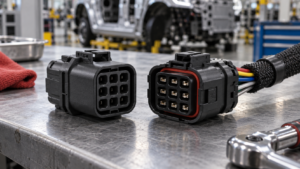
The choice between a sealed and an open rectangular connector begins with the defined exposure and complete assembly boundary. A housing appearance alone cannot establish the environmental protection required for a finished product.
Contents
Part 1. Define the environmental boundary before comparing connectors
Describe where the interface is located, what it may be exposed to, how the enclosure is arranged, and which conditions the responsible program must evaluate. This scope makes the comparison about a complete assembly rather than a label applied to a connector family. For a related technical reference, see Quick-Connector vs Permanent Crimp: Compare the Complete Interface System.
The controlled requirement should also identify the mating interface, cable entry, routing, access, and service context. Those details affect the questions a supplier and engineering team need to resolve.
| Environmental input |
Why it matters |
Record to review |
| Exposure definition |
Establishes the condition the assembly must address |
Intended location and controlled exposure description |
| Enclosure boundary |
Identifies dependencies outside the connector |
Enclosure drawing, interfaces, and access features |
| Cable and mating path |
Shows whether interfaces introduce additional variables |
Cable entry, mating drawing, and routing layout |
Part 2. Compare sealed and open interface assumptions
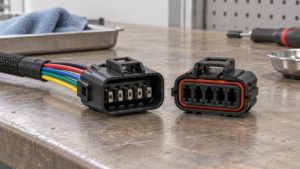
A sealed-interface concept and an open-interface concept may lead to different questions about the housing, mating condition, enclosure, cable entry, inspection, and service process. Do not interpret a product image or a broad category label as a rating statement.
The comparison must remain tied to the released design and the evidence required by the application. An open interface can depend heavily on its surrounding enclosure, while a sealed interface can still require specific mating and assembly conditions.
Important: A connector that appears sealed in a catalogue image is not proof of an environmental rating or suitability for a particular exposure. Source: NEMA enclosure guidance.
Part 3. Review mating, enclosure, and cable-entry dependencies
Review the connector and mating definition with the enclosure walls, gaskets or other system interfaces where applicable, cable entry, strain relief, and access path. These dependencies belong to the complete product definition, not to a generic category description. For a related technical reference, see RAST Connectors on Appliance PCBs: Review Layout, Mating, and Retention.
Document the relevant revision and identify any conditions that require engineering review. This helps a sourcing request stay aligned with the actual assembly context.
Part 4. Include service access in the selection
Service and inspection can change the practical choice of interface. Consider how the connector is reached, mated, checked, released, and protected during the controlled service process.
These questions should not be converted into a field procedure on a general web page. The responsible organization must define work authorization, tools, and any applicable safety controls for the equipment.
Use a controlled package to compare supplier responses. It should state the required inputs without assuming that a catalogue category proves compliance with them.
| Inquiry item |
Why it is needed |
Send with RFQ |
| Exposure and enclosure definition |
Connects the request to the actual assembly boundary |
Controlled environment description and enclosure drawing |
| Mating and cable entry |
Identifies interface dependencies |
Mating drawing, cable-entry, routing, and access details |
| Evidence request |
Makes program expectations explicit |
Sample objective, requested records, and evaluation needs |
| Change control |
Keeps the comparison valid through updates |
Revision, notification, and traceability expectations |
Part 6. Reassess when the exposure or assembly changes
A change to location, exposure, enclosure, cable entry, mating part, routing, service access, or intended use can change the original selection review. Record the difference and route it through the responsible engineering process before reusing prior conclusions.
This discipline helps buyers avoid treating a similar-looking connector as an equivalent replacement. Equivalence must be assessed against the controlled interface and program evidence. The locking-mechanism comparison covers the related mating-and-access questions.
Part 7. Use ZUCH routes for a controlled connector inquiry
ZUCH’s rectangular connectors route and product catalogue offer a commercial starting point for identifying connector families. They do not confirm a specific environmental rating or an approved application.
For an inquiry, provide the controlled exposure description, enclosure and mating drawings, cable-entry and access constraints, sample objective, requested records, and change-control expectations. Use the sample request route or contact page to submit the controlled package.
FAQ
Is a sealed connector always required outdoors?
No. The required interface must be determined from the controlled exposure, enclosure, mating, cable entry, service context, and program evidence.
Does a connector housing alone define environmental protection?
No. The complete assembly boundary and the released design determine what must be evaluated.
What should be compared between sealed and open options?
Compare the controlled exposure, enclosure, mating, cable entry, routing, access, service requirements, and evidence requested for the program.
Why do enclosure and cable entry matter?
They can introduce or control dependencies that are outside the connector housing but part of the finished assembly.
Can a catalogue image prove an environmental rating?
No. Confirm required ratings and conditions against controlled documentation and application-specific evidence.
What needs review when an environment changes?
Review the exposure description, enclosure, cable entry, mating interface, routing, service access, and the impact on the released evidence.
What belongs in a sealed-connector RFQ?
Include controlled drawings, exposure and enclosure definition, mating and cable-entry details, access constraints, sample objective, requested records, and change-control requirements.
References
 Zhejiang ZUCH Technology Co., Ltd.