Zhejiang ZUCH Technology Co., Ltd.
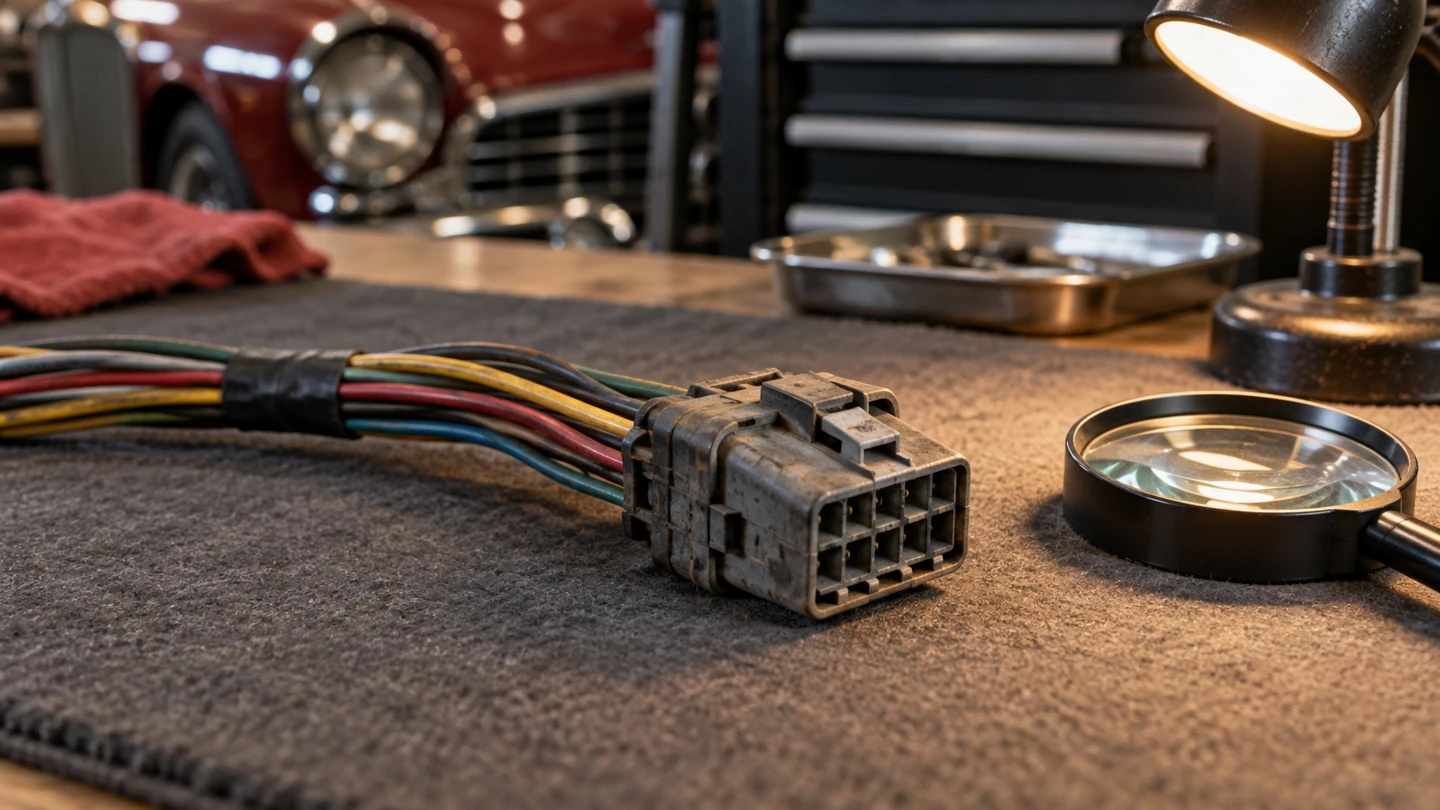
An old connector can look correct for a classic car and still be a poor candidate for reuse. A dull contact, cracked sleeve or hardened wire may be part of a wider problem, while a modern replacement can change the harness appearance or introduce an undocumented interface. Restoring vintage automotive electrical connectors therefore requires two separate decisions: what the vehicle originally used and what remains serviceable today. This guide explains how to document an unknown connector, assess the case for preservation or replacement, and verify terminal dimensions before ordering. It also describes how to keep restoration choices traceable when previous repairs have already changed wire colors, terminals or circuit routing.
Retain original parts only when their identity, condition and intended use can be established. Start with period service information and an inventory of the actual harness, then inspect contacts, insulation and the mating components. Replace damaged parts using a documented specification and an appropriate repair method. IEC 61210:2010 covers a defined group of non-insulated flat quick-connect terminations; it does not identify every vintage automotive terminal or authorize a restoration. Bosch Classic offers vehicle and product search resources for its classic-vehicle program, illustrating a useful documentation route without promising availability for an unknown connector.
What should be documented before an old connector is disturbed?
Photograph the installed connector, both sides of the separated interface where safe, the wire route and any markings. Record the component served, vehicle year, relevant chassis or production information and any modifications. Keep the original wiring diagram alongside a record of what is actually present. The two may differ after decades of repairs.
Label the wire positions before removing terminals. An old harness may have faded colors, replacement leads or owner-added accessories. A correct period diagram remains useful, but it should not be used to assume that every existing wire still follows the original arrangement. Identify the vehicle’s electrical architecture from reliable information rather than assuming a particular voltage or ground polarity from its age.
| Evidence | Restoration value | Limitation |
|---|---|---|
| Period service or parts information | Establishes the original circuit and component arrangement | May not describe later modifications |
| Installed-part photographs | Preserves current routing, orientation and appearance | Does not prove the installation is correct |
| Housing and terminal markings | Supports part identification | May identify only one component or production tool |
| Dimensions and material condition | Narrows replacement and reuse options | Does not establish electrical performance alone |
Which terminal dimensions need separate confirmation?
For a flat push-on connection, tab width and thickness are separate matching dimensions. Record both, together with the retention arrangement and the permitted wire specification for the replacement receptacle. Two parts that share a width label may have different thickness or retention requirements. Bullet, ring and other terminal forms require their own matching information.
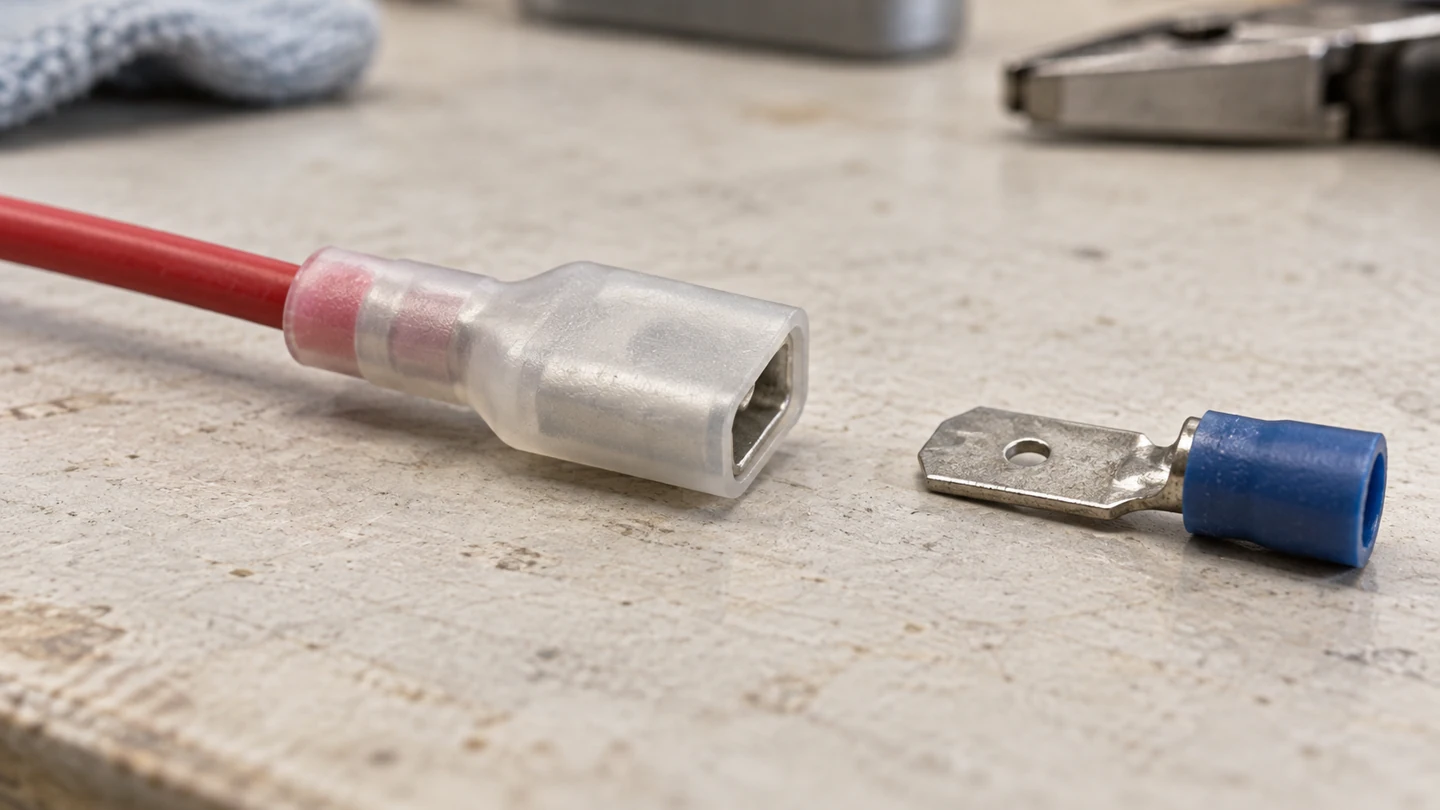
IEC 61210:2010 describes non-insulated flat quick-connect terminations with specified tab sizes, including 2.8, 4.8, 6.3 and 9.5 mm, within its stated scope. That list is not a complete inventory of automotive terminals. The standard’s existence does not prove that an unidentified historical part follows it. Confirm the original component drawing or the replacement manufacturer’s specification before selecting male-tab dimensions and the mating receptacle.
When should old connector parts be replaced?
Cracked insulating parts, damaged retention features, heat distortion and compromised contact surfaces should not be retained simply to preserve appearance. Check the mating component and the wire close to the termination as well. A connector replacement can leave the fault unresolved if brittle insulation, corroded strands or an overheating component remains in service.
| Condition or objective | Possible direction | Required verification |
|---|---|---|
| Identified original assembly in serviceable condition | Preserve under an appropriate maintenance procedure | Contacts, retention, insulation and circuit function |
| Localized damaged contact with sound wire | Use a documented terminal repair | Mating dimensions, termination method and tooling |
| Damaged shell or sleeve | Replace the insulating component or assembly | Fit, support and protection from adjacent metal |
| Widespread deterioration or undocumented alterations | Assess a broader harness repair or replacement | Circuit design, protection and routing |
Can corrosion be cleaned without changing the contact?
Cleaning is not a universal restoration method. The appropriate treatment depends on the contact material, plating, insulating components and extent of damage. Aggressive abrasion can remove surface material, while a general-purpose chemical may be unsuitable for the connector plastics or leave a residue. Use product-compatible maintenance instructions rather than a household cleaning recipe.
If the contact surface or spring geometry is damaged, a cleaner cannot establish that the interface has recovered. Inspect the conductor and mating part before choosing a repair. Where verification is needed, IEC 60512-1:2018 provides a framework for connector tests and measurements. Test conditions and acceptance limits still need a relevant product or restoration specification. The mechanism described in contact-resistance assessment explains why appearance alone is insufficient.
When is a modern connector an appropriate restoration choice?
Separate a historically faithful restoration from a functional modification. A documented modern replacement may suit a modified vehicle, but it changes the parts record and may require a revised mating half, wire termination and harness support. Confirm its electrical and environmental requirements rather than treating a newer plastic shell as an automatic upgrade.
Keep removed parts and a record of the change where practical. This makes future service clearer and helps avoid an apparently original interface with an undocumented modern pinout. ZUCH’s connector and terminal catalog can support an inquiry based on verified dimensions and application requirements. It should not be interpreted as a catalog of period-authentic replacements for every classic vehicle.
Frequently asked questions
Where can I find vintage automotive electrical connectors?
Begin with vehicle-specific restoration parts sources and documented original references. Manufacturer heritage programs, such as Bosch Classic for its own product scope, can help with research, but availability and exact application must be confirmed.
Can old car connectors be restored instead of replaced?
Some may be retained when identity and condition are established. Damaged contacts, cracked insulation or weakened retention require an appropriate repair rather than cosmetic restoration alone.
How do I identify a vintage automotive connector?
Use the period wiring and parts information, component location, markings, photographs and defined mating dimensions. Record later modifications instead of assuming the present harness is original.
Are modern replacement connectors suitable for classic cars?
They may be suitable for a documented modification if electrical, mechanical and environmental requirements are met. They are not automatically period-correct or interchangeable with the original interface.
How do I clean corrosion from vintage connector terminals?
Use a treatment compatible with the identified contact and insulating materials. Avoid aggressive abrasion or unverified chemicals, and replace parts when cleaning cannot restore a serviceable interface.
What should I check before rewiring a classic car connector?
Confirm the circuit, electrical architecture, protection, conductor condition and terminal specifications. Preserve the cavity map and use an appropriate termination and verification procedure.
References
- Bosch Classic — vehicle and product search and classic-vehicle support within its product scope.
- IEC 61210:2010 — safety requirements for specified flat quick-connect terminations.
- IEC 60512-1:2018 — connector test and measurement framework.
- Sumitomo Wiring Systems components catalog — includes old-series filters as an example of manufacturer-led identification, without proving historical vehicle fitment.
What should guide a connector restoration decision?
Preservation is most useful when the original part can be identified and its continued use can be justified by condition and function. Document the circuit and current installation first, confirm the mating dimensions and materials next, and then choose whether to retain, repair or replace the assembly. Keep historical authenticity separate from the engineering assessment, especially where a later modification has changed the wiring. Do not preserve a damaged contact or uncertain circuit simply because its appearance matches the vehicle’s period. Record every substitution and complete the relevant electrical and mechanical checks before returning the system to use. ZUCH can review a terminal or connector inquiry against its published range when the required interface and application details are available.