Zhejiang ZUCH Technology Co., Ltd.
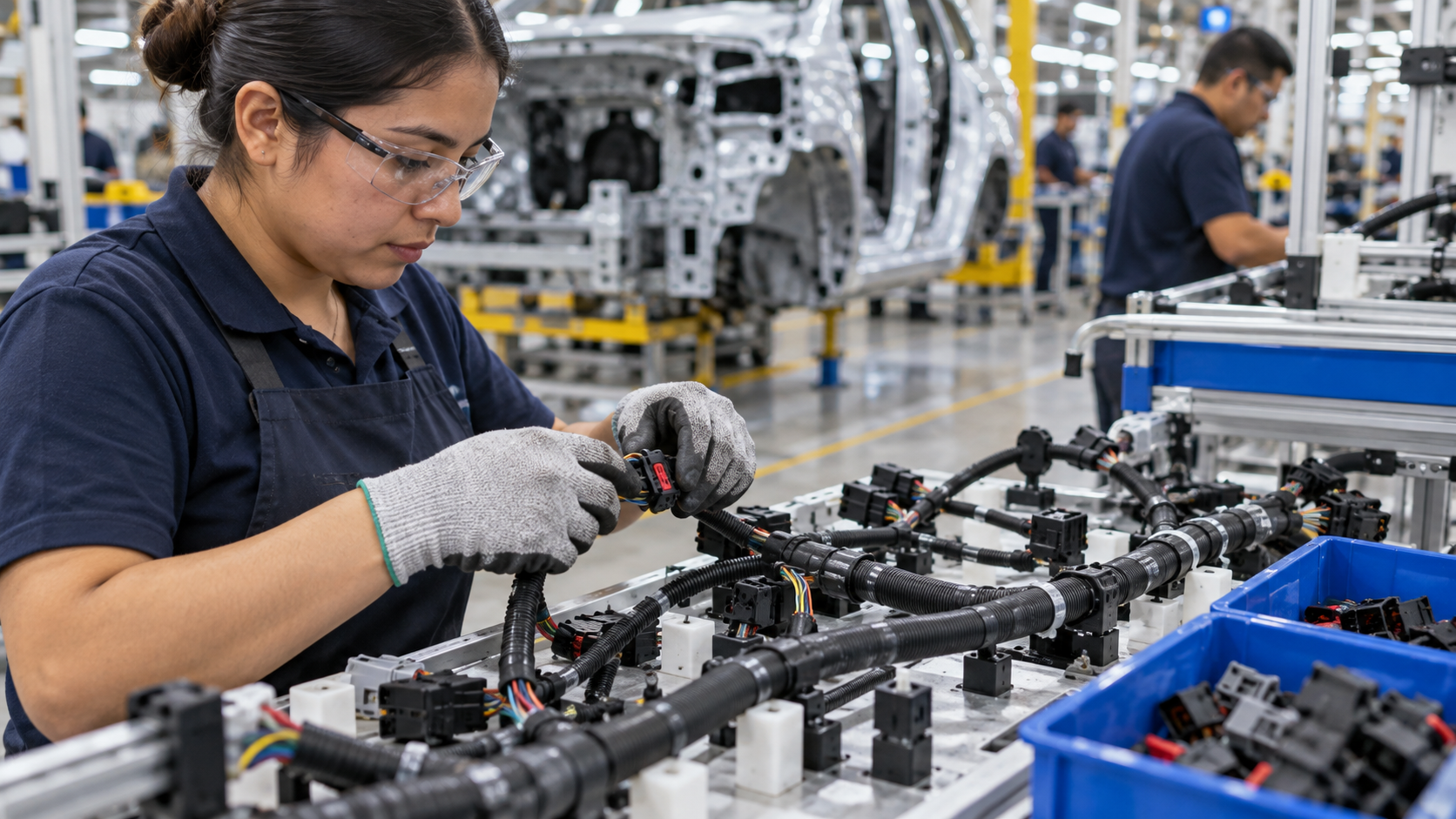
When a procurement engineer in Monterrey receives a quote for an automotive harness connector, the visible problem is often a price difference. The faster failure appears later: a terminal family is not documented, a drawing uses a different cavity view, or a validation report does not match the plant’s process. The root cause is not simply a bad connector; it is an incomplete sourcing specification. Mexico programs connect vehicle production, export requirements, plant quality systems, and cross-border logistics. This guide gives buyers a verification path that separates a usable quotation from a production-ready source.
Zusammenfassung: The Mexico automotive connectors market should be evaluated through application fit, traceable documentation, quality-system evidence, and supply continuity rather than unit price alone. INA Mexico describes a large, export-oriented automotive manufacturing ecosystem, while the U.S. International Trade Administration’s Mexico automotive industry guide explains the importance of OEM and supplier production networks. Start an RFQ with the mating interface, terminal and wire data, environment, annual demand assumptions, delivery location, and required validation records; then confirm which requirements are contractual and which are supplier recommendations.
Why does Mexico sourcing require more than a catalog match?
Mexico production may involve an OEM, Tier 1 harness assembler, component supplier, and logistics provider across different jurisdictions. The connector therefore has to remain identifiable as it moves from drawing release to incoming inspection, line-side kitting, assembly, and service. A public market overview can establish the manufacturing context, but it cannot prove that a particular connector is approved for a vehicle program. Buyers need a controlled part number, revision history, mating information, and acceptance criteria.
Use the official vehicle or harness drawing as the primary identity source. Record the housing, terminal, seal, secondary lock, keying, cavity numbering view, wire range, and crimp requirements. If the connector is intended for an exposed location, define the environmental inputs and the validation method; do not infer an IP rating or temperature range from a product photograph.
What should a Mexico automotive connector RFQ contain?
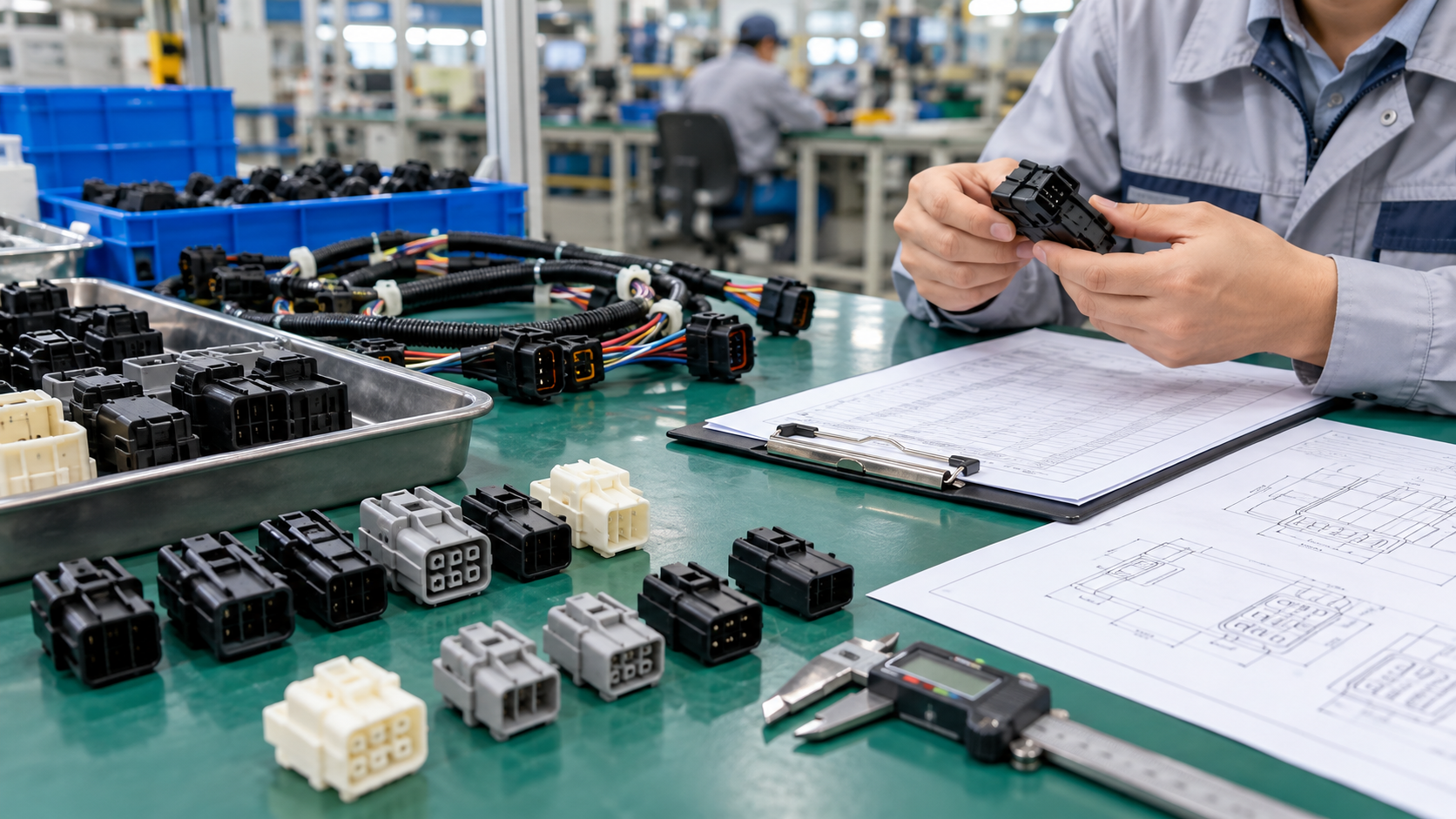
An RFQ should let a supplier price the same interface and the same evidence package. Include the mating connector or reference part, cavity count, terminal family, conductor and insulation details, crimp style, retention features, packaging, forecast assumptions, delivery point, and change-control expectations. State whether the quotation covers loose components, a terminated pigtail, or a complete harness subassembly.
Ask for a document index rather than a generic promise of compliance. Useful records can include a controlled drawing, material declarations, dimensional inspection, crimp validation, continuity results, and applicable environmental or mechanical test reports. Each report should identify the tested configuration and revision. A supplier may have a certificate for its management system, but that certificate does not automatically certify every connector part.
How should buyers compare supplier offers?
Compare offers by the risk they remove. A low unit price can be offset by tooling ownership ambiguity, undocumented substitutions, line-side packaging changes, or repeated sample loops. The table below is a buyer’s screening framework, not a ranking of suppliers.
| Verification dimension | Evidence to request | Why it matters in Mexico production | Red flag |
|---|---|---|---|
| Interface identity | Part number, drawing revision, mating-half confirmation, cavity view | Prevents look-alike substitutions during multi-site handoffs | Quote identifies only a pin count or photo |
| Terminal and wire fit | Terminal part number, wire range, crimp specification, pull-test method | Supports repeatable harness assembly and incoming inspection | “Fits standard automotive wire” without a defined range |
| Environment | Application location, fluid exposure, temperature and vibration inputs, test plan | Links the connector choice to the vehicle zone and validation scope | Unqualified IP, temperature, or durability claims |
| Quality system | Current management-system certificate and site scope | Shows how changes, nonconformities, and records are controlled | Certificate is expired or scope is unrelated |
| Supply continuity | Manufacturing site, capacity discussion, change notice process, packaging plan | Reduces disruption across border, plant, and logistics interfaces | No named production site or change-control contact |
Which production and logistics dimensions should be separated?
Mexico sourcing decisions become clearer when technical, commercial, and operational dimensions are reviewed separately. A connector can be technically suitable but operationally weak if packaging, labeling, or release controls do not match the receiving plant.
| Dimension | Questions for the buyer | Decision record |
|---|---|---|
| Engineering | What is the mating interface, circuit role, wire range, and environmental zone? | Approved drawing and interface checklist |
| Quality | Which tests are required, by which revision, and who approves deviations? | Validation matrix and deviation log |
| Operations | How are reels, loose parts, labels, and lot codes presented at the plant? | Packaging and traceability instruction |
| Commercial | What is included in tooling, samples, freight assumptions, and engineering changes? | Comparable quotation schedule |
| Continuity | Where is production located, and how are capacity or material changes communicated? | Source and change-control plan |
Which standards and compliance records apply?
IATF 16949:2016 is an automotive quality-management-system standard; it describes process and quality-system expectations, not a blanket certification of a connector’s performance. ISO 8092 is used for dimensions and characteristics of road-vehicle wiring-harness connections in its applicable parts. Product safety and material requirements may also depend on the vehicle program, destination market, customer-specific requirements, and the selected terminal and housing materials.
For a Mexico RFQ, ask the supplier to identify the exact standard, edition, test method, and sample configuration behind each claim. Material statements such as PA66 or PA66 glow-wire performance should be tied to a material grade and evidence; “UL/CUL coverage” should be confirmed for the relevant part and file, not assumed from a company-level statement. Unsupported compliance language can create approval delays, re-testing costs, and contractual exposure.
How can buyers reduce sourcing risk before nomination?
- Freeze the interface: release the mating part, cavity view, terminal, wire range, keying, and seal information before comparing prices.
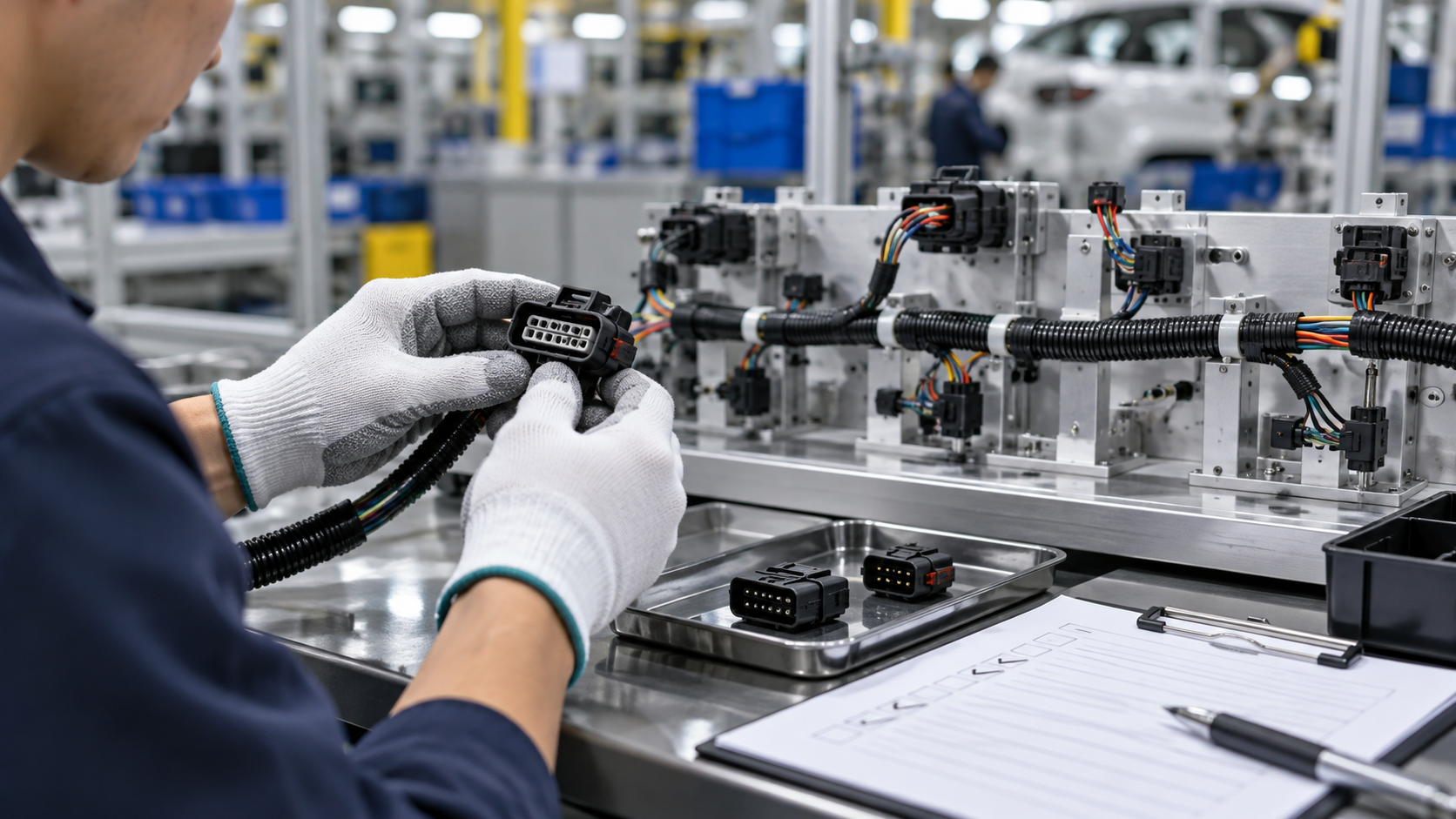
- Define the evidence package: list dimensional, crimp, electrical, environmental, and material records required for sample and production approval.
- Separate validation from certification: record which results are design verification, which are customer-specific tests, and which certificates cover the manufacturing site.
- Audit continuity inputs: confirm the production site, lot traceability, packaging, change notification, and escalation contacts that the Mexico plant will use.
- Use a controlled comparison: score technical fit, evidence quality, logistics, and commercial assumptions in separate fields so price does not hide a gap.
ZUCH is a connector manufacturer with rectangular connectors, RAST, FASTON terminals, terminals, and motor/compressor connector lines. Its stated quality and laboratory capabilities include IATF 16949:2016, a CNAS laboratory, a UL witness laboratory, and UL/CUL coverage for relevant products. Buyers can review the ZUCH connector product directory after their interface and evidence requirements are defined.
Frequently asked questions about automotive connectors Mexico sourcing
What drives automotive connector demand in Mexico?
Demand follows vehicle production, component manufacturing, harness assembly, and related export supply chains. INA Mexico and the U.S. International Trade Administration provide public context on the country’s automotive manufacturing ecosystem, but neither source approves a specific connector. Buyers should translate the production context into a controlled part and validation requirement.
What should a buyer verify before sourcing connectors for Mexico production?
Verify the mating interface, terminal and wire range, environmental inputs, validation evidence, manufacturing site, packaging, traceability, and change-control process. Confirm that the quoted configuration is the one tested. For a practical supplier screen, see the connector manufacturer selection guide.
Which connector documents should be included in a Mexico RFQ?
Include the controlled drawing, part and revision identifiers, terminal and wire data, crimp requirements, sample and approval plan, material declarations, applicable test methods, packaging, labeling, delivery assumptions, and deviation process. The final list should reflect the customer-specific requirements for the vehicle program.
Does a Mexico production site require different connector testing?
The plant location does not by itself change the connector’s physical design test. It can change logistics, incoming-inspection, labeling, documentation, and customer-specific approval requirements. Confirm the destination market, vehicle application, and plant quality manual before finalizing the test matrix.
References
- INA Mexico, public automotive-industry information and organization resources.
- U.S. International Trade Administration, Mexico: Automotive Industry.
- IATF Global Oversight, IATF 16949 resources.
- ISO 8092, Road vehicles — Connections for on-board electrical wiring harnesses.
- ZUCH: Terminal Supplier Quality Control Checklist.
Conclusion
Mexico sourcing is not a contest to find the lowest connector line item. The sound decision sequence is to freeze the mating interface, define the terminal and wire system, map the vehicle environment, and then require evidence that the quoted configuration was inspected and tested. After that technical gate, procurement can compare packaging, delivery, change control, and total approval effort on a like-for-like basis. Do not skip the customer-specific requirements or treat an IATF 16949 certificate as proof that every part is compliant; both shortcuts can reopen validation after nomination. ZUCH’s product directory can help buyers review connector families once the specification is controlled, and its stated laboratory and quality capabilities provide a basis for an evidence-focused supplier discussion. Contact the team with the drawing, application zone, and RFQ evidence list.