Nylon vs PBT Connector Housings: How Material Choice Affects Reliability
A housing that fits at incoming inspection can behave differently after humid storage or service. That matters when a small change at a latch, terminal cavity or seal interface affects assembly and retention. The tempting shortcut is to select nylon for toughness or PBT for dimensional stability without specifying a compound or its conditioning state. That leaves the buyer unable to compare the actual molded parts or set a meaningful acceptance plan. Nylon vs PBT connector housings is therefore a grade-and-application decision: identify the exposure, compare properties at relevant conditions, and test the assembled interface rather than treating a polymer-family label as a reliability claim.
The short answer: Polyamide (often PA6 or PA66) absorbs moisture, so dimensions and mechanical properties can change between dry-as-molded and conditioned states; PBT generally takes up less moisture, but that does not prove resistance to hydrolysis in hot, wet service. Neither family wins every housing design. Specify the exact reinforced, stabilized and flame-retardant grade, obtain its conditioned data, and check the actual wall thickness and color associated with any claimed flame classification. Then qualify fit and retention on representative molded parts under the intended climate and assembly process. Polyram’s PBT-versus-nylon material discussion explains these qualitative differences, not a ZUCH housing’s rating.
Inhalt
Why does housing material choice matter to the assembled connector?
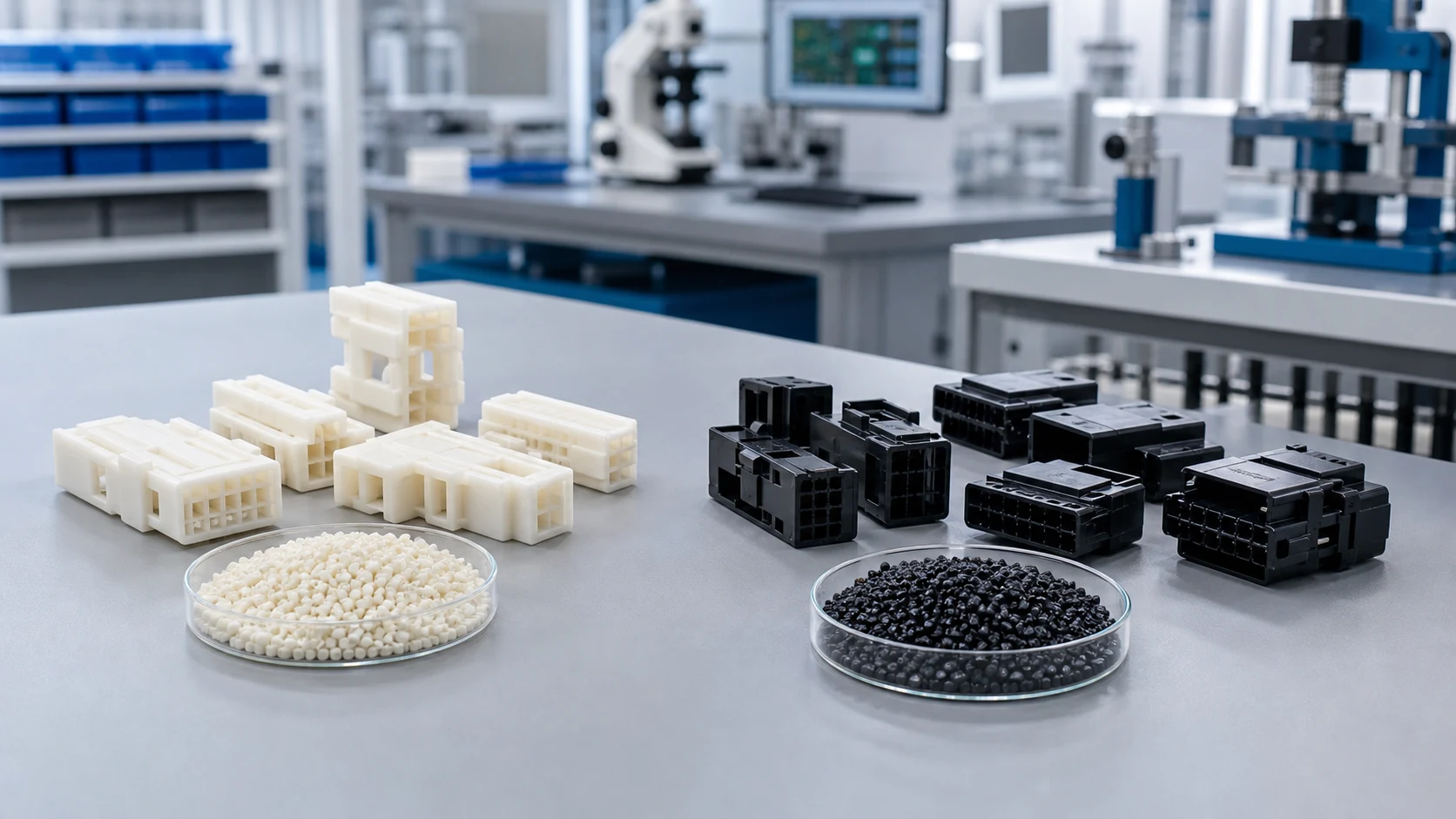
The housing locates terminals and supports latches and, where present, seal interfaces. Material behaviour can therefore affect retention or fit without obvious bulk degradation. These are design risks to check, not inevitable failures of either polymer. For the geometry and retention questions beyond resin choice, see Connector Housing Selection: Material, Keying and Retention Features. The following tendencies help form a shortlist; exact grades and molded geometry can reverse a simple family-level ranking.
| Behaviour |
Nylon tendency |
PBT tendency |
| Moisture uptake |
Noticeable; compare dry and conditioned dimensions and stiffness |
Generally lower; hot-water hydrolysis remains a separate question |
| Toughness |
Can support snap features; conditioning and grade matter |
Grade, reinforcement and geometry determine the result |
| Dimensional stability |
Conditioned state must be reviewed |
Often steadier across humidity changes; molding distortion still needs measurement |
Compare like-for-like test states. A dry-as-molded PA tensile result and a conditioned PBT result, or data from different reinforcements, do not isolate the polymer choice. Request the test condition, conditioning method and orientation where reinforcement may make properties directional.
How does moisture conditioning change nylon, and what about PBT?
Unfilled and filled nylons absorb moisture, which can increase toughness while shifting dimensions and stiffness relative to the dry-molded state. Designs that mate, latch or seal on tight tolerances must review the moisture-conditioned condition, not only the as-molded one. PA6 and PA66, and their glass-filled variants, are not interchangeable data sets. State which grade and conditioning state the drawing and inspection dimensions represent, then measure cavities, latch engagement and seal compression after representative conditioning.
PBT’s lower moisture uptake may reduce humidity-driven fit changes, but low uptake is not hydrolysis resistance. Prolonged hot-water or steam exposure can challenge an unsuitable polyester compound even if its dimensions initially appear stable. Ask whether a proposed PBT grade is hydrolysis-stabilized and for relevant aged-property evidence. Moisture exposure during service and resin moisture before molding are different questions; processing instructions, including any drying conditions, must come from the exact resin supplier and process specification, not a generic nylon-versus-PBT table.
Which thermal and processing conditions need grade-specific evidence?
Both families offer grades for elevated temperatures, yet ratings differ by compound and exposure duration, and board-mounted housings may also face soldering heat. Verify the specific grade against your thermal profile and assembly process instead of relying on family reputation. Separate a brief solder excursion from continuous service, thermal cycling and storage; a single heat-deflection value is not a connector lifetime rating. Request the supplier’s applicable thermal-aging and process data, then examine molded parts for warpage, latch function and mating fit after the actual assembly profile.
A heat-stabilized PA grade and a hydrolysis-stabilized PBT grade answer different exposure problems. Reinforcement and flame-retardant packages can change shrinkage, toughness and processing behavior in either family. The decision should follow the specified time-temperature-humidity history and the supplier’s exact-grade instructions, not a universal service temperature or drying recipe.
How should latch and retention risk be compared?
PBT is often favored where dimensional steadiness and low moisture uptake dominate, while nylon’s conditioned toughness can help snap features tolerate assembly deflection. Long-term latch preload and terminal retention deserve review in both cases, because creep behavior is grade, load, temperature and geometry specific. Do not substitute an unaged resin coupon value for the behavior of a thin molded latch after assembly and conditioning.
Define the failure mode first: a terminal backing out, an insert moving within an outer housing, and a latch disengaging are different tests. IEC 60512-15-2:2018 addresses axial insert retention in a housing when invoked by a detail product specification; it does not set a universal terminal pull-out limit. IEC 60512-1:2018 likewise explains that the detail specification selects tests, severities and permissible limits. The engineering team must specify acceptance criteria for the actual connector architecture.
| Review item |
Why it matters |
Evidence to request |
| Compound designation |
Reinforcement and additives change behavior |
Exact grade, color, supplier data and change control |
| Conditioned properties |
Field parts may not remain dry-as-molded |
Dry and relevant conditioned data, with conditioning method |
| Flammability class |
Claim depends on evaluated material configuration |
Current listing for grade, color and applicable thickness |
What does a flame rating actually establish?
Request the compound’s applicable flammability classification, such as a V-0 listing, together with the temperature indices relevant to the duty. Check the recognized material record for the exact grade, color and tested thickness against the thinnest relevant housing wall. A classification at one specimen thickness does not automatically transfer to a thinner molded feature, another color or a reformulated additive package. It describes a specified material test, not approval of the complete connector or its suitability for every market.
Wichtig: General material guidance cannot approve a specific design or lot. Define the applicable product and market requirements in the controlled drawing and acceptance plan. IEC 60512 connector test methods, where selected by a detail specification, are not material flame certifications or automatic product qualifications.
What evidence should decide between candidate housings?
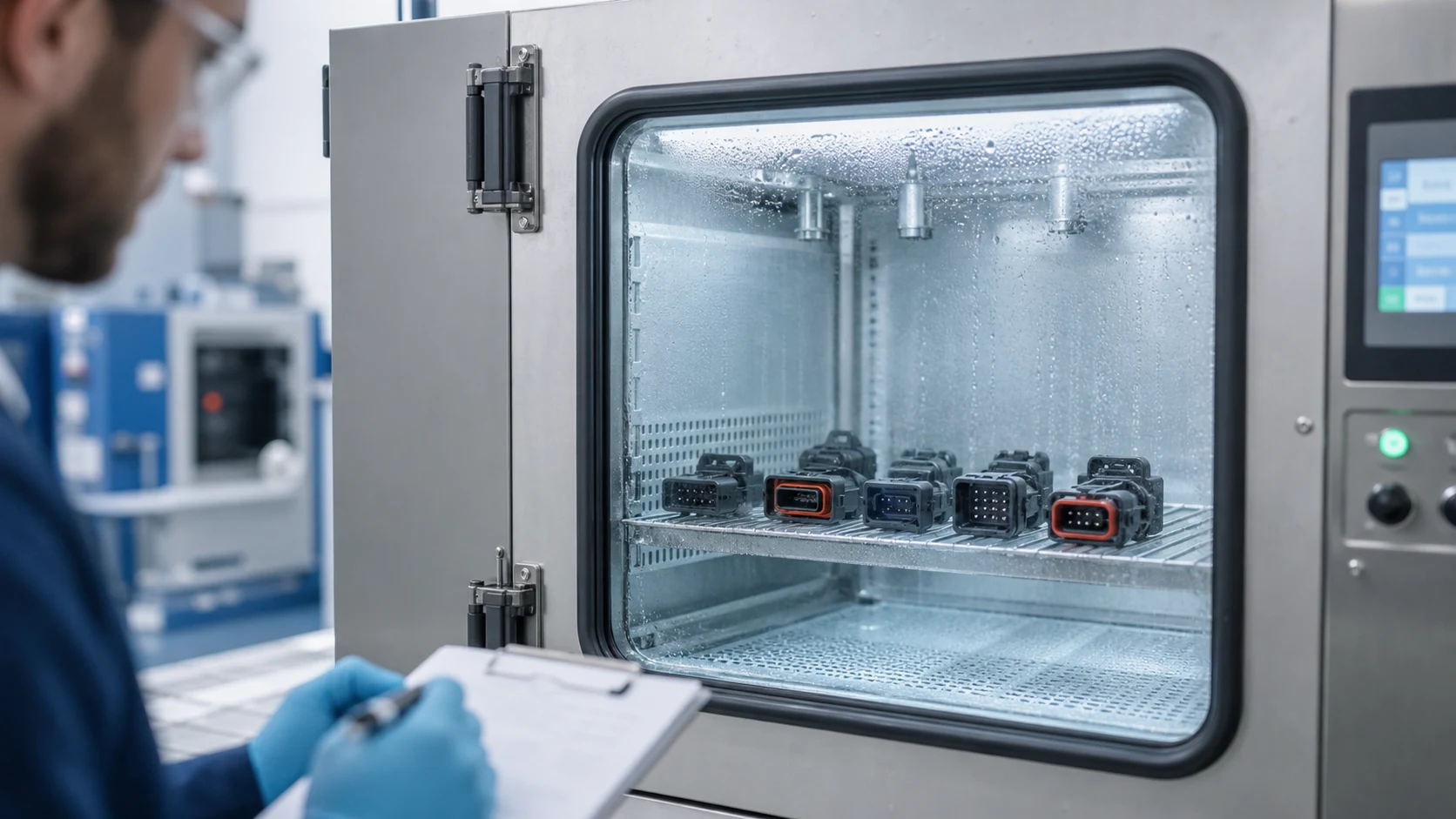
Run fit, latch and retention trials on housings conditioned to represent the intended climate and process history. Record the specific grade, lot, molding condition and measurement state so a later material substitution can be assessed against the same baseline. A material decision based on conditioned-part behavior is more defensible than one based only on a datasheet headline.
For combined environmental exposure, IEC 60512-11-1:2019 describes a climatic sequence of temperature, humidity and, where required, low air pressure when the detail product specification calls for it. The published scope supplies a possible method, not a service-life prediction, pass limit or proof against chemicals. Agree on sequence, measurements and permissible post-test changes before testing. Compare mating geometry, latch engagement, insert or terminal retention as applicable, and seal performance only if the design has a seal.
What should a buyer send with a material inquiry?
Use ZUCH’s Housing category and the live product catalogue to identify relevant connector, terminal or housing component families. These are discovery routes only and do not demonstrate that a specific configuration is approved for the application. An inquiry is more actionable when it states the interface and acceptance conditions rather than asking whether nylon or PBT is simply “better.”
Which inputs belong in the RFQ?
- State operating and storage temperature, humidity, hot-water/steam and relevant chemical exposure, with duration or cycle profile.
- Request exact compound and color designations, reinforcement and stabilization details, plus dry and application-relevant conditioned-property data.
- Specify flame-class evidence at applicable thickness and color, and distinguish material recognition from finished-connector approval.
- Define controlled dimensions and fit, latch, relevant retention and sealing trials on representative conditioned samples, with acceptance criteria.
Where does this guide stop?
This guide supports engineering and sourcing discussion; it cannot replace program-specific validation, market requirements or an approval record. Use ZUCH’s sample request route or contact page for controlled component documentation and samples. Confirm the proposed resin and configuration before assigning any material rating to a ZUCH part.

FAQ
Which is better for connector housings, nylon or PBT?
Neither universally. Nylon’s conditioned toughness and PBT’s generally lower moisture uptake are useful starting points, but grade, geometry and exposure decide. Compare representative molded housings after the intended conditioning.
Does nylon really change size with humidity?
Polyamide compounds take up moisture and may shift dimensions and stiffness from their dry-as-molded state. The change depends on grade, reinforcement and conditioning. Measure critical cavities and latches at the states specified in the drawing.
Does low moisture uptake make PBT suitable for hot, wet service?
No. Low uptake can help dimensional consistency, while hydrolysis under prolonged hot-water or steam exposure is a distinct degradation mechanism. Ask for evidence on the exact grade, including stabilization and aged properties under a relevant exposure profile.
Is PBT safe for high-temperature applications?
No polymer-family answer establishes this. Review the grade’s thermal-aging data, exposure duration and any soldering or molding process constraints, then inspect and test the assembled housing after representative thermal conditions.
What does a V-0 flammability class tell a housing buyer?
It identifies burning behavior under a defined material test for a listed grade and specimen configuration. Verify that the record covers the proposed color and relevant thickness; it does not certify the assembled connector or establish its thermal service limit.
Why do compound designations matter more than polymer names?
Glass reinforcement, impact modifiers and heat, hydrolysis or flame-retardant packages change properties within a family. A PA66 or PBT label alone cannot identify the data set to use for an approval. Lock the supplier grade and change-control process.
How should I test housings before choosing a material?
Condition samples to represent climate and process history, then measure fit, latch engagement and the retention mechanism actually used. Add sealing checks only where relevant. Specify test severity and permissible change in the product plan; a method title alone does not supply pass criteria.
What material information belongs in a housing RFQ?
Include the exposure profile, exact compound/color, reinforcement and stabilization, conditioned-property data, applicable flame listing and wall thickness. Add the mating interface, controlled dimensions and assembly-level trial criteria so suppliers can answer against the same requirement.
References
- Polyram, “PBT vs Nylon: How to Choose Between Polyester and Polyamide Compounds” (public material-manufacturer discussion; publication date unverified; accessed October 10, 2026). Qualitative material behavior only, not exact-grade data.
- IEC 60512-1:2018, Connectors for electrical and electronic equipment, Part 1: Generic specification (edition 5.0, October 22, 2018). Detail specifications select tests, severities and limits.
- IEC 60512-11-1:2019, Test 11a: Climatic sequence (edition 2.0, May 16, 2019). Method scope covers a specified temperature/humidity sequence and, where required, low air pressure.
- IEC 60512-15-2:2018, Test 15b: Insert retention in housing (axial) (edition 2.0, January 12, 2018). This concerns insert retention, not a universal terminal-retention limit.
How should the final material decision be made?
Nylon vs PBT connector housings is not a contest between one tough and one stable plastic. The defensible decision starts with the application’s humidity, heat, chemical and assembly history, then narrows to named compounds with comparable conditioned data. Measure the molded interface and verify the latch, relevant retention mechanism and any seal after representative exposures. PBT’s low moisture uptake must never be treated as proof of hydrolysis resistance, just as nylon’s dry-as-molded dimensions cannot stand in for conditioned fit. Do not skip the grade-, color- and thickness-specific evidence behind a flame claim or let an IEC method stand in for agreed acceptance limits. Once those boundaries are written into the RFQ, ZUCH’s housing catalogue and sample route can help identify candidate parts for documented, application-specific validation rather than implying that a polymer name alone approves them.
 Zhejiang ZUCH Technology Co., Ltd.