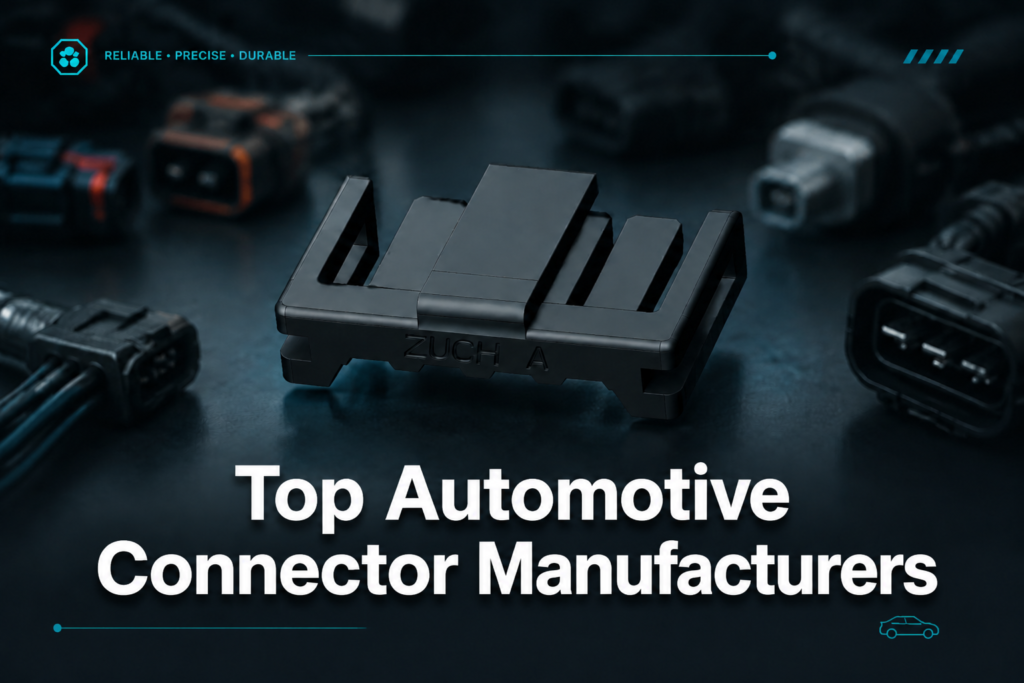
Top Automotive Connector Manufacturers
As an important component in today’s cars, trucks, and electric cars, automotive connectors are responsible for transmitting electrical signals and power from one part of the vehicle to the other in an efficient manner. Therefore, it is critical to select the right automotive connector manufacturer to ensure that the products will perform at the highest level of quality, efficiency and safety. In this article, we will discuss some of the leading automotive connector manufacturers and how to evaluate them based on their strengths, product offerings, and other factors.
What Are the Characteristics of a Good Automotive Connector Manufacturer?
When evaluating potential automotive electrical connector producers, the following factors should be considered: product quality; industry certifications; capability to provide customized solutions; level of manufacturing capacity; and reliability of supply chain operations. In addition to these key factors, look for manufacturers with a significant amount of experience in the automotive connector industry, an outstanding research and development department, and/or strong relationships with well-known manufacturers.
Top Automotive Connector Manufacturers in the World
The following companies represent the largest producers of automotive electrical connectors and provide high-quality automotive electrical connectors:
TE Connectivity
TE Connectivity is one of the largest and most established producers of automotive connectors worldwide. In addition to supplying high-performance connectors to many different types of applications, they also provide innovative solutions for electric vehicles, powertrains, and safety applications. TE Connectivity has become a leading supplier due to its high level of durability, reliability, and operational efficiency.
Deutsch
Deutsch has earned a reputation as an outstanding producer of automotive connectors, thanks to their highly rugged connections that can withstand a wide range of environmental conditions, including extreme cold, heat, humidity, and corrosive substances. These products are perfect for heavy-duty vehicles, off-road applications, and transportation systems that need not only electrical efficiency but also mechanical reliability.
Delphi Technologies
Delphi Technologies has years of experience and has produced advanced connector solutions for various types of vehicles, including hybrid and electric models. Their high-speed data connectivity products provide reliable solutions for all OEMs.
Zhejiang ZHCH Technology Co., Ltd.
Founded in Yueqing, Zhejiang Province in 1994, Zhejiang ZHCH Technology Co., Ltd. (stock code: 301280) has developed into one of the leading connector manufacturers nationwide. The company focuses on research and development, production, and sales of connectors for consumer electronics, new energy vehicles, and photovoltaic power generation and storage. With more than ten subsidiaries, it is recognized as a key enterprise in the connector market.
The company strives to provide high-quality products by maintaining trust with its customers in an ethical manner. It has been certified with IATF16949 and has a CNAS and UL-certified laboratory. Manufacturing and production are completed at its lean manufacturing digital factory, where more than 95% of equipment is connected digitally for optimum efficiency. ZHCH Technology has successfully worked with many global brands such as BYD, BOSCH, and PANASONIC.
Amphenol
Amphenol designs connectors used in the automotive industry as well as for military and various industrial applications. Their innovative design features, superior electrical performance, and compact footprints are well respected by the connector industry. Amphenol is a major player in the market and has an extensive presence across many different industries.
Factors to Consider When Selecting an Automotive Connector Manufacturer
When looking for an automotive connector manufacturer, the following factors can assist you in making the right decision for your needs:
- Certification: Look for manufacturers with certifications like IATF16949, UL, and ISO9001, as these indicate adherence to global quality standards.
- Industry Partnerships: Manufacturers with established partnerships within the industry typically deliver proven products.
- Range of Applications: Ensure the manufacturer supplies connectors suited to your specific requirements, whether for consumer electronics, electromotive vehicles, or heavy equipment such as tractors.
- Innovation: Companies that invest in R&D tend to provide solutions that are more forward-thinking, better performing, and have longer life spans.
- Customer Service: Excellent post-sale service and technical support are important for dealing with complex applications and troubleshooting.
FAQ
What is an automotive connector?
An automotive connector is a device used to connect electrical or electronic systems within a vehicle, allowing for the transfer of power or signals from one part of the vehicle to another for proper operation.
What industries use automotive connectors?
Automotive connectors are not limited to automobiles. They are widely used in large trucks, buses, motorcycles, ATVs, and an ever-increasing number of electric vehicles (EVs). Other applications, such as smart terminals and photovoltaic energy collection systems, also use automotive connectors.
How do I choose a reliable supplier of automotive connectors?
Look for a manufacturer that is certified by the appropriate industry organizations and has a history of reliable manufacturing processes as well as the ability to produce customized products. Additionally, partnering with manufacturers that invest heavily in R&D and offer excellent post-sales support can help ensure the quality and suitability of their products for your needs.
Which is the most widely accepted certification(s) for an automotive connector manufacturer?
The certifications to look for are IATF16949, UL, and ISO9001, as these demonstrate that a manufacturer is committed to high-quality manufacturing standards and global regulatory compliance.
Working with the properly matched automotive connector manufacturer can have a significant influence on the success of your projects. Several global leaders (TE Connectivity, Deutsch, Delphi Technologies, Amphenol) and top-tier manufacturers such as Zhejiang ZHCH Technology Co., Ltd., produce exceptional products that meet the needs of many different industries. When selecting a supplier, consider certifications, industry partnerships, application compatibility, innovative capabilities, and the level of support they provide. Whether a particular project focuses on new energy or traditional automotive systems, reliable and efficient solutions are available from these manufacturers.
If you would like to power your project with the finest automotive connectors, reach out to a quality supplier today! Find out how ZHCH Technology and other industry leaders can bring your next project to fruition by contacting us today or requesting a quote.
Who are the major automotive connector manufacturers?
Public industry sources commonly list TE Connectivity, Aptiv, Yazaki, Amphenol, Molex, and other regional and specialist suppliers. The useful question is not which company is universally number one, but which supplier can document the complete interface and support the target program.
Is IATF 16949 enough to approve an automotive connector manufacturer?
No. IATF 16949 concerns an automotive quality-management system. It does not prove that a particular connector family, terminal, seal, or assembly meets your drawing, electrical load, environmental exposure, or customer approval requirements. For a related technical topic, see Where To Buy Automotive Electrical Connectors.
What should I request from a connector manufacturer before ordering samples?
Request controlled drawings, mating-part references, terminal and seal options, wire range, crimp application information, material and plating details, test conditions, change-control terms, sample identification, and any limitations on interchangeability.
How do I compare two automotive connector suppliers?
Use the same interface and evidence checklist for both. Compare fit, keying, terminal and seal compatibility, ratings under stated conditions, validation coverage, documentation, tooling, quality controls, traceability, lead time, and total program risk.
Should a supplier ranking include aftermarket and OEM manufacturers together?
Only if the article clearly separates their role and evidence. An aftermarket repair supplier, an OEM platform supplier, a custom manufacturer, and a component distributor solve different purchasing problems and should not be treated as equivalent.
What is the safest way to verify an “equivalent” automotive connector?
Compare the released interface drawing, cavity map, mating geometry, keying, terminal family, wire range, seals, locks, materials, environmental limits, and test evidence. Approve the substitute only after sample fit and the required electrical and mechanical checks.
Use a Supplier Landscape, Not an Unverified “Top” Ranking
There is no single manufacturer that is best for every automotive connector program. Public directories and market reports provide a starting supplier landscape, but a list position is not evidence of fit, approval, capacity, or quality for a specific vehicle interface. Treat the companies named in this article as candidates for verification and compare the exact series, mating parts, terminals, seals, tooling, and regional support.
| Supplier-review dimension |
Questions for the manufacturer |
Evidence to request |
| Interface coverage |
Can the supplier provide the housing, mating part, contacts, seals, locks, and accessories as a controlled system? |
Part numbers, drawings, revisions, cross-reference limits, and samples |
| Application evidence |
Has the proposed family been evaluated for the voltage, current, signal, temperature, vibration, fluid, and sealing boundary? |
Test method, conditions, report scope, and limitations |
| Quality and process |
How are tooling, crimp application, incoming materials, traceability, and nonconformities controlled? |
Relevant quality-system documentation and process-control records |
| Änderungsmanagement |
How are material, tooling, plant, terminal, seal, and manufacturing changes communicated? |
Change-notification procedure and approved-alternate rules |
| Program support |
Can the supplier support samples, validation builds, PPAP or customer-specific records, and production ramp? |
Named technical contact, sample lead time, documentation package, and supply plan |
How to Compare Automotive Connector Manufacturers Before Approval
- Define the interface and application before requesting a supplier ranking.
- Shortlist suppliers with a documented product family and a compatible mating system.
- Compare drawings and samples position by position. Do not approve a substitute from a similar photograph.
- Review validation evidence against the actual environment and load. A quality-system certificate does not prove product suitability by itself.
- Check tooling ownership, minimum order assumptions, lead time, traceability, change control, and authorized supply channels.
- Record the approved supplier, series, part numbers, revisions, alternates, evidence, and release conditions in the purchasing file.
References and Further Reading
- Mordor Intelligence, Top Automotive and Transportation Connector Companies
- Metoree, Automotive Connector Manufacturers directory
- TE Connectivity automotive connectors
- Aptiv automotive connection systems
- Molex automotive solutions
 Zhejiang ZUCH Technology Co., Ltd.