Zhejiang ZUCH Technology Co., Ltd.
Consider a hypothetical repair in Perth: a technician replaces a damaged auxiliary-light connector, hears the latch engage and returns the vehicle to service. Moisture later appears at a wire entry because the replacement seal was selected by wire colour rather than insulation diameter. The housing was new, but the assembled sealing arrangement was never verified.
Resumen: Choose automotive electrical connectors in Australia from the actual installation conditions: heat, dust, water, vibration and fluids. Match the full housing, terminal, wire and seal combination. IEC 60529 concerns ingress protection, while IEC 60512-1 provides a framework for connector tests; neither makes every sealed connector suitable for a 4WD, an engine bay or coastal use.
A search for automotive electrical connectors Australia often emphasizes “harsh conditions.” That description needs translating into measurable requirements. A shaded cabin connection and an exposed auxiliary harness on the same vehicle do not experience the same environment, and a national climate label cannot supply a component rating.
Which exposures must be specified separately?
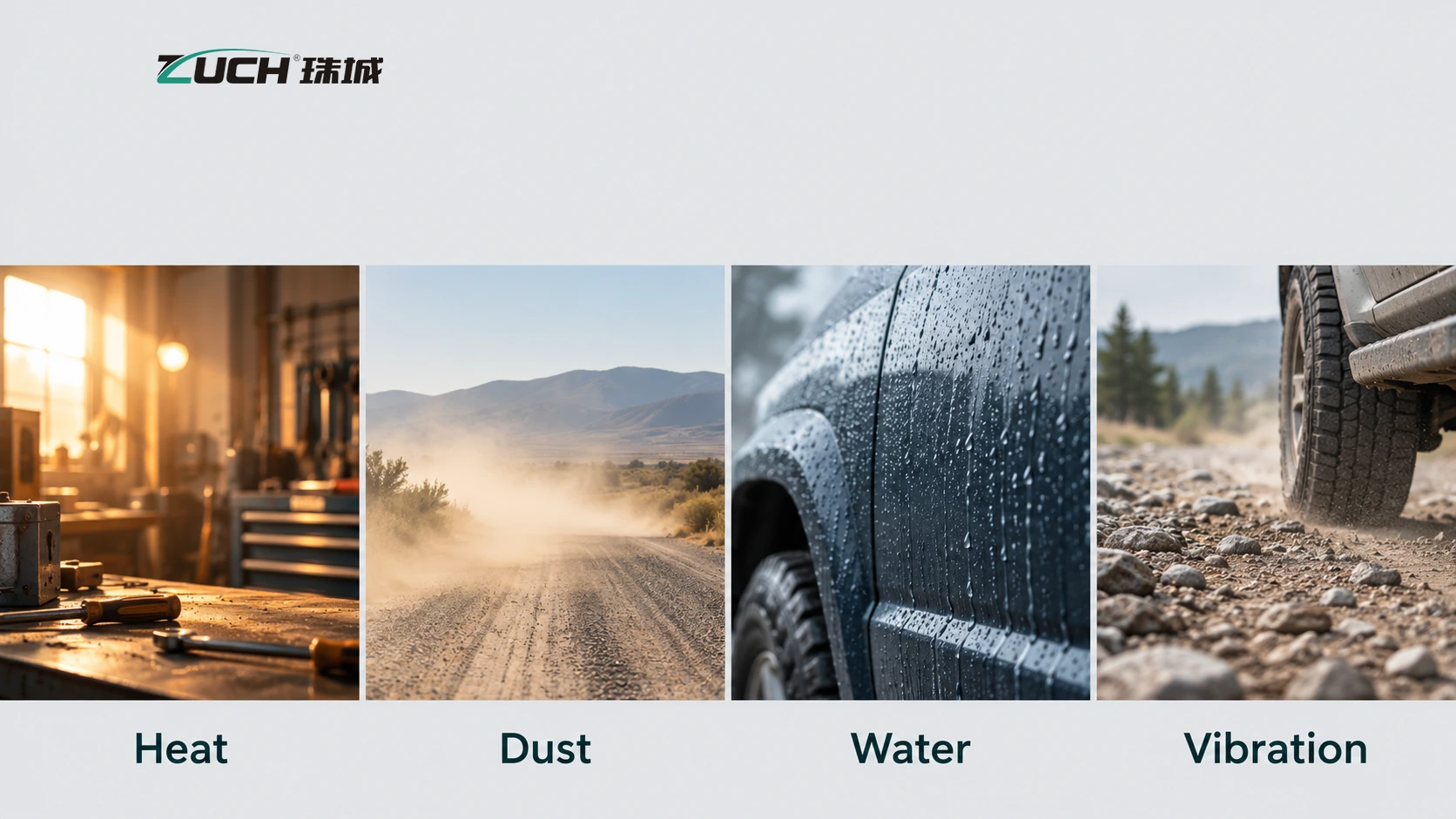
Heat, dust, water and vibration require separate consideration because protection against one does not establish protection against the others. Add relevant fluids, cleaning methods and sunlight exposure where the installation calls for them. Record where the harness is mounted and how it moves during operation, servicing and access to adjacent components.
The Bureau of Meteorology’s Annual Climate Statement 2025, published in February 2026, identifies 2025 as Australia’s fourth-warmest year since 1910, with the national mean temperature 1.23°C above the 1961–1990 average. This is useful climate context. It is not an engine-bay temperature measurement or evidence that a particular polymer can tolerate the installation.
| Installation exposure | What to document | Evidence needed from the supplier |
|---|---|---|
| Heat | Local ambient, nearby heat sources and circuit loading | Applicable temperature limits and current-rating conditions |
| Dust and water | Mounting position, splash and cleaning exposure | Ingress test conditions for the specified assembly |
| Vibration and movement | Harness routing, support and expected movement | Retention and relevant environmental validation |
| Coastal or fluid exposure | Actual salt, oil, fuel or cleaning-agent contact | Material compatibility and relevant corrosion or fluid evidence |
A vehicle used near the coast does not automatically need the same connector as a boat installation. Describe actual exposure instead: road splash, salt contamination, cleaning practice and mounting location. Automotive ingress evidence should not be presented as marine approval, and a water rating does not establish resistance to every chemical or salt environment.
Why can a latched connector still allow moisture into a harness?
The latch indicates mechanical engagement; it does not independently prove sealing. Interface seals, wire-entry seals and closures for unused positions perform different tasks. Damage, contamination or an incorrectly sized component can undermine the intended arrangement even when the housing appears fully closed.
Wire-seal selection depends on the specified terminal arrangement and the wire’s insulation diameter, not only its nominal conductor area. Two wires carrying the same conductor-size designation may have different outside diameters. Confirm the application range and assembly instructions rather than forcing a seal over an unsuitable wire.

Check whether unused cavities require plugs and whether any retained seal is permitted to be reused after repair. The guide to connector wire seals and cavity plugs separates those checks. An IP claim should identify the tested mated or capped condition; it should not be extended to a disconnected connector without evidence.
How do current and temperature change the connector choice?
Current capability depends on the contact system, wire, surrounding temperature and configuration used to establish the rating. Ask for the manufacturer’s relevant rating conditions rather than treating one catalogue number as valid for every circuit. Several loaded positions can create a different thermal situation from the configuration used in a single-contact test.
Inspect heat-damaged connections for causes beyond the plastic shell. A poor termination, unsuitable contact, deteriorated mating half or excessive circuit load may remain after the housing is replaced. The explanation of contact resistance and connector heating provides context; the vehicle’s service information determines the repair limits and test procedure.
For automotive electrical connectors Australia enquiries, state the conductor specification, current profile and local environment together. A thicker wire is not a universal remedy if it falls outside the terminal or seal range. Protection devices and harness design also require their own engineering assessment.
When is a repair kit preferable to a bare replacement housing?
A housing-only replacement may be appropriate when damage is confined to the shell, the original contacts and wires are serviceable, and the vehicle procedure permits transfer. A repair kit may be more appropriate when the required contacts, seals or retention components need replacement. If corrosion extends along the conductor or damage affects the mating device, the repair can be wider than either option.
| Estado observado | Possible repair scope | Decision to verify |
|---|---|---|
| Broken housing latch only | Housing replacement | Permission to transfer terminals and condition of retained parts |
| Damaged contact or wire-entry seal | Specified contact and sealing components | Correct terminal, wire range, tooling and assembly method |
| Damage to adjacent wire | Approved repair lead or pigtail | Extent of deterioration and permitted joining location |
| Widespread contamination or heat damage | Broader harness or device assessment | Root cause and manufacturer replacement criteria |
For hybrid or electric vehicles, identify the circuit before beginning work. HSE’s electric-vehicle repair guidance is a useful safety reference on competence, stored energy and manufacturer information, but it is UK guidance, not a substitute for Australian legal requirements or the vehicle’s instructions. Ordinary low-voltage repair advice should not be extended to traction or safety-critical circuits.
What should an Australian supplier confirm before dispatch?
Obtain the exact part reference, mating reference, kit contents, assembly requirements and delivery terms. Confirm whether “in stock” means local physical stock and whether terminals are sold individually or in larger packs. For remote workshops, a missing seal or tool can be more disruptive than a modest difference in unit price.
IEC 60512-1:2018 places test severity and acceptance limits in the relevant detailed specification. Ask for evidence tied to the proposed assembly and intended exposure; a generic certificate or unrelated test report is insufficient. Keep quality-system documents, product tests and vehicle approval as separate records.
ZUCH’s rectangular connectors can be reviewed against those requirements. For automotive electrical connectors Australia projects, provide the installation location, wire details and repair or production quantity so the proposed item can be assessed without guessing at climate suitability or vehicle fitment.
Preguntas frecuentes
Where can I find automotive electrical connectors in Australia?
Start with vehicle parts suppliers for service replacements, authorized distributors for known connector references, or wiring specialists for repair kits. A direct manufacturer may suit repeat orders. Confirm actual Australian stock, complete kit contents and the specified application rather than assuming local availability from the website domain.
Which automotive connectors are best for Australia's harsh climate?
There is no single best connector for all Australian conditions. Select from the actual local temperature, current, dust, water, vibration and fluid requirements. Ask for evidence covering the specified assembled configuration; a broad harsh-climate claim or an IP rating alone cannot establish every required property.
Do 4WD vehicles need waterproof electrical connectors?
Exposed 4WD connections may require a documented sealed system appropriate to their mounting and cleaning conditions. A protected cabin connection may have different needs. A connector described as waterproof does not by itself make a vehicle suitable for water crossings or establish the protection of other electrical equipment.
How do I choose a connector for an Australian vehicle repair?
Identify the vehicle, circuit, housing and mating reference, then inspect the terminals, seals and adjacent wire to establish repair scope. Match wire and tooling requirements before ordering. Follow the manufacturer-approved method rather than substituting a similar-looking universal connector into an original circuit.
What should I look for in an automotive connector supplier in Australia?
Look for exact part references, complete component information, traceable supply and relevant application or test documents. Confirm stock location, delivery terms, pack sizes and access to required tools. A supplier should distinguish verified application evidence from general catalogue descriptions or unsupported climate claims.
Are heat-resistant automotive connectors important in hot climates?
Temperature capability matters wherever local ambient conditions and circuit loading demand it. Specify the installation temperature and rating conditions, including wire and contact loading, rather than relying on a national weather average. A heat-resistant housing alone cannot correct an unsuitable contact, poor termination or excessive circuit load.
References
- Australian Bureau of Meteorology: Annual Climate Statement 2025, published February 2026
- IEC 60529: degrees of protection provided by enclosures (IP Code)
- IEC 60512-1:2018: connector tests and measurements, general specification
- UK Health and Safety Executive: electric and hybrid vehicle repair guidance
Sources checked on 26 October 2026. Illustrations show generic examples and do not establish product fitment or approval.
What to take away
Select for the conditions at the connection, then verify the complete assembly. In Australian vehicle applications, heat, ingress, vibration and corrosion require separate evidence; a correct latch or a large rating printed in a listing cannot substitute for matched terminals, wires, seals and an approved repair method.
For ZUCH application review, provide the mounting environment, wire specification and connector reference, together with the required quantity.