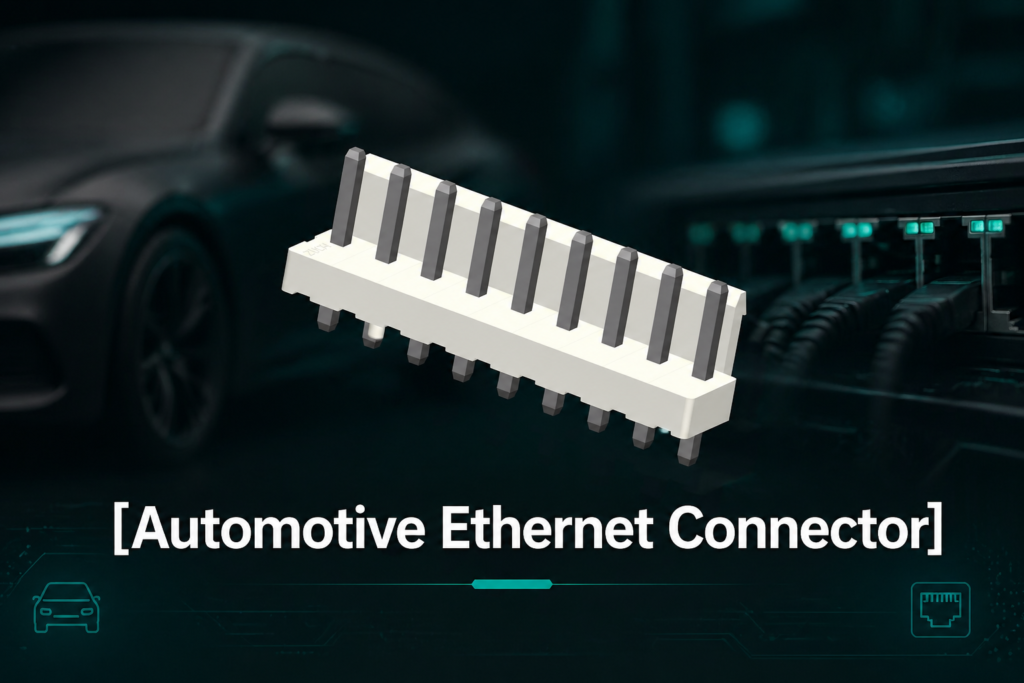
Automotive Ethernet Connector
Today’s vehicles are becoming increasingly technologically advanced and connected to the world around them. As a result, an automotive Ethernet connector plays a critical role in how data is communicated between different systems within an automobile. Some examples of applications that can use this innovative technology include Advanced Driver Assistance Systems (ADAS), In-Vehicle Infotainment (IVI), and Autonomous Driving Systems. This article aims to define an automotive ethernet connector, explain its benefits to automotive manufacturers and consumers, discuss its functions, types of connectors available on the market today and much more.
Quick Answer
Automotive Ethernet uses the Ethernet protocol family in a vehicle-specific physical environment, usually with single-pair cabling and compact, vibration-resistant interfaces rather than an office-style RJ45. For selection, first identify the required PHY—such as 100BASE-T1, 1000BASE-T1, or a multi-gigabit BASE-T1 option—then verify the connector, cable, shielding, temperature, sealing, vibration, and interoperability requirements as one channel. IEEE 802.3 defines Ethernet PHY and data-link requirements; ISO 21111 and OPEN Alliance documents add automotive implementation and test guidance. These documents do not, by themselves, prove that a particular ZUCH or third-party connector is certified.
Definition of Automotive Ethernet Connector
An automotive Ethernet connector is a specialized device that provides an interface for transmitting data over the Ethernet protocol. The increasing use of data in vehicles has made traditional communication protocols (like CAN, LIN, and MOST) no longer sufficient because they are limited by bandwidth and speed of data handling. Automotive Ethernet connectors allow automobile manufacturers to use high-speed Ethernet to transmit data reliably and securely even in the harsh environments found inside an automobile.
A more precise engineering view is that Ethernet complements rather than automatically replaces CAN, LIN, or other vehicle networks. Low-speed control, deterministic behavior, cost, and legacy architecture can still make those protocols suitable, while Ethernet is commonly considered for bandwidth-intensive backbones, cameras, domain controllers, diagnostics, and infotainment. The connector is only one part of the channel; the transceiver, cable, termination, shielding strategy, and ECU design must all match the selected PHY.
Traditional Ethernet vs Automotive Ethernet
“Traditional Ethernet” generally refers to office, data-center, or industrial Ethernet implementations, while automotive Ethernet adapts the Ethernet family to vehicle packaging and environmental constraints. RJ45 is a connector format commonly associated with conventional Ethernet, but Ethernet is the networking technology—not the connector itself.
| Selection dimension |
Traditional Ethernet |
Automotive Ethernet |
| Typical physical medium |
Often two or four balanced pairs, depending on the PHY |
Commonly one balanced twisted pair for BASE-T1 PHYs |
| Common interface |
RJ45 is widespread, although other interfaces exist |
Compact automotive interfaces selected for the ECU, cable, sealing, and retention needs |
| Representative data rates |
Rate depends on the Ethernet PHY and channel category |
100 Mb/s with 100BASE-T1, 1 Gb/s with 1000BASE-T1, and 2.5/5/10 Gb/s with multi-gigabit BASE-T1 PHYs |
| Environmental design focus |
Building or industrial installation requirements |
Vehicle temperature, vibration, mechanical retention, packaging, EMC, and—where exposed—sealing |
| Validation focus |
PHY and structured-cabling conformance for the intended network |
PHY conformance plus ECU, harness, channel, EMC, and OEM-specific validation |
| Interchangeability |
Standards-based interfaces may be broadly interoperable within their defined channel |
A matching data rate alone is insufficient; mating interface, keying, cable, pinout, shielding, and qualification must also match |
Common Applications for Automotive Ethernet Connectors
Automotive Ethernet connectors have many applications. They are critical components for many of the in-vehicle technologies used today and support a variety of new and emerging automotive technologies like:
1. Advanced Driver Assistance Systems (ADAS)
ADAS is made possible by the implementation of a high-speed data network that sends information from various sensors such as LiDAR (Light Detection and Ranging), cameras, radar, and ultrasonic sensors to a central processing unit (CPU) in order to complete tasks like lane departure warning, adaptive cruise control, and collision avoidance.
2. In-Vehicle Infotainment Systems (IVI)
Most modern vehicles offer a sophisticated infotainment system that allows passengers to access streaming media, as well as GPS navigation and other information in real time. Ethernet connectors provide the fast and consistent connection necessary to support these multimedia-rich systems.
3. Autonomous Driving Systems
Fully autonomous vehicles use sensors and systems to process large amounts of data in real time. Ethernet connectors allow for both the low latency and high throughput required to be able to make decisions very quickly so that safe navigation can occur.
4. Over-the-Air Software Updates
Automakers are now able to offer customers the opportunity to receive updates to the firmware on their vehicle over-the-air using Ethernet connectors that enable downloads and processing of the updates securely and efficiently.
Automotive Ethernet Connector Types
There are several different types of Ethernet connectors available for use in the automotive industry, including:
1. RJ45 Ethernet Connector
Traditional RJ45 connectors are found extensively in consumer electronics, but are normally not appropriate for automotive applications because they are too fragile for this type of application. There have been ruggedized versions of RJ45 connectors designed for less demanding automotive environments.
2. FAKRA and Mini-FAKRA Connectors
FAKRA connectors are specifically designed to transmit high-frequency/high-speed data within a vehicle. They are used extensively in infotainment systems and in cameras and sensors.
3. H-MTD Connectors
H-MTD Connectors (also known as High-Speed Modular Twisted Pair Data Connectors) were developed for automotive applications where fast Ethernet communications take place on a vehicle LAN. These connectors’ small size and weight would work well in an automotive application requiring lightweight and compact vehicles.
Other connector types, including BroadR-Reach and Gigabit Ethernet connectors, also provide unique features for various automotive applications.
Terminology note: FAKRA is primarily a keyed automotive coaxial connector system used for RF and some high-speed links, while H-MTD is a high-speed automotive data connector family. BroadR-Reach is the former industry name associated with single-pair automotive Ethernet PHY technology, not a connector form factor. Procurement teams should therefore specify the PHY, mating interface, cable construction, keying, pinout, and validation requirements separately instead of treating these names as interchangeable connector categories.
Benefits of Automotive Ethernet Connectors
Automotive Ethernet Connectors provide several advantages to the automotive industry:
1. High Bandwidth: Automotive Ethernet has a bandwidth range from 100 Mbps to 10 Gbps, enabling fast and efficient data communication.
2. Lightweight Design: Ethernet cables and connectors weigh less than traditional point-to-point wire harnesses, contributing to a reduction in vehicle weight and improving fuel economy.
3. Expandability: Ethernet technology’s scalability allows automakers to add additional features and systems without compromising performance.
4. Cost Effectiveness: The simplified Ethernet infrastructure reduces the time and materials needed for installation, as well as labor and maintenance expenses.
These benefits depend on the architecture and should be verified at vehicle level. A smaller connector or single-pair cable can reduce packaging burden, but engineering cost may rise if the design requires new switches, shielding, EMC controls, diagnostic tools, or more demanding assembly validation. Total cost should include harness mass, ECU ports, tooling, test time, field service, and the cost of a channel failure—not connector unit price alone.
Automotive Ethernet Connector Selection Table
Use the table as a requirements checklist, then confirm the final combination with connector, cable, transceiver, and OEM documentation. If the existing part is unknown, start with a disciplined automotive connector identification process rather than matching by appearance alone.
| Question to resolve |
What to specify |
Why it matters |
| Which PHY and speed? |
100BASE-T1, 1000BASE-T1, 2.5GBASE-T1, 5GBASE-T1, or 10GBASE-T1 as required by the architecture |
The connector-and-cable channel must support the signal performance and frequency range of the selected PHY |
| Where is it installed? |
Cabin, chassis, camera, sensor, gateway, or other defined zone; document temperature, fluids, vibration, and ingress exposure |
Environmental conditions determine housing, seal, retention, material, and test requirements; see this guide to waterproof automotive wire connectors when ingress protection is required |
| Shielded or unshielded? |
Follow the PHY, channel, EMC, cable-routing, and OEM requirements |
Shielding is a system decision; adding a shield without a correct termination strategy does not guarantee EMC performance |
| Which mechanical interface? |
Mating geometry, keying, polarization, CPA/secondary lock where applicable, retention force, and service access |
Prevents mismating, back-out, intermittent contact, and service damage |
| How will it be assembled? |
Wire range, terminal, strip length, crimp tooling, process window, inspection, and pull-force plan |
Signal integrity cannot compensate for a poor termination; establish a controlled process using appropriate automotive connector crimping practices |
| What evidence is required? |
Relevant component reports, channel tests, environmental tests, change control, traceability, and OEM-specific documentation |
A standards citation is not a substitute for evidence that the exact production configuration meets the purchaser’s requirements |
How to Determine the Appropriate Connector for Vehicles
Choosing the right connector for a vehicle involves assessing its communication requirements:
1. Data Transmission Speed: Select a connector that supports the data speed required by the system, ranging from 100 Mbps to 10 Gbps.
2. Environmental Conditions: Ensure the connector can withstand the temperature, vibration, and humidity levels of the intended environment.
3. Compatibility: Choose connectors that comply with standards like IEEE 802.3bw or IEEE 802.3bp for seamless system integration.
4. Size and Weight: Opt for lightweight and compact connectors to reduce overall vehicle weight and improve efficiency.
5. Reliability: Prioritize connectors with robust performance and durability to reduce maintenance costs and ensure long-term functionality.
By considering these factors, you can select a connector that aligns with your vehicle’s requirements and ensures consistent performance.
Standards, Test Scope, and Compliance Claims
- IEEE 802.3: The Ethernet standards family defines MAC and PHY requirements. IEEE 802.3bw covers 100BASE-T1, IEEE 802.3bp covers 1000BASE-T1, and IEEE 802.3ch covers 2.5/5/10GBASE-T1. These are not blanket connector certifications.
- ISO 21111: This multipart road-vehicle standard addresses in-vehicle Ethernet, including general information, physical-layer requirements, and conformance testing in the parts applicable to a project. Applicability depends on the selected PHY and implementation.
- OPEN Alliance: Its technical committees publish automotive Ethernet implementation specifications and test documents for areas such as channels, components, interoperability, and EMC. A report against one test specification does not establish that an entire connector, ECU, harness, or vehicle is universally “OPEN Alliance certified.”
- OEM and supplier requirements: Vehicle makers can impose additional electrical, mechanical, environmental, documentation, and production controls. The purchase specification should identify document editions, test configurations, acceptance limits, and the party responsible for validation.
Unsupported “compliant” or “certified” language creates sourcing and warranty risk because it can hide which part, revision, channel, and test method were actually evaluated. For a custom or series-production program, request the exact evidence package during automotive electrical connector OEM sourcing. ZUCH Technology can discuss connector configuration and documentation needs, but suitability and compliance must be confirmed for the exact application. For a related technical topic, see Automotive Electrical Connectors Applications Types Functions.
Frequently Asked Questions About Automotive Ethernet
What is the difference between Ethernet and automotive Ethernet?
Ethernet is a broad family of networking technologies defined mainly through IEEE 802.3. Automotive Ethernet uses members of that family—often single-pair BASE-T1 PHYs—with vehicle-specific connectors, cabling, EMC controls, environmental qualification, and system validation. The word “automotive” does not denote one universal plug or one certification.
What is automotive Ethernet cable used for?
Automotive Ethernet cable carries packet data between vehicle devices such as cameras, gateways, domain controllers, infotainment units, diagnostic interfaces, and other high-bandwidth ECUs. The required pair construction, impedance behavior, shielding, temperature range, and connector termination depend on the selected PHY and channel specification.
What is the difference between RJ45 and Ethernet?
RJ45 is the common name for a modular connector interface widely used with conventional Ethernet cabling; Ethernet is the networking technology. Ethernet can use other media and interfaces, and in-vehicle BASE-T1 networks commonly use purpose-designed automotive connector systems rather than RJ45.
What is automotive Ethernet and what is it used for?
Automotive Ethernet is Ethernet adapted for in-vehicle communication. It is used where scalable packet networking and higher bandwidth are useful, including backbones, cameras, ADAS data paths, diagnostics, infotainment, and software-update infrastructure; the safety and timing architecture still requires system-level engineering.
What are the different types of automotive connectors?
Automotive connector families include low-voltage signal and power connectors, sealed and unsealed wire-to-wire or wire-to-board connectors, coaxial RF interfaces such as FAKRA, and high-speed differential data interfaces. They are not interchangeable: pin count, terminal system, keying, sealing, current, voltage, frequency, and qualification must match the application.
Are there different types of Ethernet connectors?
Yes. Conventional networks commonly use modular RJ45 interfaces, while fiber, industrial, and automotive Ethernet systems use other interfaces suited to their media and environment. For automotive Ethernet, choose the connector together with the cable and PHY rather than selecting a connector by data-rate label alone.
FAQs
1. What types of Ethernet connectors are used in automobiles?
There are three main types of Ethernet connectors used in automobiles: H-MTD Connectors, FAKRA Connectors, and BroadR-Reach Connectors. Each type is designed to meet specific in-vehicle communication needs, balancing speed, size, and reliability.
2. Are Automotive Ethernet Connectors interchangeable with common Ethernet connectors?
No, Automotive Ethernet Connectors differ from standard Ethernet connectors in their rugged designs and adherence to automotive standards. They are engineered to withstand higher temperatures, vibrations, and other harsh conditions while maintaining reliable performance.
3. Why is Ethernet popular in the automotive industry?
Ethernet’s high-speed data transfer capabilities, scalability, and reliability make it an ideal choice for supporting advanced features such as ADAS, in-vehicle infotainment, and autonomous driving systems.
4. How does Ethernet compare to traditional automotive communication protocols?
While traditional protocols like CAN and LIN offer limited bandwidth, Ethernet technology provides significantly faster data transfer rates, making it better suited for modern, data-intensive automotive applications.
The Automotive Ethernet connector represents a significant step forward in technology, enabling fast data transmission for modern vehicle systems. From ADAS to in-car entertainment and autonomous driving technologies, Ethernet connectors play a vital role in ensuring reliable communication. By understanding the various types, benefits, and selection criteria, automakers and tech enthusiasts can harness the full potential of this transformative technology, paving the way for the future of connected and innovative vehicles.
References and Further Reading
- IEEE 802.3 Ethernet standards — the base Ethernet standard, including the context for BASE-T1 PHY specifications.
- OPEN Alliance — automotive Ethernet specifications, technical committees, and test-document resources.
- ISO 21111, Road vehicles — In-vehicle Ethernet — the ISO series entry for in-vehicle Ethernet requirements and related test scope.
- TE Connectivity automotive connector systems — supplier background on automotive connection-system categories and applications.
Final takeaway: Select automotive Ethernet as a complete, validated channel—the PHY name or connector shape alone cannot establish compatibility.
For a connector review tied to your data rate, environment, cable, assembly process, and documentation needs, explore ZUCH Technology products and contact the team with your interface drawing and validation requirements.
 Zhejiang ZUCH Technology Co., Ltd.