Zhejiang ZUCH Technology Co., Ltd.
Consider a packaging-line harness that passes an initial check but fails during washdown. The connector body might look intact, yet the investigation would still need to examine jacket fit at the cable entry and plugs in unused cavities. This is an illustrative specification problem, not a reported field case or proof of a defective part. A sealed rectangular connector is a system of housing, interface, cable entry and assembly process. Buyers who compare only the housing shape can overlook a leak path, make service unnecessarily slow, or claim an IP level that the finished assembly has never demonstrated.
Summary: Sealed rectangular connectors are useful when the complete mated assembly must manage dust or water exposure, but an IP code describes a defined test scope, not every installation condition. Check the enclosure, mating interface, cable entry, cavity plugs, strain relief and cleaning method together. Specify the target environment, wire range and service procedure in the RFQ; then validate the assembled configuration against the applicable IEC 60529 test scope. Keep an open version in consideration when inspection, frequent rework or ventilation matters more than ingress control.
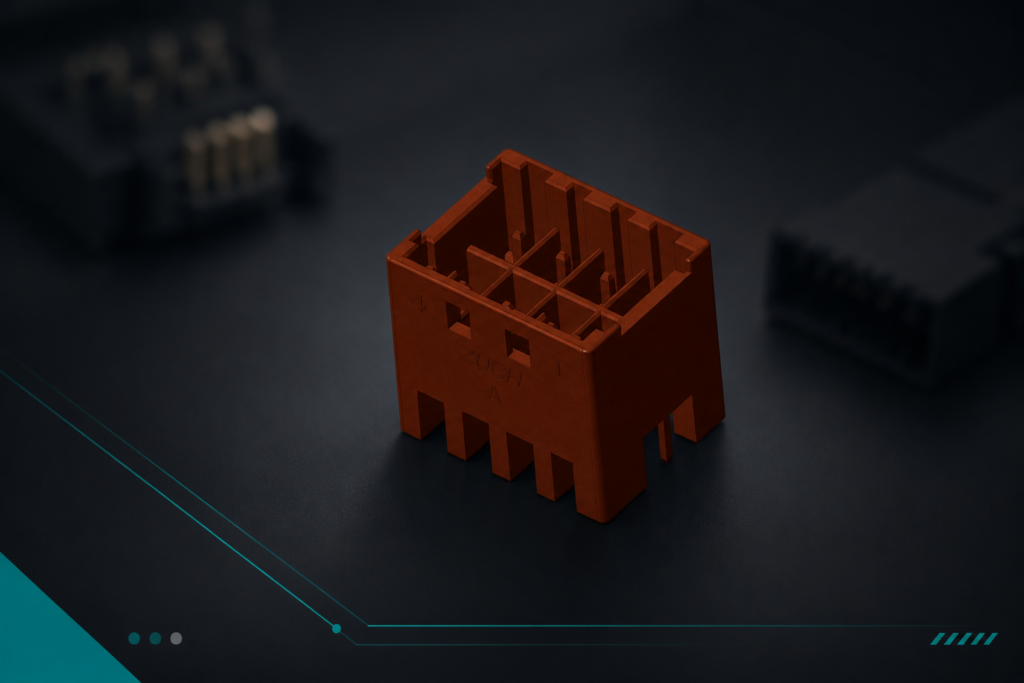
Rectangular formats are valued for organized contact layouts, keyed mating and efficient panel use. Sealing is an added design choice rather than a universal property of the shape. The result depends on the mating seal, interface geometry, contact protection, wire seals and the way the connector is mounted. For a broader overview of contact layouts, see rectangular connectors and Everything You Need to Know about Rectangular Multi Pin Connector.
Start with the exposure, not the connector shape
For sealed rectangular connectors, the first decision is whether the interface itself faces the exposure or is already protected by the host enclosure.
Use a sealed design when contaminants can reach the interface or cable exit during normal operation, transport or cleaning. Examples include outdoor cabinets, mobile equipment and machinery exposed to dust or splash. An open or vented design can be more appropriate inside a controlled enclosure, where operators need frequent visual inspection or where heat dissipation and fast rework dominate. The decision should follow an exposure map, not a generic “waterproof” label.
| Decision factor | Sealed configuration | Open or less-sealed configuration |
|---|---|---|
| Ingress exposure | Supports a defined housing and interface sealing strategy; confirm the complete assembly test. | Relies on the host enclosure and installation environment. |
| Maintenance | Protects the interface but may require seal inspection and controlled re-mating. | Faster visual access and rework, with less protection at the interface. |
| Cable entry | Needs a compatible gland, grommet or wire seal for the actual cable range. | May use simpler entry hardware when the enclosure provides protection. |
| Cost of failure | Can reduce contamination-related downtime when correctly specified. | Can simplify replacement where contamination risk is demonstrably low. |
An IP code covers a test scope, not every installation
IEC 60529 defines the classification of degrees of protection provided by enclosures. The first characteristic numeral addresses access and solid foreign objects; the second addresses water under specified test conditions. It does not automatically prove resistance to every chemical, pressure washer angle, continuous immersion, condensation cycle, cable flexing pattern or field assembly error. A supplier statement should identify the tested configuration and the limits of the claim.
Ask for the test method, sample configuration and mounting assumptions. If the connector is integrated into a larger box, the box, cable entry and mating half can become the limiting elements. Avoid replacing “tested to IP…” with “waterproof in all conditions”; those statements are not equivalent.
Cable entry, unused cavities, and service access decide sealing
The cable entry is a frequent weak point. Match the seal or gland to the cable jacket diameter, conductor arrangement and bend radius stated in the drawing. An over-compressed seal can damage the jacket; an under-compressed seal can leave a path for dust or water. Unused cavities should use the specified plugs, and strain relief should prevent pull loads from transferring to the contact or seal.
Maintenance instructions should define how to inspect the gasket, remove contamination, check latch engagement and replace damaged seals. Do not apply an unapproved lubricant or solvent merely because it makes mating easier. Record the connector orientation and service clearance so technicians can re-mate it without twisting the harness.
| RFQ dimension | Evidence to provide | Why it changes selection |
|---|---|---|
| Environment | Indoor/outdoor location, dust, splash, washdown, condensation and chemicals. | Sets the sealing strategy and material compatibility questions. |
| Cable interface | Outer diameter range, jacket material, bend radius and unused cavities. | Determines gland, grommet, wire seal and strain-relief fit. |
| Service pattern | Expected mating cycles, inspection frequency and available clearance. | Balances seal life, latch design and maintenance time. |
| Verification | Required IEC 60529 scope, sample assembly and acceptance records. | Prevents an enclosure rating from being misread as a product-wide guarantee. |
Separate connector evidence from system compliance
Use IEC Webstore to identify the current edition of IEC 60529 and any product-family standards that apply to the equipment. A protection code is a classification from a test scope, not a blanket certification of the connector in every use. If the connector is part of machinery, vehicle equipment or a control panel, destination-market rules and the host equipment standard may add requirements for temperature, flammability, creepage, EMC or mechanical retention.
For a polymer housing, ask whether the material, marking and flammability evidence are documented for the intended product family. Where a customer requests UL or other approvals, verify the exact file, component scope and conditions of acceptability rather than relying on a logo. The UL resources library is a useful starting point for understanding certification terminology.
Turn the application into a supplier-ready RFQ
- Map the actual exposure and cleaning process at the connector location.
- Define cable diameter, contact layout, keying, latch access and service clearance.
- State the required protection classification as a tested assembly, including the mating half and cable entry.
- Request drawings, material declarations, assembly instructions and test evidence; list open assumptions.
- Run an installation sample and record visual seal checks, latch engagement and any required environmental validation.
ZUCH can be included in a supplier comparison when a project needs configurable geometry, documented drawings or an agreed verification plan. Product fit should be decided from the application evidence, not from a generic “sealed” descriptor.
Questions buyers ask before specifying sealed rectangular connectors
Are sealed rectangular connectors always IP-rated?
No. The rating must be stated for a defined product and test configuration. Confirm the applicable IEC 60529 scope, mating condition and cable entry before using the rating in a specification.
Does an IP rating cover chemical exposure?
Not by itself. IP testing addresses the stated ingress tests; chemical compatibility requires separate material and exposure evidence for the housing and seals.
Can a sealed connector be reused after service?
It may be reusable when the manufacturer permits re-mating and the latch, gasket, wire seals and contacts remain within their inspection limits. Replace damaged or permanently deformed sealing parts and document the service decision.
What should I send a supplier for a sealed connector quote?
Send the cable range, contact layout, keying, environment, cleaning method, target protection classification, service cycles and available envelope. A drawing or mating-half sample reduces ambiguity about fit.
How should I verify a sealed rectangular connector after assembly?
Verify the complete mated configuration, including the housing, mating seal, cable entry, unused-cavity plugs, strain relief and mounting orientation. Define the applicable IEC 60529 test scope with the supplier and record the exact sample configuration; an IP claim for a component or a different cable entry does not automatically cover the installed assembly.
Do sealed rectangular connectors need a vent or drain?
Only when the enclosure and pressure, condensation or drainage design calls for it. A vent, drain or membrane is an application-specific feature and should be selected with the enclosure designer; do not add one or treat it as a sealing substitute without checking the complete ingress-control plan.
References
- IEC 60529: Degrees of protection provided by enclosures (IP Code)
- IEC 60512-1: Electrical connectors and components — Tests and measurements
- IEC 60512-2-1: Contact resistance test method
- UL 1977: Component connectors for use in data, signal, control and power applications
Decision summary for sealed rectangular connector selection
The governing principle is simple: specify the exposure and the complete interface, then verify the assembled result. Start by deciding whether ingress control is genuinely needed; an open connector inside a proven enclosure may be easier to inspect and service. If sealing is required, validate the IP scope, cable entry, unused cavities and maintenance process as one chain. Compare drawings and evidence before comparing unit cost, and record every assumption that could change the result. When the requirements are clear, review ZUCH options for sealed rectangular connectors at the product range and invite a technical review for the mating, cable and verification details that remain unresolved.