Wiring Harness Labeling Standards: Improving Installation and Serviceability
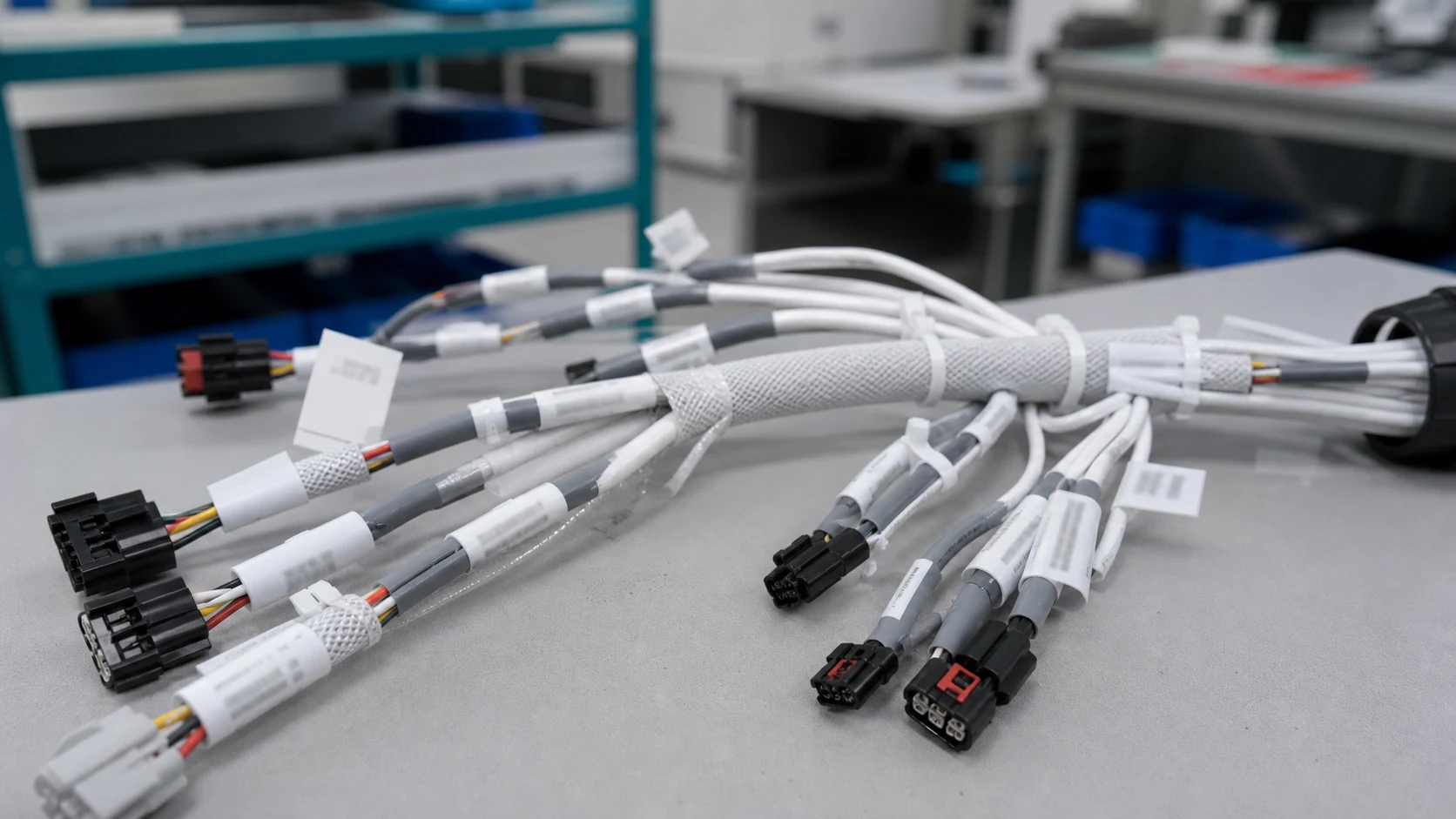
Harness labels only help installation and service when their content, placement, material and verification are defined on the controlled drawing. Decide those four elements before production, not on the shop floor.
Contents
What should a harness label communicate?
A label answers a reader’s question at a specific moment: which circuit this is, where it connects, or which assembly revision is in hand. Define the reader and the moment first, then choose content such as circuit identity, connector destination, part number or date code. For a related technical reference, see Wiring Harness vs Cable Assembly: Differences That Affect Your RFQ. For a related technical reference, see Wire Harness Branch Design: Choosing Splices, Junctions and Breakouts.
| Label decision |
Options to evaluate |
What drives the choice |
| Content |
Circuit ID, destination, part number, date code |
Who reads it and when |
| Carrier |
Adhesive flag, wrap, heat-shrink sleeve, moulded tag |
Wire size, environment, service life |
| Print method |
Thermal transfer, laser marking, pre-printed stock |
Durability and volume economics |
Where should labels be placed for installation flow?
Position labels where the installer can read them in the mounted orientation, near the connector or branch they describe. Keep a consistent offset from terminations and avoid surfaces that clamps, sleeves or adjacent parts will cover.
Which label materials and print methods survive the environment?
Match the label base material, adhesive or sleeve type and print method to temperature, cleaning agents, abrasion and handling in the application. Industry workmanship references treat legibility and attachment after exposure as acceptance topics, so record the exposure assumptions you used.

How does labeling support service and traceability?
Service teams use labels to confirm circuits without tracing wires through an enclosure. Traceability content such as lot or date coding lets a nonconformance be bounded quickly, provided the coding rule is documented and stable.
| Durability factor |
Risk if ignored |
Drawing control |
| Temperature exposure |
Fading or adhesive failure |
Material class and exposure statement |
| Cleaning and chemicals |
Illegible print at service |
Print method and test note |
| Abrasion and handling |
Lost or torn labels |
Placement rule and protection |
What belongs in the labeling section of a harness drawing?
Specify label content, format, size, colours, material, attachment method, position with tolerance, and orientation. Add the acceptance rule for missing, illegible or misplaced labels so inspection has a clear disposition path.
Important: General guidance cannot approve a specific design or lot. This is a source-note application of the IPC and TE Connectivity references listed below; apply it through your controlled drawing and acceptance plan.
How should labeling be verified before shipment?
Verify content against the drawing, check placement and orientation on representative units, and confirm legibility after any cleaning or handling steps in the process. Record results with the inspection evidence for the lot.
Which ZUCH route supports a labeled harness inquiry?
Use ZUCH’s Home Appliance solution route and the live product catalogue to identify relevant connector, terminal or housing component families. These are discovery routes only and do not demonstrate that a specific configuration is approved for your application.
RFQ inputs
- Controlled drawing revision with the labeling specification section.
- Label content rules, positions, tolerances and orientation requirements.
- Environmental exposure assumptions for label material selection.
- Inspection method, acceptance criteria and records for labeling.
Fit Boundary
This guide supports engineering and sourcing discussion; it cannot replace programme-specific validation, market requirements, or an approval record. Use ZUCH’s sample request route or contact page for controlled component documentation and samples.

Treat every label as an installation and traceability control
A harness label has two jobs: help the installer identify the correct connection and help quality or service teams trace the assembly. Define its content, location, orientation, material, print method, revision or lot data, and verification method in the drawing or controlled work instruction.
| Label decision |
What to define |
Failure prevented |
| Content |
Circuit, pin/cavity, branch, assembly, revision, serial or lot identifier |
Wrong connection or inability to identify a suspect assembly |
| Placement |
Reference point, orientation, distance from connector, and visibility after installation |
Label hidden by a branch, clamp, or connector body |
| Material/process |
Marker sleeve, wrap label, flag, laser/thermal print, adhesive and substrate |
Print loss, lift, abrasion or chemical damage |
| Verification |
Legibility, content, position, adhesion, barcode/scan, and sample retention |
Shipment of a harness that cannot be installed or traced |
FAQ
What information should a wiring harness label contain?
Include only identifiers needed for installation, service, and traceability, such as circuit or cavity, branch, assembly revision, serial or lot data. The controlled drawing should define the exact format.
Where should labels be placed on a harness?
Place them where the installer can see and read them during the intended connection step, while preserving bend radius, connector access, strain relief, and service clearance.
Which label types last in hot or oily environments?
Choose the material and print method from the actual temperature, fluids, abrasion, UV, cleaning and flex exposure. Verify the exact label system rather than assuming a generic “industrial” label is suitable.
How is label quality checked before shipment?
Check content, legibility, position, orientation, adhesion, barcode/scan performance where applicable, and the retained sample or inspection record tied to the assembly revision.
What information should a wiring harness label contain?
Only the content its reader needs at that point: typically circuit identity, connector destination, part number or traceability coding defined on the drawing.
Where should labels be placed on a harness?
Near the termination or branch they describe, readable in the installed orientation, and clear of clamps, sleeves and covered surfaces.
Which label types last in hot or oily environments?
Material and print method must be matched to the stated exposure; heat-shrink sleeves and laser or thermal-transfer marking are common candidates that still require application-level confirmation.
Do labeling requirements belong on the drawing?
Yes. Content, material, position, tolerance and acceptance rules should be drawing requirements, not shop-floor preferences.
How does labeling reduce installation errors?
Clear destination and circuit labels let installers confirm connections without tracing wires, which shortens assembly time and reduces mis-connections.
How is label quality checked before shipment?
Content, placement and legibility are verified on representative units against the drawing, with results kept in the lot records.
What should buyers ask suppliers about labeling capability?
Ask which label carriers and print methods they run, how they verify content and placement, and how label changes are handled under change control.
Key takeaway
Labeling is part of harness function, not decoration. A controlled label specification makes installation easier, supports service, and preserves lot or revision traceability without adding unverified durability claims.
References
 Zhejiang ZUCH Technology Co., Ltd.