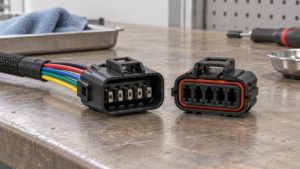
Quick-Connector vs Permanent Crimp: Compare the Complete Interface System
A quick connector and a permanent crimp should be compared as complete interface systems, not as standalone labels. The released connector, conductor, mating definition, assembly route, access, service boundary, and evidence requirements determine what a project can approve.
Contents
Part 1. Define the interface system before comparing options
The comparison starts with the released connector and mating definitions, conductor, termination interface, routing, enclosure, and intended assembly context. Neither “quick connector” nor “permanent crimp” alone describes the complete product requirement. For a related technical reference, see RAST Connector Termination: Compare IDC and Crimp Interfaces by System.
Define the decision being requested as well. A supplier conversation, an engineering review, an assembly instruction, and a service authorization are distinct activities with different owners and evidence.
| System input |
Why it matters |
Controlled record |
| Connector and mating definition |
Identifies the physical interface to compare |
Current drawings, keying, and revision |
| Conductor and termination |
Links the choice to the wire system |
Wire definition and connector requirement |
| Assembly and access |
Shows packaging and service dependencies |
Routing, enclosure, and access layout |
Part 2. Compare quick-connect and permanent-crimp questions
A quick-connect concept may raise questions about the controlled mating and release interface, while a permanent-crimp concept may raise questions about the specified connector-and-conductor system and assembly controls. Neither label establishes performance, serviceability, or suitability for the finished assembly.
Compare the project’s released definitions and required evidence. Do not use a generic category name as proof that a different connector family or wire configuration is interchangeable.
Important: Visible mating or a completed crimp does not prove that an interface meets the application’s released connector, conductor, assembly, inspection, and service requirements. Source: IEC 61984 connector overview.
Part 3. Confirm mating and conductor definitions
Review the controlled mating direction, keying, terminal or contact definition, conductor construction, termination relationship, and routing features. These inputs make a comparison specific enough to identify differences that a supplier or engineering team must address.
Keep the relevant drawing revision with the request. It prevents a response based on a different mating part or wire configuration from being treated as a direct alternative.
Part 4. Review assembly, access, and service boundaries
Assembly access, inspection points, routing, harness support, enclosure space, and authorized service context can affect an interface decision. Review the finished-assembly conditions rather than comparing two isolated product samples.
The responsible organization must define any controlled assembly or service procedure. This article identifies review inputs only and does not prescribe how to crimp, mate, release, or replace a connector. For a related technical reference, see Sealed vs Open Rectangular Connectors: Define Environmental Inputs First.
Part 5. Prepare a controlled comparison package for RFQ
Ask suppliers to respond to a defined system. A broad request for a “quick connector or permanent crimp” leaves out the details needed for meaningful comparison.
| Inquiry item |
Purpose |
Send with RFQ |
| Connector, mating, and conductor definition |
Establishes the exact system under review |
Current drawings, revision, keying, and wire information |
| Assembly and access conditions |
Identifies practical constraints |
Routing, support, enclosure, inspection, and service notes |
| Evidence request |
States program expectations |
Sample objective, records, and evaluation needs |
| Change control |
Preserves the comparison basis |
Revision, notification, and traceability expectations |
Part 6. Control changes and proposed alternatives
A change to the connector, mating part, conductor, termination definition, routing, enclosure, access, or service scope can affect the original comparison. Record it as a controlled change before treating a proposed option as an equivalent replacement.
The responsible engineering team can decide whether the alternative needs a drawing update, samples, evaluation, or release evidence. Purchasing should compare supplier responses against the same revision.
Part 7. Use ZUCH routes for a controlled interface discussion
The ZUCH Quick-Connector route provides a commercial discovery path for connector-family discussions. It does not confirm a quick-connect or permanent-crimp design, fit, validation, availability, or approval for a particular product.
For a comparison inquiry, use the contact page to provide controlled drawings, conductor definition, assembly and access context, sample objective, requested evidence, and change-control needs. The serviceability planning guide addresses the related access-and-replacement review boundary.
FAQ
Is a quick connector always better for replacement?
No. The released interface, access, routing, service boundary, and program evidence determine whether a particular replacement concept can be considered.
Is a permanent crimp always more reliable?
No general conclusion follows from the label. Review the controlled connector, conductor, termination, assembly, inspection, and application requirements.
What should be compared between the two interface types?
Compare the released connector and mating interface, conductor, termination definition, routing, access, assembly, service boundary, and evidence requirements.
Why does conductor definition matter?
The wire system is part of the controlled termination relationship and cannot be inferred from a general connector category.
Does visible mating prove suitability?
No. Suitability requires the responsible organization’s review of the complete released configuration and required evidence.
What should a controlled interface drawing identify?
It should identify the connector and mating parts, keying, conductor and termination relationship, relevant envelope, revision, and application constraints.
What belongs in a quick-connect versus crimp RFQ?
Provide controlled connector and mating drawings, wire information, termination definition, assembly and access conditions, sample objective, requested records, and change-control expectations.
References
 Zhejiang ZUCH Technology Co., Ltd.