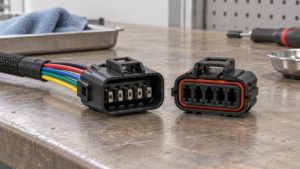
Rectangular Connector Mating Force: Plan Assembly and Ergonomics First
A rectangular connector mating-force review is useful only when the released mating pair, insertion direction, access, support, and production evidence are considered as one assembly question. A product image or a single observed force does not, on its own, define an acceptable workstation or release an end product. For a related technical reference, see Sealed vs Open Rectangular Connectors: Define Environmental Inputs First. For a related technical reference, see Rectangular Connector Pin Count: Balance Density, Routing, and Service Access.
Contents
The useful question is not simply “what force does this connector need?” Start with the released connector and mating part, their revision, intended insertion direction, and the physical arrangement in which people or equipment will mate them.
An assembly review also needs the surrounding facts: access from the workstation, harness routing, part presentation, support points, and the controlled observation method. These conditions make a later sample result reviewable instead of turning it into a generic statement about a connector family.
| Assembly input |
Why it belongs in the review |
Controlled record |
| Mating pair |
Identifies the exact interface under discussion |
Connector and mating drawings with revision |
| Insertion direction |
Connects the interface to the real approach path |
Layout or work-instruction view |
| Support condition |
Shows where reaction loads are managed |
Fixture or assembly concept |
Part 2. Set the controlled interface boundary
Name both halves of the interface and the revision before comparing observations. Keying, terminal population, housing condition, packaging, cable dress, and a nearby feature can alter how an assembly is approached or supported.
Do not replace an identified mating pair with a similar-looking sample merely because the envelope appears comparable. Keep the sample objective and open questions visible so engineering and sourcing know whether they are evaluating an interface, an assembly arrangement, or a possible alternate.
Important: Do not turn a generic connector resource into a production instruction. The released interface and application-specific evaluation remain the controlling evidence. Source: IPC.
Part 3. Review ergonomics and reaction support
An operator or fixture must be able to approach the interface without relying on an uncontrolled bend, side load, or nearby component for support. Record clearance, hand or tool access, alignment cues, and the point at which reaction is intended to be carried.
Consider the connector within the complete presentation condition. A harness may arrive at a different angle than a loose sample, and a supported bench observation may not represent the installed assembly.
Part 4. Record observations without overextending them
Use a controlled trial record to identify the sample, mating condition, setup, observed behavior, and unanswered question. The record should state what was observed, not imply a universal force target or a release decision for configurations that were not reviewed.
Where a concern appears, retain the conditions that might explain it: revision, orientation, support, access, harness state, and the person or fixture performing the action. This helps the next review compare like with like.
Part 5. Build an RFQ package for the assembly review
An RFQ can request a focused technical discussion without asking a supplier to infer the production arrangement. Send the controlled records and say which evidence the program needs before any sourcing or sample decision.
| RFQ input |
What to provide |
Why it is needed |
| Interface definition |
Connector and mating drawings, keying, and revision |
Keeps the requested comparison specific |
| Assembly arrangement |
Insertion direction, layout, access, and support concept |
Frames ergonomics and reaction review |
| Evaluation scope |
Sample objective, observed conditions, and open question |
Prevents a generic performance conclusion |
| Record request |
Required evidence and change-notice expectation |
Makes the handoff reviewable |
A new connector revision, mating part, terminal population, fixture, route, packaging state, or workstation arrangement can change the original assembly question. Flag that change instead of assuming that a previous observation applies unchanged.
Revision control is especially important when an alternate is proposed. The comparison should return to the released interface and the documented production arrangement before earlier evidence is reused.
Part 7. Use ZUCH routes for a bounded connector discussion
The ZUCH rectangular connectors route is a product-family discovery point. It does not confirm a mating-force value, tool setting, assembly method, availability, validation, or suitability for a finished assembly.
For a controlled inquiry, use the sample request route with the mating drawings, assembly layout, support concept, sample objective, required records, and revision expectations. The rectangular connector locking-mechanisms comparison gives a separate interface-review lens; the products page and contact route remain commercial entry points.
FAQ
Is mating force a connector-only property?
No. The review needs the controlled mating pair, its condition and revision, insertion direction, access, support, and the applicable assembly arrangement.
Which drawing matters first?
Start with the controlled connector and mating drawings, then add the layout that shows how the interface is approached and supported.
Why does operator reach matter?
Reach can affect alignment, access, support, and repeatability. It belongs in the assembly record rather than being assumed from a loose sample.
Can a bench observation release a production line?
No. A bench observation is only evidence for its stated setup. The responsible program must define any production evaluation and release process.
What should a fixture review show?
Show the released interface, insertion direction, location of support, clearance, harness condition, and the conditions that the fixture is meant to control.
When should a mating-force review be repeated?
Repeat it when the mating pair, revision, terminal population, routing, fixture, workstation arrangement, or intended evidence boundary changes.
What belongs in a rectangular connector mating-force RFQ?
Include the controlled drawings and revision, insertion direction, assembly layout, support concept, sample objective, known observations, requested records, and change-control expectations.
References
 Zhejiang ZUCH Technology Co., Ltd.