Zhejiang ZUCH Technology Co., Ltd.
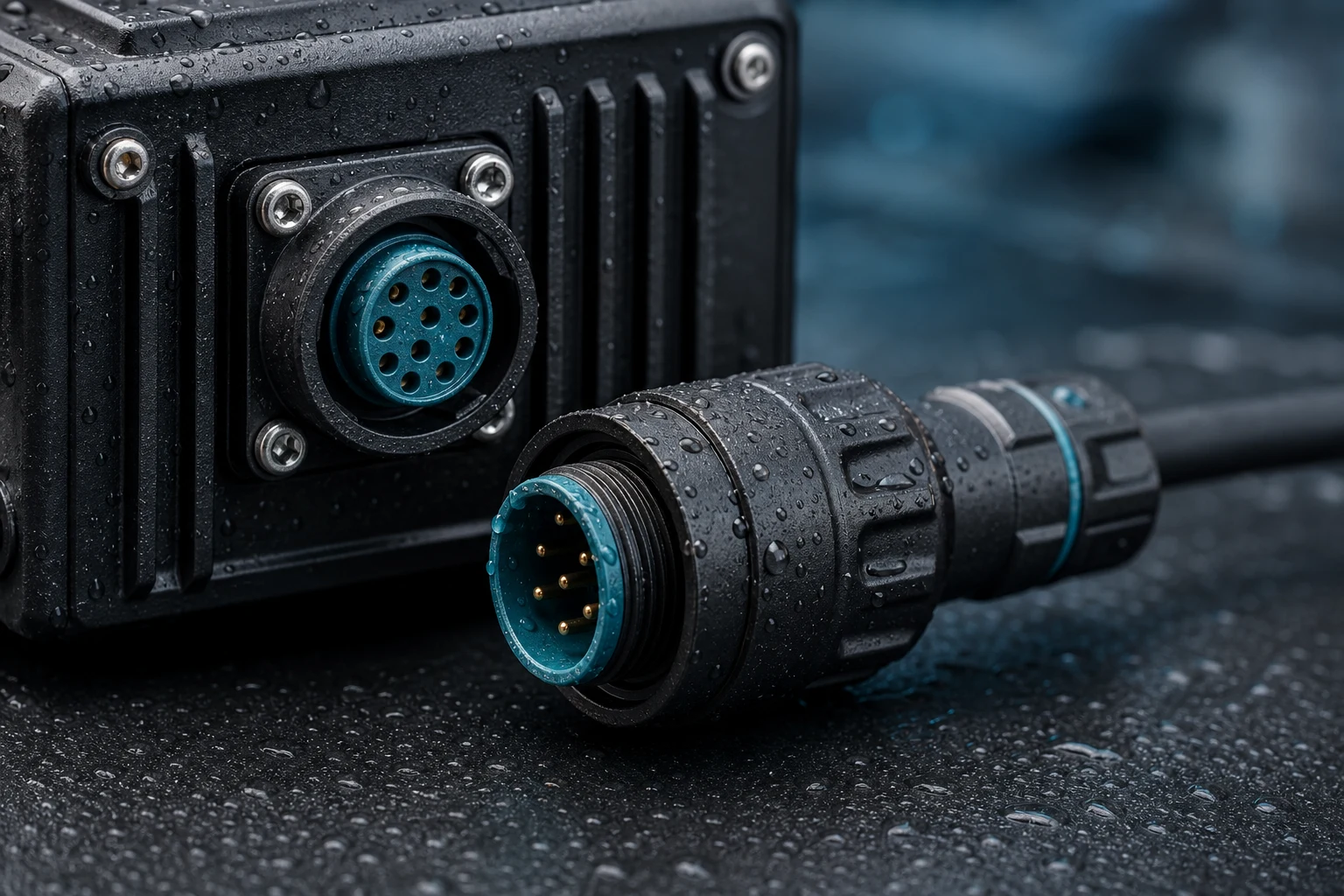
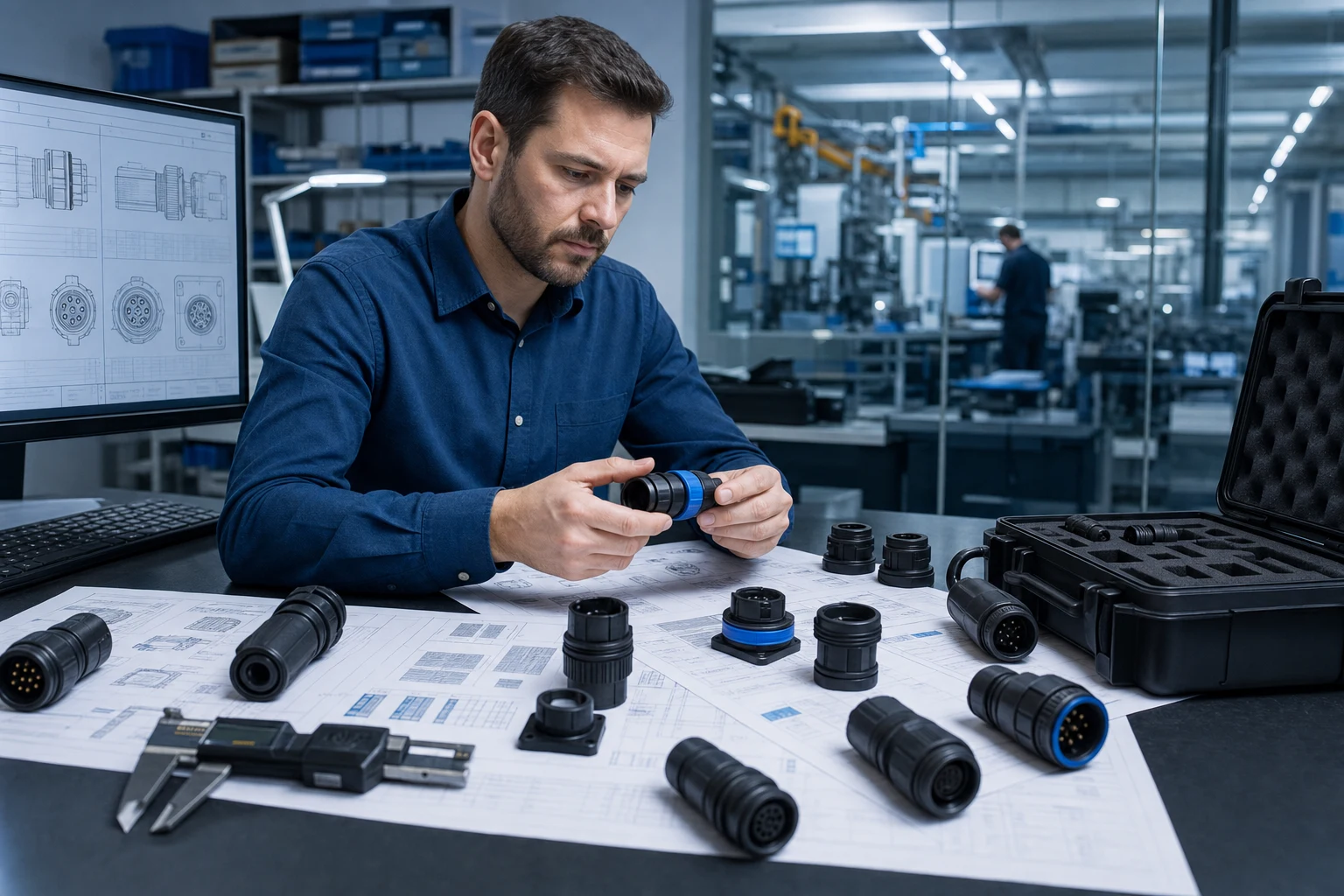
When a maintenance engineer in Rotterdam encountered repeated signal dropouts on a dockside packaging line, she replaced two visibly corroded plugs before tracing the fault to a gasket that had been compressed outside its design range. The failure appeared within minutes of washdown; the reversal came when the team specified the complete mated connection, cable entry, and exposure rather than simply requesting a “waterproof” part.
Summary: IP65 means dust-tight protection plus resistance to water jets, while IP67 adds protection for temporary immersion under the stated IEC 60529 conditions. Neither code is a blanket promise for every installed connector. Procurement teams should select the rating only after documenting the assembled product, cable, seal geometry, mounting direction, and actual water exposure; a higher digit is useful only when its test condition matches the risk.
An IP code is a concise ingress-protection classification, not a universal durability grade. For connection systems in machinery, transport equipment, and outdoor panels, it helps engineers translate the environment into a testable specification. It also prevents a common total-cost error: paying for a higher enclosure claim while leaving the cable gland, unused cavities, or mating procedure uncontrolled.
What the IP code measures
IEC 60529 defines the IP Code for enclosures. Its first numeral describes access and solid-particle protection; the second describes water protection. In IP65 and IP67, the “6” denotes dust-tight performance. The different second numeral matters: IPX5 addresses water jets, whereas IPX7 addresses temporary immersion. The code applies to the item actually tested, so an unmated housing and a finished harness should not be assumed to share one rating. Record that tested state in the rectangular-connector maintenance instructions and in the specification for any custom rectangular power connector.
For Rectangular Connectors, the specification should name the tested configuration: mated or unmated state, backshell or hood, cable diameter, sealing plugs, orientation, and any accessories. An IP rating on a rectangular power connector may be relevant at the panel face yet fail to describe leakage through an incorrectly terminated cable exit. This distinction is especially important when a purchaser combines components from different suppliers.
In a procurement specification, the interface should therefore be identified by the complete test state rather than by a housing description alone. That level of detail helps quality teams compare supplier evidence on a like-for-like basis.
IP65 and IP67 test exposure are different risks
IP5X and IP6X are dust tests; IP6X requires no dust ingress in a test chamber under the standard’s defined conditions. For the water digit, IPX5 uses a water jet—commonly specified in IEC 60529 as 12.5 L/min from a 6.3 mm nozzle for at least 3 minutes. It is a useful proxy for washdown, weather-driven spray, or cleaning equipment, but it is not an immersion test.
IPX7 evaluates temporary immersion under the standard’s prescribed depth and duration conditions. It does not automatically cover pressurized spray, hot wash cycles, long-term submersion, saltwater, chemical cleaners, vibration, or repeated thermal cycling. An installation exposed to both washdown and pooling should identify both hazards; quoting IP67 alone can leave the jet exposure unspecified.
Choose the seal around the installed assembly
The seal is a system: interface gasket, contact insert, cable gland, strain relief, blanking plugs, panel cutout, and the mating process. A rectangular power connector located below a horizontal panel may collect water at the cable entry even though the face seal passes its test. Conversely, a well-supported connector in a sheltered cabinet may not gain measurable value from an immersion classification.
Outdoor selection starts with the water’s direction, pressure, frequency, temperature, and contaminants. UV exposure, condensation, freeze-thaw cycles, cable movement, and detergent compatibility can age elastomers before a formal IP test is repeated. Buyers should therefore ask for the relevant test report or configuration statement, inspect allowable cable ranges, and define field torque or latch requirements. Where a design uses modular rectangular connectors, every populated and unpopulated interface must be included in that review.
IP65 vs IP67: value and total-cost comparison
| Decision dimension | IP65 approach | IP67 approach | Procurement implication |
|---|---|---|---|
| Water exposure addressed | Water jets | Temporary immersion | Match the code to the dominant, documented hazard. |
| Dust protection | Dust-tight (first digit 6) | Dust-tight (first digit 6) | Neither option relaxes the need for sound cable sealing. |
| Typical installation context | External panels, washdown-adjacent equipment, directed spray | Low points, accidental flooding, brief submersion risk | Location and orientation often decide the choice. |
| Component complexity | Seal design suited to jet test configuration | May require more controlled interfaces and assembly | Confirm actual construction; do not infer it from the number alone. |
| Unit-cost tendency | Potentially lower for comparable interfaces | Potentially higher when added sealing features are required | Compare validated assembly cost, not list price alone. |
| Maintenance and TCO | Inspect after aggressive washdown or cable movement | Inspect after immersion events and seal disturbance | One avoided outage can outweigh a modest component-cost difference. |
Illustrative only: if a more capable assembly costs 8% more but prevents one unplanned service visit, its economics depend on labor, downtime, and replacement access—not the 8% figure in isolation. The correct comparison is the tested system’s expected service cost across its operating life.
Application and environment checklist
| Environment | Questions to document | Likely focus |
|---|---|---|
| Outdoor control cabinet | Does rain strike the interface, enter from above, or condense inside? | Face seal, cable entry, UV and drainage. |
| Food or industrial washdown area | What nozzle pressure, distance, water temperature, and cleaning agent are used? | IPX5 relevance and chemical compatibility; validate the actual cleaning cycle. |
| Mobile equipment | Can splash, vibration, flexing, or temporary flooding occur together? | Strain relief and mated-state testing; assess service access. |
| Low-mounted outdoor junction | Could standing water submerge the connection, and for how long? | Temporary-immersion conditions and drainage redesign. |
| modular rectangular connectors | Are unused cavities plugged and are all modules retained correctly? | Configuration control across each interface and accessory. |
Compliance: make the claim match the evidence
IEC 60529 is a test and classification standard for degrees of protection provided by enclosures; it is not a product approval certificate or a substitute for electrical safety, environmental, or market-specific requirements. The product drawing, report, or supplier declaration should identify the sample configuration, test state, conditions, and any exclusions. A marketing statement that says “IP67” without those boundaries can create acceptance disputes when a customer’s cable assembly performs differently.
Destination-market rules and intended use still determine what additional evidence may be needed, including electrical safety, EMC, hazardous-location, or sector requirements. NEMA enclosure types are also not interchangeable with IP codes, even where a comparison is sometimes used for orientation. For a rectangular power connector used in a regulated assembly, the buyer should align the IP evidence with the system’s technical file and contract language.
Selection actions for engineering and procurement
- Map the actual exposure: dust type, jet direction, immersion depth and duration, temperature, chemicals, UV, and vibration.
- Specify the complete mated assembly, including cable diameter, gland, backshell, panel cutout, unused-position plugs, and mounting orientation.
- Request evidence tied to the specified configuration and stated IEC 60529 conditions; retain it with the drawing and incoming-inspection plan.
- Define assembly controls such as torque, gasket seating, contact retention, and post-installation inspection rather than treating the IP code as self-executing.
- For modular rectangular connectors, control module combinations and sealing accessories through approved part numbers and a repeatable work instruction.
When sourcing configurable connection systems, ZUCH can support a structured discussion of interface selection, documentation, and production requirements. Buyers evaluating its Rectangular Connectors should still make the final ingress claim only from the evidence for the selected assembly. For a category-level starting point, review the connector portfolio. Its published quality capabilities include IATF 16949:2016, a CNAS-recognized laboratory, and a UL Witness Lab; those qualifications do not themselves establish an IP rating for any product.
What must be recorded before choosing IP65 or IP67?
Use the code as one part of an environmental specification, not as a substitute for the installation drawing.
| Review point | Record or question | Why it closes risk |
|---|---|---|
| Water event | Jets, temporary immersion, direction, duration and cleaning method | Maps the selected digit to the real hazard |
| Assembly state | Mated pair, seals, cable diameter, plugs and unused cavities | Prevents a component label from being transferred to a different configuration |
| Installation | Mounting orientation, drainage, enclosure and maintenance access | Controls water paths outside the connector housing |
| Other hazards | Dust, impact, chemicals, temperature and insulation | Keeps IP, IK and electrical evidence distinct |
FAQ: How should IP65 and IP67 be applied to a connector assembly?
What is the difference between IP65 and IP67 rectangular connectors?
Both codes have a first digit of 6, meaning dust-tight under IEC 60529. IP65 is intended for the water-jet test, while IP67 addresses temporary immersion under defined conditions. Select according to the installed assembly and exposure, not the highest-looking number.
Can an IP65 connector be submerged in water?
No immersion protection is conveyed by the “5” water digit. An IP65-marked assembly may resist the specified jet test but should not be specified for submersion unless separate evidence explicitly covers that condition.
When do I need an IP67 rectangular connector?
Consider IP67 when a correctly configured and tested connection could be temporarily immersed, such as at a low point subject to brief flooding. Also assess whether water jets, chemicals, heat, or long dwell times occur, because IPX7 does not automatically represent those exposures.
Are IP ratings the same for the connector and cable assembly?
Not necessarily. The housing, mated pair, cable gland, backshell, seals, and installation method can change the result. Request the rating for the exact assembled/configured product and verify that its tested cable range and accessories match the bill of materials.
How do I keep water out of a rectangular connector?
Use compatible seals, the correct cable diameter, approved blanking plugs, and controlled assembly torque; then orient the installation to drain rather than trap water. Inspect gasket damage and cable strain after maintenance, especially in washdown or mobile applications. See the broader waterproof connector guidance when defining the interface.
Does a higher IP rating affect connector cost or size?
It can, because achieving a different test condition may add sealing features, tighter interface control, or validation effort. The best purchase decision compares the assembly’s fit, validation evidence, maintenance burden, and downtime risk rather than assuming that a higher code is always better.
Can an IP65 connector be submerged?
No. The water digit 5 addresses a jet exposure and does not establish the temporary-immersion condition represented by IP67.
Does IP67 cover water jets?
Do not assume that one water test automatically proves another. Check the full marked code and the applicable test evidence for the assembly.
Are IP ratings the same for a connector and its cable assembly?
Not automatically. Seals, cable entries, backshells, mating state, plugs and installation can change the tested boundary.
Does a higher IP code prove better chemical resistance?
No. IEC 60529 concerns degrees of enclosure protection; chemical compatibility needs its own material and application evidence.
Can an IP rating be copied from an unmated connector?
No. Confirm the state and configuration represented by the evidence; many protection claims depend on the mated assembly and closed unused positions.
Does IP67 remove the need for drainage and inspection?
No. Water can enter through installation paths or damaged seals, so orientation, drainage, maintenance and inspection remain part of the design.
References
- IEC 60529 — Degrees of protection provided by enclosures — public scope checked 2026-10-14; it does not establish a product-specific rating, certification or application approval.
- IEC 62262 — IK impact-protection code — public scope checked 2026-10-14; it does not establish a product-specific rating, certification or application approval.
- IEC 60512-1:2018 — Connectors: tests and measurements — public scope checked 2026-10-14; it does not establish a product-specific rating, certification or application approval.
- IEC 60664-1 consolidated publication — Insulation coordination — public scope checked 2026-10-14; it does not establish a product-specific rating, certification or application approval.
Conclusion
Choose IP65 or IP67 from the documented water event and the complete installed assembly, not from a higher-number assumption. Define whether the interface sees jets, temporary immersion, cleaning, condensation or another exposure. Then freeze the mated pair, seals, cable entry, blanking plugs, orientation, drainage and maintenance path. Keep IEC 60529 focused on enclosure protection; IK impact, insulation coordination and chemical compatibility require separate evidence. A connector housing label cannot automatically transfer to a cable assembly or a changed installation. ZUCH can discuss rectangular and waterproof connector candidates against the application drawing, while the final protection claim belongs to the tested configuration and responsible product owner.