Ring Terminal Stud Size Guide: Choosing the Correct Hole Diameter and Tongue Width
Ring Terminal Stud Size Guide: Choosing the Correct Hole Diameter and Tongue Width
Choose a ring terminal from the complete joint definition: stud, hole, tongue, conductor, hardware stack-up, and installation space. A nominal stud label is only one piece of that definition.
Contents
Part 1. Understand what the stud-size callout describes
A stud-size callout describes one interface dimension in a bolted electrical connection. It does not by itself establish the terminal’s conductor range, barrel type, tongue width, material, finish, or clearance within the finished assembly.
Start from a released joint definition. This helps purchasing avoid comparing two parts that share a hole label but differ in the geometry or crimp system needed for the actual application.
| Selection input |
What to confirm |
Consequence of omitting it |
| Fastener interface |
Stud and required hole condition |
A nominal label may not represent the real stack-up |
| Tongue profile |
Width, reach, and neighboring clearances |
The terminal may interfere despite fitting the stud |
| Conductor and barrel |
Wire construction and approved crimp range |
The joint can be unsuitable even when the hole fits |
Part 2. Match hole geometry to the released hardware
Use the controlled drawing and the actual fastener specification to determine the required hole geometry. Check the relevant clearance condition, hardware tolerances, coatings, and alignment requirement rather than assuming all parts marked for one nominal stud are interchangeable.
Where a joint uses special hardware or constrained access, include that information in the design record. It lets the evaluation team review the intended assembly, not a simplified catalogue scenario.
Important: A ring terminal must be selected and crimped for the specified conductor and termination system; a stud-hole match alone does not demonstrate a compliant electrical connection. Source: TE Connectivity terminal and splice resources.
Part 3. Check tongue shape against the available envelope
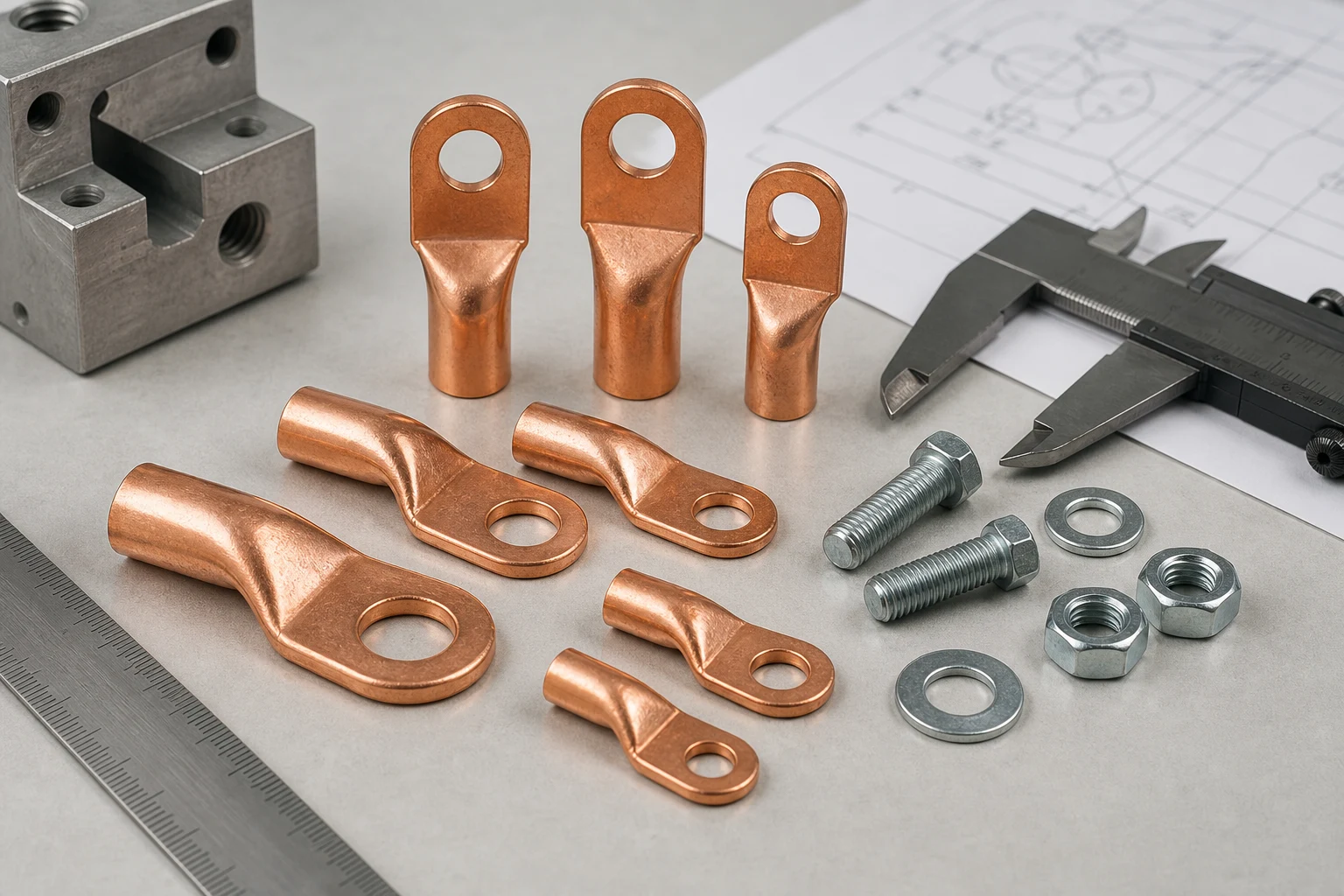
Tongue width and length affect contact area, clearance around washers, orientation, and proximity to barriers or adjacent terminals. Place the terminal geometry in the same view as nearby hardware and insulation components.
This check is useful when several cables converge on one mounting point. It reveals a packaging issue before the buyer treats different ring-terminal shapes as equivalent alternatives.

Part 4. Treat conductor and crimp as separate decisions
Conductor construction, cross-section, strip condition, barrel design, and approved crimp tooling need their own review. The terminal’s interface with the stud is distinct from its interface with the conductor. For a related technical reference, see Quick-Connector vs Permanent Crimp: Compare the Complete Interface System.
Ask for the applicable conductor range and the evidence expected by the program. Do not infer suitability from visual fit, a catalogue photo, or the fact that another terminal shares a similar tongue.
Part 5. Record the complete connection stack-up
Document how the stud, ring terminal, washer or spacer, nut, adjacent parts, and access limitations occur in the controlled assembly. This creates a selection record that engineering, manufacturing, and a supplier can review against the same revision.
| Stack-up item |
Review purpose |
Send with RFQ |
| Hardware arrangement |
Confirms seating and available engagement |
Stud, washer, spacer, and nut specification |
| Terminal envelope |
Identifies clearance and orientation limits |
Hole, tongue, barrel, and insulation dimensions |
| Wire definition |
Connects terminal choice to the conductor |
Construction, range, and approved crimp method |
| Program evidence |
States the evidence requested for release |
Samples, validation needs, records, and change notice |
Part 6. Compare supplier responses to the same revision
Use a single controlled drawing revision when comparing responses. Differences in hole shape, tongue geometry, barrel range, or requested documentation should be visible rather than hidden in a broad description such as “fits M-size stud.”
When a supplier proposes an alternative, route it through the responsible design review. The team can then decide whether the alternative requires an updated drawing, evaluation, or release record.
Part 7. Start a controlled ZUCH ring-terminal inquiry
ZUCH’s ring terminals route and product catalogue provide a commercial starting point for identifying relevant terminal families. The routes do not establish part fit, production availability, certification, or approval for a particular assembly. For a related technical reference, see Spade Terminals in Vibration: Open-Barrel vs Insulated Designs Compared.
For a meaningful inquiry, provide the drawing revision, hardware stack-up, terminal envelope, conductor details, sample quantity, desired records, and change-notice requirement. Use the sample request route or contact page to provide that controlled information.

FAQ
How do I choose the correct ring terminal hole size?
Begin with the released stud and hardware definition, then review clearance, alignment, and the full assembly stack-up.
Is a nominal stud label enough to select a terminal?
No. Confirm the drawing dimensions, hardware arrangement, tongue shape, and conductor termination requirements.
Why is tongue width important on a ring terminal?
It affects contact area, orientation, and clearance around nearby hardware and insulation.
Can one ring terminal fit different conductor sizes?
Only when the controlled barrel range and approved crimp method support the specified conductors.
Do washers change ring terminal selection?
Yes. Washers or spacers can change seating, available engagement, clearance, and terminal orientation.
What should a ring-terminal drawing specify?
It should state controlled hole and tongue geometry, barrel or conductor requirements, material or finish needs, and relevant application constraints.
What should be included in an RFQ for ring terminals?
Supply the current drawing, hardware stack-up, conductor data, quantities, sample needs, required evidence, and change-control expectations.
References
 Zhejiang ZUCH Technology Co., Ltd.