Spade Terminals in Vibration: Open-Barrel vs Insulated Designs Compared
Vibration selection for a spade terminal starts with the complete connection, including the tab interface, crimp system, wire support, and the movement expected in service. The terminal style alone cannot establish durability. For a related technical reference, see Quick-Connector vs Permanent Crimp: Compare the Complete Interface System.
Contents
Part 1. Define the connection that will see vibration
A spade-terminal review should describe more than the disconnect terminal. Record the mating tab, conductor, crimp system, cable route, support points, enclosure, and the operating environment that the engineering team must evaluate.
This scope prevents a buyer from comparing terminal styles without the rest of the joint. It also gives a supplier a usable drawing and application context for a technical discussion.
| Connection input |
Why it belongs in the review |
Record to provide |
| Mating tab |
Defines the receptacle interface and retention context |
Tab drawing and revision |
| Terminal and crimp |
Connects geometry to the selected conductor system |
Terminal drawing, wire construction, and crimp requirement |
| Cable support |
Identifies loads that can reach the connection |
Routing view, clip locations, and accessible service envelope |
Part 2. Compare open-barrel and insulated constructions
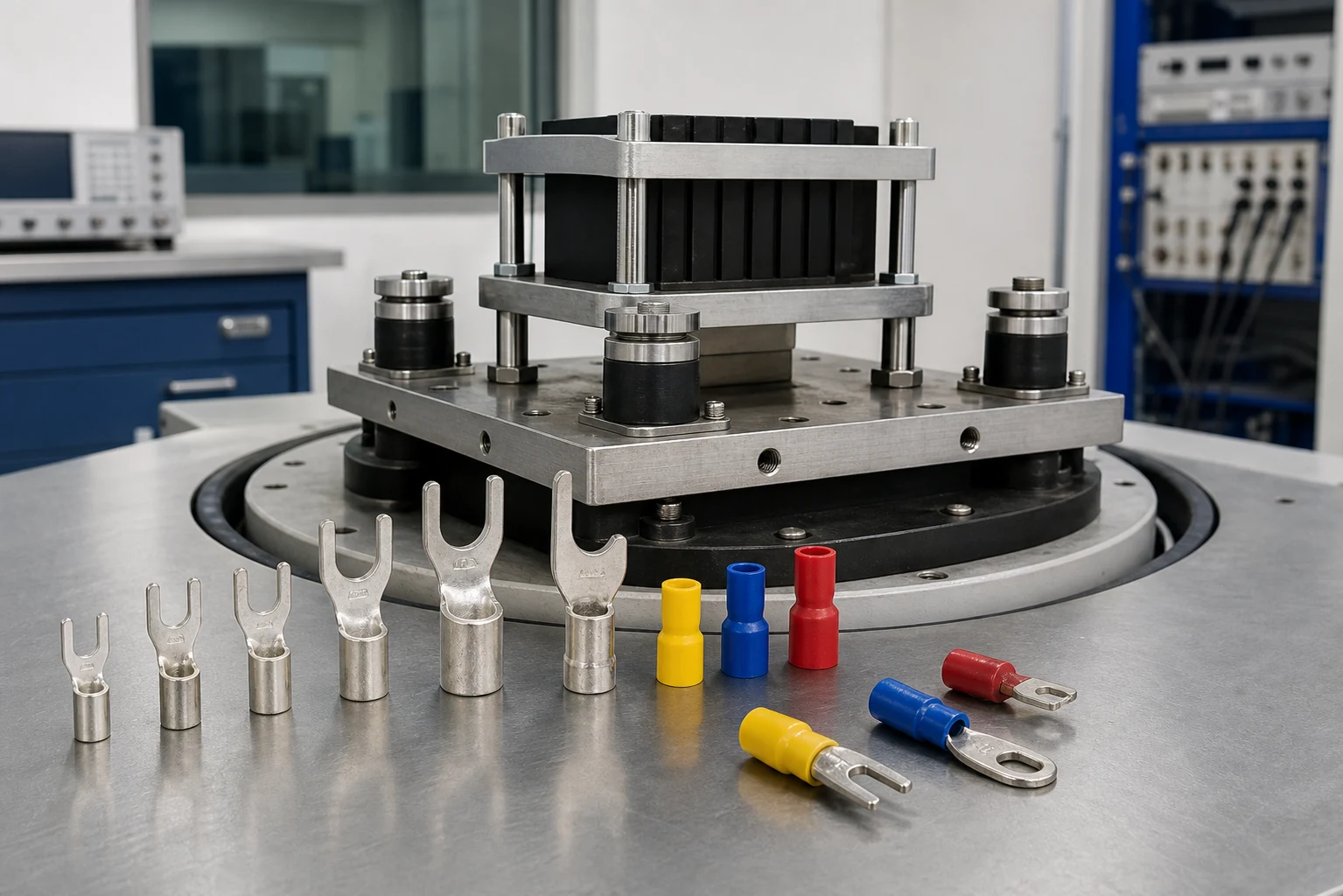
Open-barrel and insulated spade terminals serve different interface and assembly requirements. Compare the defined barrel, insulation arrangement, mating feature, tooling, and inspection method instead of assuming that one construction is universally better in vibration. For a related technical reference, see Male Tab Terminals: How Tab Width and Thickness Affect Mating Performance.
The chosen design must fit the released joint and manufacturing controls. Evidence from one terminal configuration does not automatically transfer to a different material, barrel, tab, or wire combination.
Important: A mating terminal that appears to fit can still be unsuitable when its crimp system, support arrangement, and released application differ. Source: TE Connectivity terminal-system overview.
Part 3. Check the tab and receptacle interface
Review tab dimensions, receptacle geometry, insertion direction, retention feature, orientation, and nearby clearances against the controlled drawing. The team should also consider whether movement at the cable can be transmitted to the mating interface.
Inspection criteria should identify the conditions the organization needs to control. Those criteria belong in the applicable production and validation documentation, not in a generic article.

Part 4. Include wire routing and support in the review
Cable routing, bend position, strain relief, clips, and service access influence the loads seen by a terminal. A terminal selected from a catalogue may still be unsuitable when the actual harness routing introduces repeated movement or interference.
Map support points and adjacent hardware in the same assembly view as the mating terminal. That makes it easier to identify conditions that need engineering attention before a design is released.
Part 5. Set evidence expectations for the program
The responsible program team should define the evidence it needs for its specific application. A pull value alone may be one inspection input, but it is not a complete vibration-durability conclusion for an assembled connection.
| Evidence question |
What it clarifies |
Send with RFQ |
| Which revision is under review? |
Prevents a response against a different interface |
Current drawing and mating tab definition |
| Which assembly conditions matter? |
Relates the request to the actual harness and enclosure |
Wire, routing, support, environment, and access details |
| Which records are requested? |
Makes evaluation expectations visible |
Sample need, inspection expectations, and change-notice requirement |
Changes to the tab, terminal, barrel, conductor, insulation, routing, support hardware, or intended environment can affect the original assessment. Record the change and route it through the organization’s engineering and quality review before relying on prior evidence.
This approach also helps purchasing distinguish a like-for-like replenishment request from a proposed alternate part. The distinction should be made against the controlled revision.
Part 7. Begin a controlled ZUCH spade-terminal inquiry
ZUCH’s spade terminals route and product catalogue offer a commercial starting point for identifying relevant terminal families. They do not prove a specific part is suitable, validated, available, or approved for an end assembly.
For an inquiry, provide the terminal and tab drawings, wire definition, intended routing and support, environmental context, sample objective, requested records, and change-control requirements. Send controlled information through the sample request route or contact page.

FAQ
Are open-barrel spade terminals always better for vibration?
No. The appropriate construction depends on the released terminal system, conductor, tooling, mating interface, routing, and program evidence.
Do insulated spade terminals eliminate vibration risk?
No. Insulation is one feature. The complete connection, support arrangement, and operating conditions still require review.
What should be compared between spade terminal designs?
Compare the controlled tab interface, barrel and wire range, insulation arrangement, retention features, assembly method, and evidence requested for the application.
Why does wire routing affect a spade terminal?
Routing and support can transmit movement or create interference at the terminal. Review them in the actual assembly context.
Can a pull test alone prove vibration durability?
No. It may be an inspection input, but the responsible program must define the evidence needed for the assembled connection and intended conditions.
What should an inspection plan control?
It should control the items the organization specifies, such as released parts, crimp system, mating interface, assembly conditions, and records.
What should buyers include in a spade-terminal RFQ?
Include controlled terminal and tab drawings, wire data, routing and support constraints, sample objective, evidence needs, and change-notice expectations.
References
 Zhejiang ZUCH Technology Co., Ltd.