Waterproof Connector Ratings: IP67 vs IP68 vs IP69K for Industrial Equipment
IP67, IP68, and IP69K describe different exposure conditions, so none is a universal shorthand for “better waterproofing.” Select a waterproof connector by matching the documented rating, test setup, and complete installed interface to the real equipment environment.
Contents
Part 1. Begin with the complete sealed interface
The rating discussion should start with the assembled system: plug and receptacle, seals, backshell or housing, cable, cable entry, mating state, covers, and mounting surface. A connector body can be only one element in the water path. Define whether the equipment faces immersion, washdown, spray, cleaning process, condensation, or another exposure before narrowing the product category. For a related technical reference, see IP65 vs IP67 Rectangular Connectors: Which One Do You Need?.
| Interface element |
Review question |
Why it matters |
| Mating interface |
Is the connector tested in the same mated state required in equipment? |
Seals and latches can depend on full engagement |
| Cable entry |
Are cable diameter, jacket, gland, and assembly instructions controlled? |
A water path can occur behind the connector face |
| Enclosure boundary |
How does the interface mount into the equipment wall or cover? |
The finished system may introduce another sealing path |
Part 2. Read IP67 and IP68 in context
IP67 and IP68 are associated with temporary immersion and immersion conditions respectively under the relevant standard framework. The exact claimed condition must come from the product documentation, including the tested assembly and any stated depth, duration, or other limits. Do not turn an IP68 label into an assumption that every immersion use case has been covered.
IEC 60529 describes the IP-code framework. Its value in selection is the discipline of comparing the stated condition to the real exposure, not using the code without the associated product instructions and limitations.
Part 3. Understand the IP69K exposure question
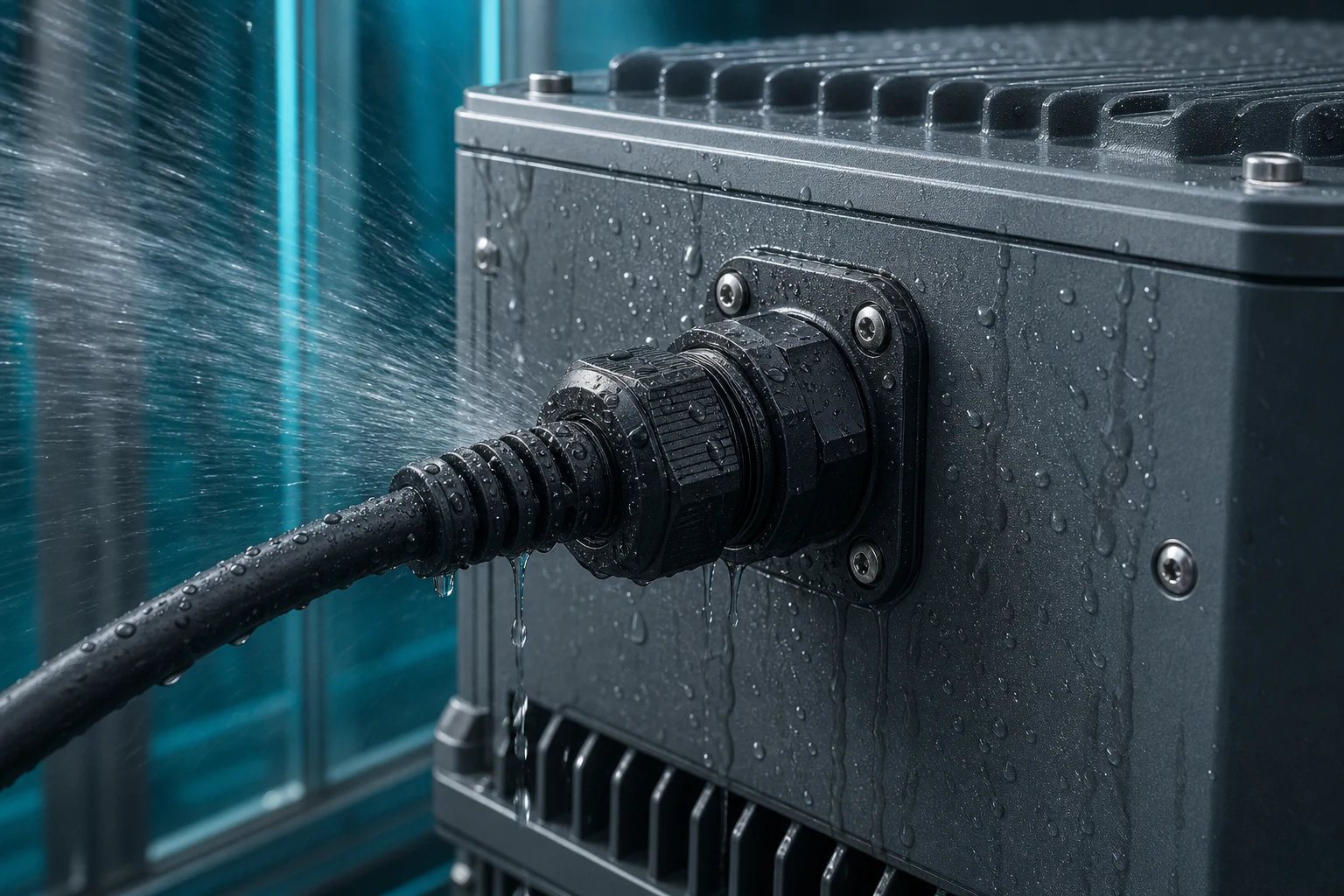
IP69K addresses a different scenario: high-pressure, high-temperature water-jet exposure defined in the relevant framework. It should not be treated as a substitute for every immersion or environmental requirement. Equipment that experiences both cleaning jets and immersion can require evidence that addresses both situations.
| Rating context |
Exposure question |
Selection evidence to request |
| IP67 |
Does the documented temporary-immersion condition match the installation? |
Product test statement and assembly conditions |
| IP68 |
Does the specified immersion condition match the expected use? |
Exact limits, mated configuration, and limitations |
| IP69K |
Does the documented jet exposure match the cleaning process? |
Test configuration and mounting or sealing conditions |
Part 4. Compare the exposure conditions
The codes are not a ranking ladder. Describe the water mechanism, direction, pressure, temperature, duration, frequency, contaminants, and post-exposure electrical function expected in service. Then compare the evidence offered for the complete interface. This prevents a procurement decision from relying on an IP label that answers a different question.
Installation state also matters. A protective cap, an unmated receptacle, a mated connector, and a cable-terminated assembly can have different documented conditions. Keep those states separate in drawings and test requests.
Important: An IP code is not a release decision for an entire machine. The applicable standard, the tested configuration, and the product documentation define what was assessed; the installed equipment still needs its own validation plan. (IEC 60529 IP-code overview)
Part 5. Control installation-dependent sealing
Cable preparation, clamp location, torque or closure method where applicable, seal condition, and panel cutout all influence the installed interface. Avoid treating a cable gland as proof of the whole assembly rating; it may address only one boundary. Define the actual cable range, assembly sequence, inspection points, and any restrictions from the selected product documentation.
Keep housing, sealing, and enclosure-interface requirements in the controlled selection record; they cannot verify the ingress rating of this equipment on their own.
Part 6. Request comparable evidence
An RFQ should specify the required exposure scenario, system state during exposure, connector arrangement, cable and entry hardware, enclosure interface, expected operating conditions, and documentation needed for review. Ask each supplier to identify the exact product configuration and test evidence behind the quotation.
Retain a clear fit boundary: a component test statement does not automatically validate the final installed equipment. The project validation plan should address the application-specific build, interfaces, and acceptance criteria.
Part 7. Where can a waterproof connector inquiry begin?
Use the ZUCH waterproof connector route and product catalogue for controlled category discovery. These routes do not prove that a connector has a particular IP rating or is approved for a finished industrial installation.
RFQ inputs
- Required water exposure, test state, environment, and applicable documentation.
- Connector arrangement, mating state, cable, seal, gland, and enclosure-interface details.
- Electrical, mechanical, installation, inspection, and service requirements.
- Samples, evidence, records, acceptance criteria, and change-control expectations.
Fit Boundary
This guide supports a technical and sourcing discussion. It does not certify ingress protection or replace product documentation and equipment-level validation. For a category-level discussion, send the application inputs through ZUCH’s sample request page or engineering contact channel.
FAQ
What does IP67 mean for a waterproof connector?
It refers to a documented temporary-immersion condition within the applicable IP-code framework. Review the exact product statement, configuration, and limitations.
Is IP68 always better than IP67?
No. IP68 addresses a specified immersion condition, while IP67 addresses another defined condition. The relevant exposure and test details determine fit.
What does IP69K add?
It addresses a high-pressure, high-temperature water-jet exposure scenario. It does not automatically replace evidence for other water or environmental conditions.
Does an IP rating apply to an unmated connector?
Not automatically. Check the product documentation for the precise state tested, such as mated, capped, or installed in a specific housing.
Can a cable gland determine the whole assembly rating?
No. A gland may be one sealing element. Review the connector face, cable entry, enclosure boundary, assembly method, and complete water path. For a related technical reference, see Waterproof Connector Cable Sealing: Grommets, Overmolding and Strain Relief Compared.
What test details should buyers request?
Request the standard context, rated configuration, exposure condition, duration or limits where stated, cable and mounting conditions, and documented restrictions.
What belongs in a waterproof connector RFQ?
Include exposure conditions, system state, interface drawings, cable and enclosure details, required evidence, samples, acceptance criteria, and change-control expectations.
References
 Zhejiang ZUCH Technology Co., Ltd.