Zhejiang ZUCH Technology Co., Ltd.
Two automotive connectors can have the same cavity count and still use different terminals, seals or keying. Ordering by a photograph or housing colour can therefore leave a harness with a part that looks right but cannot be assembled or verified correctly. The first task is to identify the complete connection system and the vehicle zone where it will operate. This guide compares the principal automotive connector types, explains what TPA and CPA actually do, and separates low-voltage connector validation from high-voltage requirements. It also shows which records should accompany a replacement or supplier change, so selection is based on the exact configuration rather than a catalogue label.
The short answer is to classify automotive connectors by the parts they join, the exposure they face and the circuit they carry. Wire-to-wire, wire-to-board and board-to-board are interface categories; sealed and unsealed describe environmental construction; low-voltage, high-voltage and data describe circuit duties. Those categories overlap. Approve the housing, contacts, seals, locks and wiring together. The public scope of SAE/USCAR2-9, revised 6 December 2024, covers defined low-voltage and coaxial road-vehicle systems, not every automotive connector or high-voltage power circuit.
Which parts make up an automotive connector system?
We must first examine the architecture of an automotive connector before we investigate the various types of automotive connectors that are out there.
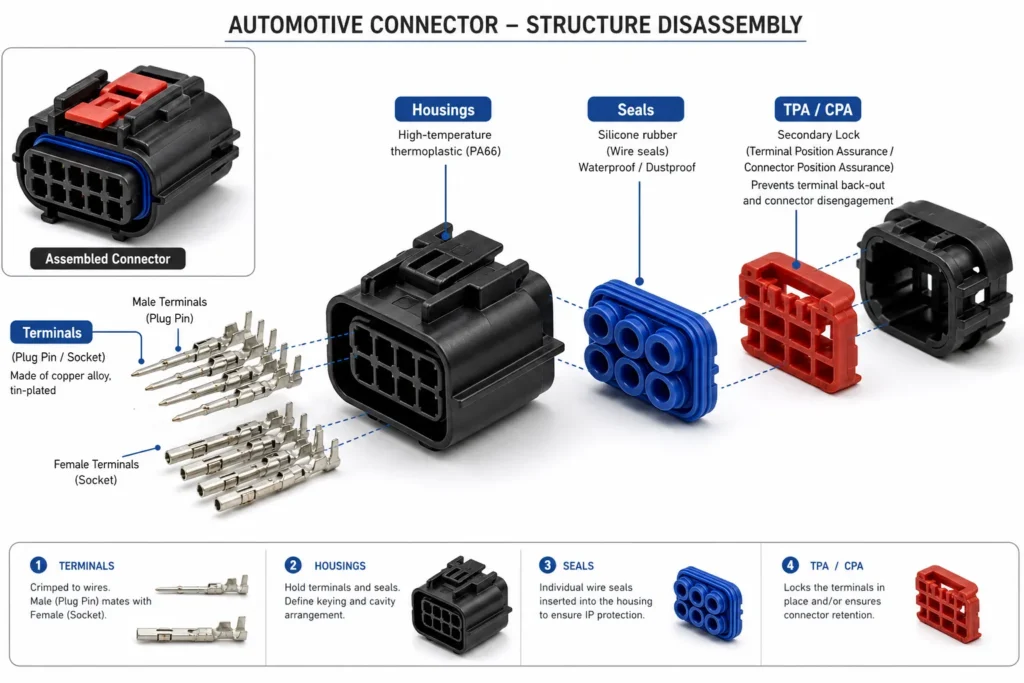
Four elements in combination create an automotive connector that is dependable. They are:
- Terminals (pins or sockets) carry the circuit current or signal. Select the specified contact material, plating, wire range and crimp method as a system.
- Housings locate and retain the contacts and provide the defined mating geometry and insulation arrangement.
- Seals and gaskets limit ingress only within the documented assembly. Wire diameter, unused cavities, accessories and the mating state affect that configuration.
- Locking and assurance features support terminal seating and connector retention. Their presence does not replace the specified assembly checks.
TPA and CPA do different jobs. Terminal Position Assurance supports correct contact installation. Connector Position Assurance supports correct assembly and helps guard against accidental unmating. TE’s NTSEAL documentation describes both features. Their operating sequence and retention limits must still come from the selected connector’s application instructions.
How are automotive connector types classified?
The extensive variety of wire connectors available in the automotive ecosystem can be confusing. Having a clear awareness of how to categorize wire connectors can assist in simplifying the task of navigating through them.
Below, you will find an overview of the primary categories of automotive connectors used by today’s automobiles.
| Classification Dimension | Main Automotive Connector Types | Typical Automotive Applications |
|---|---|---|
| Connection Method | Wire-to-Wire (W2W), Wire-to-Board (W2B), Board-to-Board (B2B) | Wire harness joints, ECU modules, compact sensor arrays |
| Environmental Sealing | Sealed connectors with specified test scope vs. unsealed connectors | Engine bay, chassis, exterior lighting vs. in-cabin infotainment |
| Functional Domain | Low-Voltage Signal, High-Voltage (HV) Power, High-Speed RF | Body controls, EV power circuits, cameras and radar interfaces |
How do power and data requirements change connector selection?
Review voltage class, current load, channel requirements and packaging for the actual vehicle architecture. A calendar year is not a technical specification, and a design used in one vehicle programme is not evidence of suitability in another.
What changes when the vehicle circuit is high voltage?
For a high-voltage circuit, specify the operating and transient conditions, insulation distances, touch protection, service isolation, cable size and any interlock or shielding requirements. An HVIL can support detection of an open interface, but it is not a substitute for the approved de-energization procedure. Do not transfer a low-voltage test claim to the high-voltage connector.
What must be verified for camera, radar and data connections?
FAKRA, HSD and automotive Ethernet interfaces serve different channel requirements. Confirm protocol, pinout, impedance, shielding and the complete cable-to-device path. The interface name alone does not prove data rate or signal performance, and the connector is only one part of the channel.
How does limited installation space affect the interface?
As automobiles continue to add more electronic systems, space in the vehicles themselves is becoming a premium. To accommodate these expanding electronic systems, today’s automotive connector types need to provide a very compact footprint while allowing for high ampere capacity. This is especially important in ECUs and battery management systems where modules are densely packaged.
Can a connector approved in another industry be used in a vehicle?
Not solely because it handles a similar voltage or exposure. A solar, storage or industrial connector may suggest useful construction choices, but vehicle installation adds its own vibration, fluid, temperature, packaging and service requirements. Reuse is conditional on the exact connector and the applicable programme evidence, not on the industries appearing together in a brochure.
The same limitation applies to a manufacturer’s experience. A supplier’s broader product range is a reason to investigate its documentation, not proof that every part has automotive approval.
Which requirements change between vehicle zones?
The specific environment in which automotive connectors will be used determines which types of automotive connectors to select. Below are some examples of ways that engineers solve specific vehicle zones:
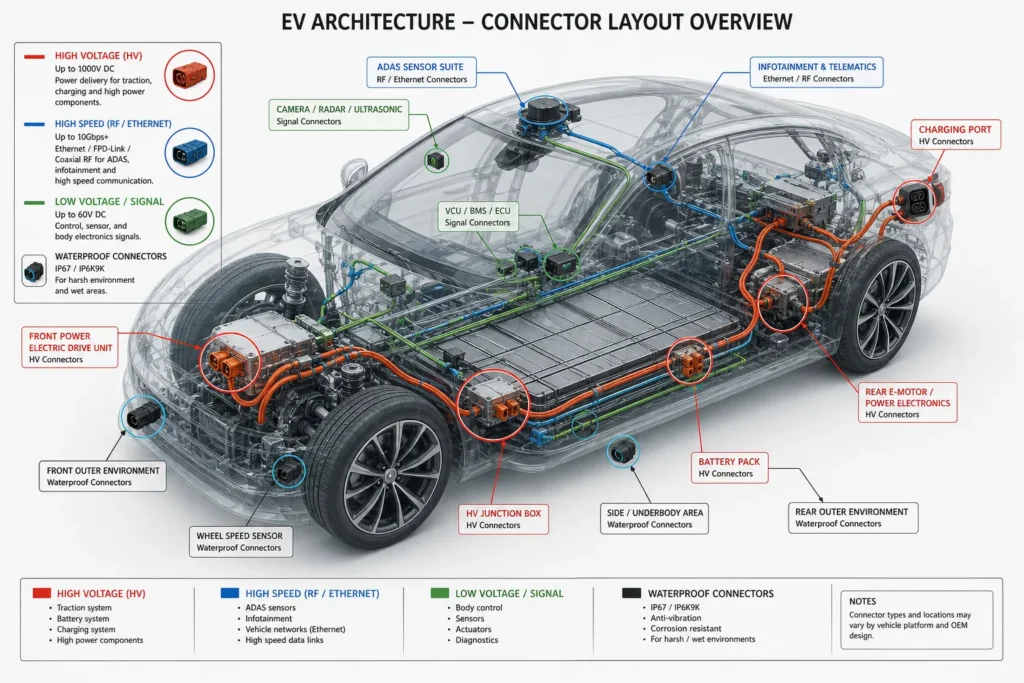
What does an engine-bay or chassis connection need?
Define the measured or specified temperature exposure, vibration, road contamination, fluid contact and washing conditions. Select the complete housing, terminals, wire seals, cavity plugs and accessories for that envelope. Do not assume that every engine-bay location reaches the same temperature or requires the same spray test.
What does an EV powertrain connection need?
Define the voltage class, continuous and peak current, cable geometry, EMC requirements and service isolation process. Touch protection, shielding and interlock features should be specified where required by the system. Their performance must be evaluated in the actual connector and installation rather than inferred from a feature name.
EMC is a system requirement. Check the intended shield path across the connector, cable, mounting and equipment. A shielding label does not demonstrate that the installed system meets its emission or immunity requirements.
What does a cockpit or infotainment connection need?
Check board space, return paths, crosstalk, channel loss and the route available for assembly or service. A compact board-to-board connector may suit an internal module, while a cable interface may be needed between separately mounted units. Validate the selected layout rather than assuming the smaller part is preferable.
How should connector cost be compared beyond unit price?
Compare total installed cost only after the requirement sheet is fixed. Include mating components, contacts, seals, tooling, assembly, inspection, qualification and replacement access. Higher ratings can be necessary, but specifying the most demanding connector everywhere can add cost without addressing the actual installation. Cost reduction must not remove required safety or validation evidence.
When is a custom connector worth considering?
Consider customization when a documented requirement cannot be met by an available standard system. First compare the cost of modifying packaging or routing with the cost of new tooling, qualification, service inventory and change control. A custom part is not automatically more reliable or less expensive than an off-the-shelf system.
What records distinguish process control from product qualification?
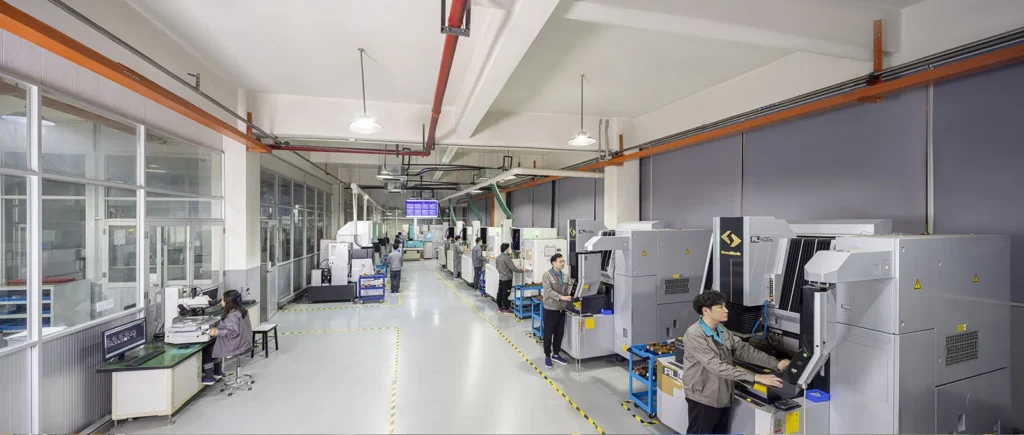
Separate organizational quality-system evidence from product qualification. A quality-management certificate concerns a defined organization and scope; it does not certify every connector or replace the programme test record. Request drawing control, lot traceability, inspection records, nonconformance handling and the exact qualification report. Digital production claims should be supported by records, not used as a promise of zero defects.
What should be verified before releasing the connector?
Use a release checklist that connects each requirement to the quoted configuration and its evidence:
- Electrical Specs: Verify operating voltage, rated current, and ensure accurate ambient temperature derating curves.
- Mechanical & Environmental: Validate auto connector waterproofing according to stated IP Ratings (such as: IP67/IP68/IP69K). Confirm specified insertion/extraction force(s) to the use of the blind-mate per manufacturer requirements.
- Testing and compliance: identify applicable connector, vehicle and material requirements separately. Record the method, revision, tested configuration and acceptance result; naming USCAR, LV214 or RoHS does not establish conformance.
Specify the exact ingress test. IEC 60529 classifies enclosure protection. Record the actual test standard, water exposure and assembly state; do not collapse immersion and high-pressure washing into one generic “waterproof” claim.
What belongs in the controlled interface record?
Store the connector and mating-part numbers, terminal and wire selections, seals, keying, assembly instructions, inspection criteria and approved revisions together. A replacement decision should be traceable to this record. Comparing automotive connector suppliers is useful only after the required configuration and evidence are defined.
How can a supplier inquiry be made specific enough to evaluate?
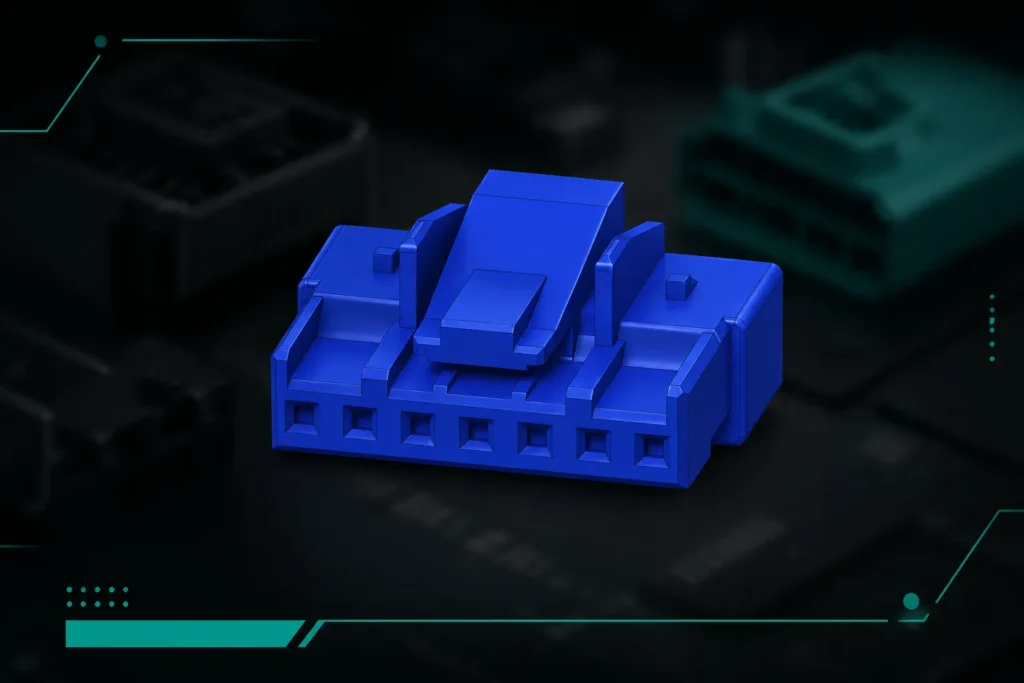
A useful inquiry includes drawings, mating-part references, the vehicle zone, circuit duty, wire and seal details, volumes and the required qualification records. ZUCH’s connector catalogue can help identify a component category. Ask for the exact proposed part and its supporting documents rather than interpreting a product category as approval for a finished harness.
For samples, define which checks the sample will support and which remain part of the vehicle programme. A sample that mates successfully is not a substitute for qualification or a basis for an unrestricted equivalence claim.
How can a replacement automotive connector be identified?
Record more than the housing colour or cavity count. If a moulded identifier is present, compare it with the manufacturer’s drawing and vehicle repair information. If it is missing, collect measurements and photographs of the mating face, lock and wire entry without assigning a part number by guesswork.
| Identification step | What to record | What it prevents |
|---|---|---|
| Housing and keying | Cavity arrangement, polarization, latch and mating half | Buying a same-count housing with the wrong interface |
| Contact system | Terminal family, wire range, plating and crimp specification | Choosing a terminal that fits loosely or cannot be retained |
| Sealing components | Wire-seal size, unused-cavity plugs and required accessories | Assuming a housing alone recreates the sealed system |
| Assembly and repair | TPA/CPA sequence, extraction tool and replacement restrictions | Damaging retention features during repinning |
TE’s NTSEAL example is instructive: its stated sealing levels require the relevant backshell, and unused cavities need specified plugs. This is evidence for that system, not a universal backshell requirement or a rating for ZUCH products.
Which USCAR2 revision and scope should be used in 2026?
SAE lists USCAR2-9 as current, revised on 6 December 2024; revisions 7 and 8 are historical. Its public scope covers specified road-vehicle electrical terminals and connection systems at 0–60 VDC or coaxial, with incomplete mechanical specifications for jacketed twisted-pair connectors. It excludes several other interfaces and circuits above 60 VAC or DC. Therefore, a USCAR2 statement cannot be transferred to an EV high-voltage connector without the appropriate separate requirements.
The SAE page also requires conformance to applicable requirements to be verified and documented before a part is represented as meeting the specification. Request the exact revision, sample construction, applicable test matrix, acceptance criteria and DVP&R. The publicly accessible scope is not the full standard; this article does not claim to reproduce its normative test clauses.
What should trigger a new review after an approved connector changes?
A new housing, contact finish, seal, wire construction, cable diameter or mating counterpart can change the approved configuration. Ask the supplier to identify the affected drawing and qualification evidence. Decide which checks or requalification are needed through the programme’s change-control process rather than assuming that an unchanged series name preserves approval. IEC 60512-1:2018 similarly ties test methods to detail specifications and their required severities and performance limits.
Frequently asked questions
How can an unknown automotive connector be identified?
Record the moulded number if present, cavity arrangement, keying, latch, contact family, seal layout, wire range and mating part. Compare the evidence with the supplier drawing and vehicle repair information. Housing colour or pin count alone cannot establish the replacement.
What is the difference between TPA and CPA?
TPA means Terminal Position Assurance and supports correct contact installation. CPA means Connector Position Assurance and supports correct assembly and resistance to accidental unmating. Their geometry and operating sequence are specific to the connector system and do not replace assembly inspection.
Can a sealed automotive connector be used with empty cavities?
Only with the configuration allowed by the product documentation. Unused cavities may require specified sealing plugs, and other accessories may be needed for the claimed ingress rating. Confirm the wire range, seals and mating state as well as the housing.
Does USCAR2 qualification cover EV high-voltage connectors?
Not on the basis of USCAR2-9 alone. Its published scope covers defined low-voltage 0–60 VDC or coaxial road-vehicle connection systems and excludes circuits above 60 VAC or DC. High-voltage parts need the separate requirements and evidence applicable to their vehicle circuit.
Can an IP67 connector be assumed suitable for engine-bay washing?
No. Temporary immersion and washing are different exposures. Verify the required test standard and exact assembly, then assess temperature, fluid contact, vibration, wire sealing and service conditions. An IP label is not a complete engine-bay approval.
Does a supplier's quality-system certificate qualify every automotive connector?
No. Organizational process evidence and product qualification answer different questions. Request the exact connector configuration, applicable test requirements, documented results and controlled revisions. Check certificate scope separately, and do not treat certification as a guarantee of absolute safety.
References
- SAE/USCAR2-9 — Automotive Electrical Connector Systems, revised 6 December 2024
- TE Connectivity — NTSEAL Connector FAQs: TPA, CPA and Sealing Configuration
- IEC 60529:1989+AMD1:1999+AMD2:2013 CSV — Degrees of Protection Provided by Enclosures
- IEC 60512-1:2018 — Connectors: Tests and Measurements, Generic Specification
Conclusion
An automotive connector should be selected as a complete connection system for a defined vehicle circuit and zone. Identify the housing and mating half first, then confirm contacts, wires, seals, keying and the assembly procedure. Compare documented performance against the real exposure rather than selecting the highest-looking IP label or copying another programme’s part number. For low-voltage systems, check the current USCAR2 revision and its scope; high-voltage circuits require their own applicable evidence and service controls. Supplier changes also need a review of the affected configuration. ZUCH can be considered during component discovery, with the final decision tied to the quoted drawings, qualification records and the vehicle programme’s approval process.