Lighting Connectors Guide: How to Choose the Right Wire Connectors for Ceiling Lights, Fixtures & Landscape Lighting Projects
Lighting Connectors Guide: How to Choose the Right Wire Connectors for Ceiling Lights, Fixtures & Landscape Lighting Projects
With the rapid development of LED lighting, smart lighting, and modular electrical systems, lighting connectors have become increasingly important components in modern lighting applications. From residential ceiling lamps to commercial LED fixtures and outdoor landscape lighting systems, reliable connection solutions directly influence electrical safety, installation efficiency, and product lifespan. For a related technical reference, see Guide to High Current DC Connectors for Modern Applications.
Unlike traditional wiring methods that often require complicated manual operations, modern LED lighting connectors provide faster installation, improved connection stability, and better system flexibility. For lighting manufacturers, electrical contractors, distributors, and OEM buyers, selecting the right lighting connector system is essential for reducing installation costs and ensuring long-term reliability.
A professional lighting wire connector system is not simply a wiring accessory. It integrates conductive contacts, insulation structures, mechanical locking designs, and environmental protection features to create a safe and efficient electrical connection solution.
Conductive Contacts: Metallic contact elements that transfer electrical current between connected components.
What Are Lighting Connectors and How Do They Work?
Lighting connectors are electrical components designed to connect wires, lighting fixtures, and power supply systems safely and efficiently. Their primary function is to provide reliable electrical continuity while maintaining mechanical stability and insulation protection.
A typical lighting connector consists of several key components:
-
Conductive contacts: Transfer electrical current with minimal energy loss.
-
Housing structure: Provides insulation and mechanical protection.
-
Locking mechanism: Prevents accidental disconnection.
-
Wire retention system: Ensures stable wire positioning.
In modern lighting applications, connector performance is usually evaluated through key parameters such as:
Compared with traditional wire connection methods, connector-based systems provide a more standardized approach for lighting assembly and maintenance, making them widely adopted in LED lighting manufacturing and large-scale installation projects.
Contact Resistance: The electrical resistance at the contact interface between two conductive surfaces.
Why Are Lighting Connector Systems Replacing Traditional Wiring Methods?
As lighting projects become more complex, traditional wiring methods face several challenges, including longer installation time, inconsistent connection quality, and difficult maintenance.
Modern lighting connector systems address these challenges by providing faster assembly, improved reliability, and greater design flexibility.
| Traditional Wiring |
Modern Lighting Connector System |
| Requires manual wire twisting or complex termination |
Enables faster plug-and-play installation |
| Connection quality depends heavily on installer experience |
Provides standardized connection performance |
| Difficult troubleshooting and replacement |
Supports easier maintenance |
| Less suitable for automated production |
Ideal for OEM and mass production |
How connector choice affects installation and service time
For commercial buildings, residential developments, and large lighting projects, installation efficiency is a major consideration.
Quick connection solutions, such as quick wire connectors and push-in connectors, allow installers to complete wiring operations faster while reducing installation errors. This is especially valuable in projects where hundreds or thousands of lighting points must be installed.
For lighting manufacturers, using standardized connectors can also improve production efficiency by simplifying assembly processes and supporting automated manufacturing.
How to prevent loose lighting connections and exposed conductors
A lighting system depends heavily on the quality of its electrical connections. Poor connections may lead to:
-
Increased contact resistance
-
Excessive heat generation
-
Voltage loss
-
Intermittent lighting failures
High-quality LED lighting connectors use optimized conductive materials and spring contact technology to maintain stable electrical performance during long-term operation.
Low contact resistance is particularly important because it helps minimize energy loss and prevents unnecessary heat accumulation inside the connector.
How to plan maintenance access and fixture replacement
Modern lighting systems increasingly require flexibility, especially with the growth of smart lighting and modular designs.
A modular lighting connector system allows technicians to replace lighting components without completely rewiring the installation. This reduces maintenance time and improves system scalability.
Applications include:
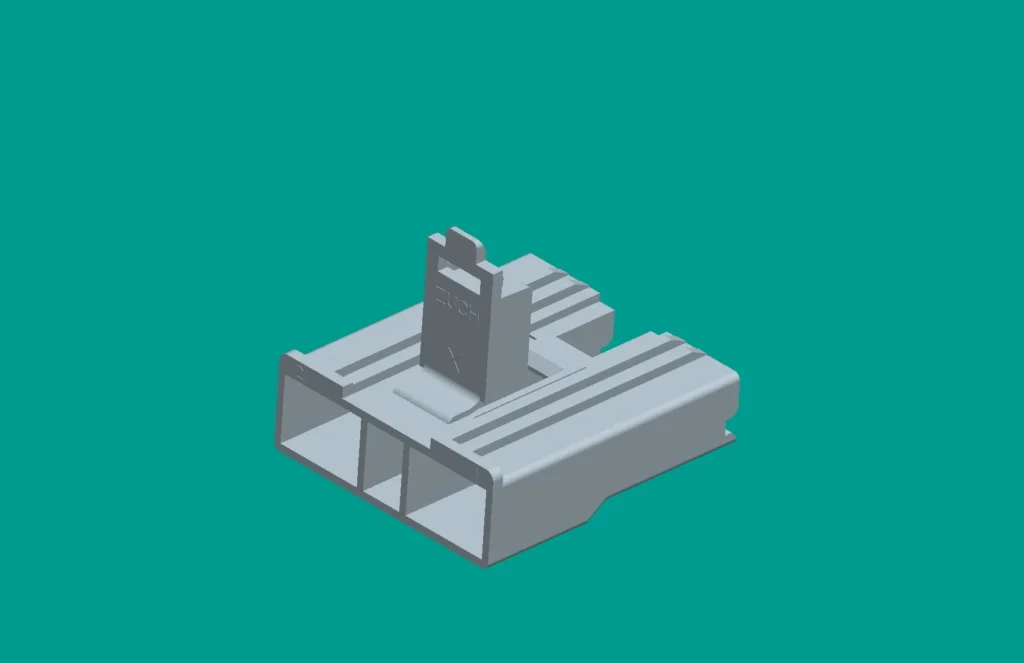
Types of Lighting Connectors for Different Applications
Different lighting applications require different connector structures. Choosing the correct connector depends on installation environment, electrical requirements, and expected service conditions.
| Application |
Recommended Connector Features |
Typical Uses |
| Ceiling Lighting |
Compact size, easy installation, reliable contact |
Ceiling lamps, pendant lights, LED panels |
| LED Fixtures |
Stable current transmission, assembly efficiency |
Commercial and residential fixtures |
| Landscape Lighting |
Waterproof protection, weather resistance |
Gardens, pathways, outdoor lighting |
| Industrial Lighting |
High durability, strong electrical performance |
Warehouses and factories |
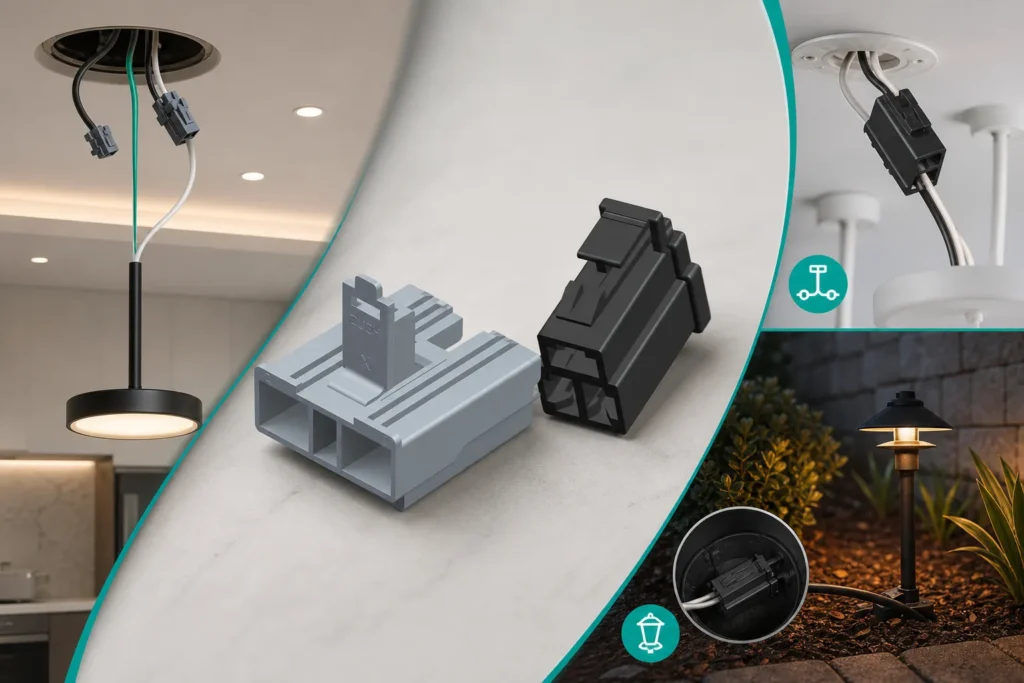
Ceiling Light Connectors for Residential and Commercial Lighting
Ceiling light connectors are among the most common lighting connection solutions used in residential and commercial environments.
Also known as ceiling lamp connectors, LED ceiling light connectors, or wire connectors for ceiling lights, these products are designed to provide safe and convenient connections between ceiling fixtures and electrical wiring systems.
Common applications include:
When selecting a connector for ceiling light, buyers should consider:
Compact Installation Design
Ceiling spaces are often limited, so connectors should have a compact structure that allows easy installation in junction boxes or fixture housings.
Wire Compatibility
A high-quality ceiling light connector should support different wire sizes while maintaining secure mechanical retention.
Electrical Safety
Flame-retardant housing materials and reliable contact structures help reduce the risk of overheating or connection failure.
For electricians and contractors, quick-install ceiling light connectors can significantly improve installation efficiency while maintaining connection reliability.
Light Fixture Connectors for LED Lighting Systems
A light fixture connector is designed to create a stable electrical connection between wiring systems and lighting components.
With the increasing adoption of LED technology, LED fixture connectors have become essential components in:
A reliable lighting fixture connector should provide:
| Performance Requirement |
Importance |
| Low contact resistance |
Reduces energy loss and heat generation |
| Strong mechanical retention |
Prevents accidental disconnection |
| Temperature resistance |
Supports LED operating environments |
| Easy assembly |
Improves production efficiency |
Note:For OEM lighting manufacturers, connector selection directly affects product reliability, assembly time, and customer satisfaction.
Landscape Lighting Connectors for Outdoor Applications
Outdoor lighting environments create additional challenges because connectors are exposed to moisture, dust, UV radiation, and temperature fluctuations.
The best landscape lighting connectors are designed with environmental protection features such as:
-
Waterproof sealing structures
-
UV-resistant materials
-
Corrosion-resistant terminals
-
Weather-resistant housings
Common applications include:
For low-voltage outdoor systems, low voltage landscape lighting connectors are widely used because they provide convenient installation while maintaining reliable electrical performance.
When selecting outdoor connectors, buyers should pay particular attention to:
A properly designed waterproof lighting connector helps prevent moisture intrusion and extends the service life of outdoor lighting systems.
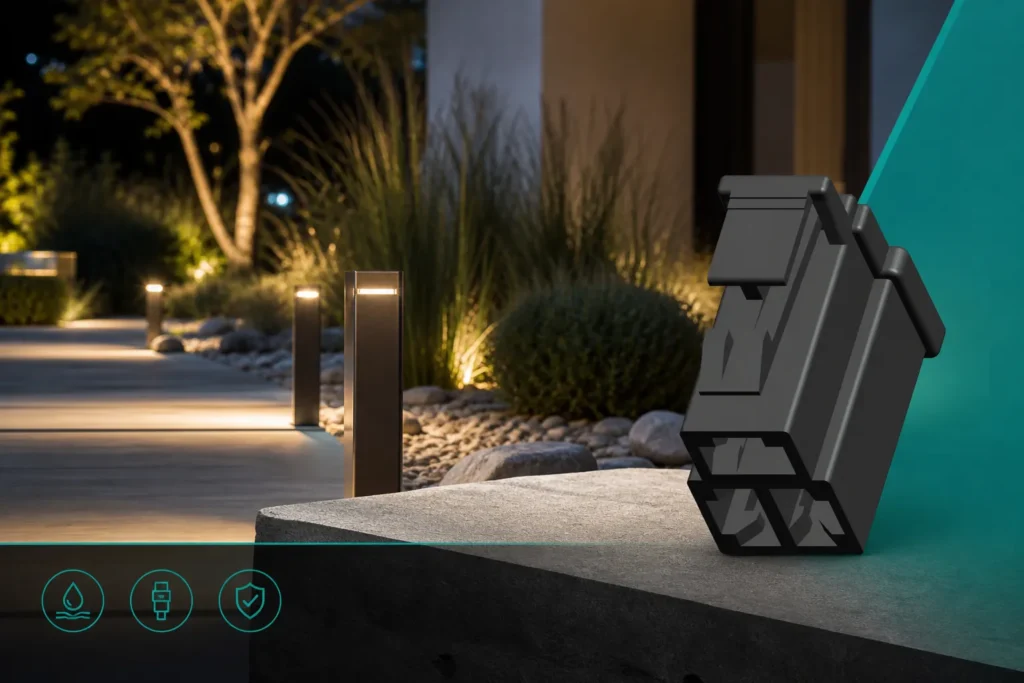
LED Wire Connectors: The Key to Efficient Lighting Installation
LED wire connectors are widely used in modern lighting systems because LED applications often require compact, efficient, and flexible connection solutions.
Compared with traditional wiring methods, LED connectors provide advantages including:
Common LED connector types include:
For lighting manufacturers and installers, selecting the correct LED wire connector helps optimize both product design and installation efficiency.
How to Choose the Right Lighting Connectors: A Buyer’s Selection Guide
Choosing the right lighting connectors requires more than comparing product prices. For lighting manufacturers, distributors, and engineering contractors, connector selection directly affects electrical safety, installation efficiency, and long-term system reliability.
A suitable connector should match the application requirements, including electrical parameters, environmental conditions, installation methods, and certification standards.
When selecting a lighting connector system, professional buyers should evaluate the following factors:
| Selection Factor |
Why It Matters |
| Voltage Rating |
Ensures the connector can safely operate under the designed voltage |
| Current Rating |
Prevents overheating caused by excessive electrical load |
| Wire Compatibility |
Ensures secure mechanical and electrical connection |
| Contact Resistance |
Affects energy efficiency and heat generation |
| Material Quality |
Determines durability and long-term reliability |
| Temperature Resistance |
Ensures stable operation in different environments |
| IP Protection Rating |
Required for outdoor and moisture-exposed applications |
| Certification Compliance |
Supports regional safety and market requirements |
Voltage Rating and Current Capacity: The Foundation of Connector Selection
The electrical performance of a connector is one of the most important selection criteria.
Voltage Rating
The voltage rating indicates the maximum voltage a connector can safely withstand during operation. Selecting a connector with an insufficient voltage rating may create safety risks and reduce product reliability.
Current Rating
The current rating represents the maximum continuous current capacity of the connector.
If the actual current exceeds the connector’s rated capacity, excessive heat may occur due to increased electrical resistance.
For LED lighting systems, proper current matching helps maintain:
-
Stable brightness output
-
Lower energy loss
-
Reduced thermal stress
-
Longer service life
Professional lighting connector manufacturers usually provide detailed electrical specifications to help customers select suitable products.
Wire Compatibility: Ensuring Secure and Reliable Connections
Different lighting applications may use different wire sizes, insulation materials, and cable structures.
A high-quality wire connector for light fixtures should provide:
Poor wire matching may result in:
For OEM lighting manufacturers, connector compatibility is especially important because production lines require consistent assembly performance.
Push-In vs Screw vs Waterproof Lighting Connectors: Which Technology Is Better?
Different connector technologies serve different lighting applications. Understanding their advantages helps buyers select the most suitable solution.
| Connector Type |
Key Features |
Best Applications |
| Push-In Connector |
Tool-free installation, fast connection |
LED lighting, residential projects, mass assembly |
| Screw Terminal Connector |
Strong mechanical fixation |
Traditional electrical systems |
| Waterproof Connector |
Environmental sealing protection |
Outdoor and landscape lighting |
Push-In Wire Connectors: Fast and Efficient Installation
Push-in wire connectors use spring contact technology to secure wires without additional tools.
They are increasingly popular in LED lighting applications because they offer:
-
Faster installation speed
-
Reduced assembly complexity
-
Consistent connection quality
-
Lower labor requirements
For large-scale lighting projects, push-in connectors can significantly improve installation efficiency.
They are commonly used in:
Screw Terminal Connectors: Traditional but Reliable Connection Solutions
Screw terminal connectors use mechanical tightening to secure wires and create electrical contact.
Their advantages include:
-
Strong mechanical holding force
-
Familiar installation method
-
Good stability in traditional electrical systems
However, compared with push-in connectors, screw-based solutions may require more installation time and manual operation.
They are often selected for applications where mechanical fixation is a priority.
Waterproof Lighting Connectors: Essential for Outdoor Applications
Outdoor lighting requires additional protection against environmental conditions.
Waterproof lighting connectors are designed to prevent water and moisture penetration while maintaining electrical performance.
Typical features include:
-
Sealed connector housing
-
Waterproof gasket structures
-
Corrosion-resistant materials
-
UV-resistant external components
They are widely used in:
-
Landscape lighting connectors
-
Garden lighting systems
-
Outdoor architectural lighting
-
Low-voltage outdoor lighting
For outdoor applications, choosing the correct waterproof connector can significantly reduce maintenance costs and improve system reliability.
Common Lighting Connector Problems and How to Prevent Them
Even a small connector failure can affect the performance of an entire lighting system. Understanding common failure modes helps buyers make better purchasing decisions.
| Common Problem |
Main Cause |
Prevention Method |
| Loose Connection |
Poor contact structure or improper wire installation |
Choose connectors with reliable contact mechanisms |
| Overheating |
Excessive current or high contact resistance |
Select connectors with suitable electrical ratings |
| Water Leakage |
Poor sealing performance |
Use appropriate waterproof connectors |
| Wire Damage |
Insufficient strain relief |
Select connectors with proper wire protection |
| Signal or Power Interruption |
Unstable electrical contact |
Use high-quality conductive materials |
Strain Relief: A structural feature that protects wires from mechanical stress and prevents cable damage.
Why Contact Resistance Matters in Lighting Connectors
Contact resistance is one of the key technical indicators affecting connector performance.
When electrical current passes through a connection point with high resistance, additional heat is generated.
High contact resistance may lead to:
Professional LED lighting connectors use optimized contact materials and precision manufacturing processes to maintain stable electrical performance.
Common approaches include:
Understanding IP Ratings for Waterproof Lighting Connectors
For outdoor lighting applications, environmental protection is critical.
The IP (Ingress Protection) rating is an internationally recognized system used to classify protection against dust and water.
| IP Rating |
Protection Level |
Typical Lighting Applications |
| IP44 |
Protection against splashing water |
Indoor or covered lighting areas |
| IP65 |
Dust-tight and water jet resistant |
Outdoor wall lights and landscape lighting |
| IP67 |
Dust-tight and temporary immersion protection |
Outdoor lighting systems |
| IP68 |
Continuous immersion protection under defined conditions |
Extreme outdoor environments |
For landscape lighting connectors, IP65, IP67, and IP68 rated solutions are commonly considered depending on installation conditions.
Lighting Connector Certifications: What Should Buyers Look For?
For global lighting markets, certification compliance is an important factor when selecting suppliers.
UL Certification
UL certification verifies that products meet recognized safety requirements established by Underwriters Laboratories.
It is especially important for products entering North American markets.
CE Certification
CE certification indicates that products comply with applicable European Union safety, health, and environmental requirements.
RoHS Compliance
RoHS compliance restricts the use of certain hazardous substances in electrical and electronic products.
For international lighting projects, certified connector products help simplify market entry and improve customer confidence.
Indoor vs Outdoor Lighting Connectors: Understanding Application Differences
Selecting connectors according to application conditions is essential.
| Feature |
Indoor Lighting Connectors |
Outdoor Lighting Connectors |
| Environment |
Dry and controlled conditions |
Moisture, sunlight, temperature changes |
| Main Requirement |
Compact design and easy installation |
Waterproof and weather-resistant performance |
| Material Focus |
Electrical efficiency |
UV and corrosion resistance |
| Common Applications |
Ceiling lights, LED fixtures |
Landscape and architectural lighting |
Using indoor connectors in outdoor environments may result in premature failure due to moisture and environmental exposure.
Which lighting connector trends are practical for buyers
The lighting industry is moving toward smarter, more efficient, and more flexible connection solutions.
Miniaturization and Space-Saving Design
Modern lighting products require smaller components without sacrificing electrical performance.
Compact connector designs help manufacturers create:
Tool-Free Installation
As labor costs increase, tool-free connector designs are becoming increasingly important.
Quick installation helps:
Higher Reliability Requirements
With the development of smart lighting and connected systems, lighting connectors must provide stable performance over longer operating periods.
Future connector solutions will increasingly focus on:
-
Better contact reliability
-
Improved environmental protection
-
Intelligent manufacturing processes
OEM Lighting Connectors and Custom Connection Solutions for Global Buyers
For lighting manufacturers, distributors, and project suppliers, standard connector products may not always meet specific application requirements. Different lighting designs may require customized structures, wire configurations, terminal arrangements, or packaging solutions.
Therefore, choosing a supplier with OEM lighting connectors and custom lighting connector capabilities can provide significant advantages in product development and market competitiveness.
A professional connector manufacturer should be able to support the complete development process, including:
Why OEM Buyers Need Customized Lighting Connectors
Different lighting applications have different technical requirements.
For example:
-
Residential ceiling lighting may require compact ceiling light connectors with easy installation.
-
Commercial LED systems may require high-cycle connectors with stable electrical performance.
-
Outdoor lighting projects may require waterproof lighting connectors with enhanced environmental protection.
A customized connector solution allows manufacturers to optimize:
| Customization Area |
Benefits |
| Connector Structure |
Better product integration and space utilization |
| Terminal Design |
Improved electrical performance |
| Wire Configuration |
Easier installation and assembly |
| Material Selection |
Enhanced durability and reliability |
| Packaging Solution |
Better logistics and brand presentation |
How to Select a Reliable Lighting Connector Supplier?
Choosing the right lighting connector supplier is a critical decision for ensuring consistent quality, stable supply, and long-term business cooperation.
A reliable supplier should provide more than products. They should offer engineering support, manufacturing capability, quality assurance, and customized solutions.
1. Evaluate Manufacturing Experience and Industry Expertise
Connector manufacturing requires deep knowledge of electrical design, materials, precision manufacturing, and reliability testing.
An experienced lighting connector manufacturer can better understand application requirements and provide optimized solutions for different lighting environments.
A supplier with long-term industry experience usually has stronger capabilities in:
-
Connector structure design
-
Contact system optimization
-
Material engineering
-
Production process control
With decades of experience in connector technology, ZHCH has been dedicated to connector research, development, and manufacturing since 1994. The company has developed professional connection solutions for multiple industries and continues to provide reliable products for global customers.
2. Check Quality Control and Certification Capabilities
Lighting connectors directly affect electrical safety and product reliability. Therefore, buyers should evaluate the supplier’s quality management system and testing capability.
Important factors include:
A professional supplier should have the ability to verify connector performance under different operating conditions.
ZHCH has established a CNAS and UL certified witness laboratory and has passed internationally recognized quality management certifications such as IATF16949, supporting strict quality control throughout product development and manufacturing.
3. Consider R&D Capability and Customization Support
For OEM customers, technical innovation and customization capability are important factors when selecting a connector partner.
A strong supplier should provide:
ZHCH has established an integrated R&D and innovation system with more than 100 R&D personnel and obtained over 150 authorized patents, helping customers solve complex connection challenges through continuous innovation.
4. Review Manufacturing Capacity and Supply Stability
For wholesale buyers and international distributors, stable production capability is essential.
A reliable manufacturer should have:
-
Advanced production equipment
-
Efficient manufacturing processes
-
Consistent quality control
-
Stable delivery capability
Modern connector production increasingly relies on digital manufacturing technologies to improve efficiency and consistency.
ZHCH has developed a digital intelligent factory with high equipment connectivity and end-to-end data integration, enabling lean manufacturing based on real-time production data.
5. Choose a Supplier Focused on Long-Term Partnership
The best connector suppliers act as technical partners rather than simple component providers.
Long-term cooperation requires:
-
Responsive technical support
-
Continuous product improvement
-
Stable supply chain management
-
Understanding of customer application needs
ZHCH has established long-term cooperation with many well-known enterprises across different industries and continues to provide global customers with reliable connector products and professional connection system solutions.
What to verify before choosing a newer lighting connector
The lighting industry is continuously evolving with the growth of smart homes, energy-efficient systems, and intelligent manufacturing.
Future lighting connector systems are expected to focus on several key trends.
Smart Lighting Integration
Smart lighting systems increasingly connect with:
This development requires connectors with better flexibility, reliability, and compatibility.
Modular and Plug-and-Play Lighting Systems
Modular designs are becoming more popular because they simplify:
-
Installation
-
Maintenance
-
System upgrades
Plug-and-play connector solutions help reduce installation complexity and improve user experience.
Sustainable and Long-Life Connection Solutions
As sustainability becomes increasingly important, lighting manufacturers are focusing on products with:
Reliable connectors contribute to the overall lifecycle performance of lighting systems.
A pre-installation check that prevents the most common lighting connector problems
Search results for lighting connector installation repeatedly surface the same practical concerns: correct strip length, secure contact, strain relief, corrosion exposure, and the difference between an indoor splice and an outdoor connection. These are not interchangeable details. A connector should be approved against the fixture, conductor, enclosure, and environment as one connection system.
| Check before ordering |
What to confirm |
Why it matters |
| Electrical boundary |
System voltage, expected load, conductor size and allowable temperature |
A catalogue family is not proof that every configuration is suitable |
| Mechanical fit |
Wire entry, insulation support, mating clearance and available service space |
A connector that fits the drawing may still be difficult to install or inspect |
| Environment |
Indoor/outdoor location, water exposure, UV, chemicals and corrosion risk |
Sealing and material choices must match the actual installation |
| Workmanship |
Strip length, insertion check, retention check and any approved tool |
Loose or over-stripped conductors can create flicker, heat or rework |
For outdoor or landscape projects, treat the connector location as part of the enclosure design. Keep the joint away from standing water where the installation allows, follow the connector maker’s preparation instructions, and verify that the cable jacket and connector entry are compatible. For indoor fixtures, service access and a repeatable installation method usually matter more than choosing the smallest housing.
The practical selection question is therefore not “Which connector is fastest?” It is “Which connector gives this crew a repeatable, inspectable connection under the real voltage, wire and environmental conditions?”
Component certification is not the same as luminaire approval
A connector or terminal may have a defined component certification scope, while the complete light fixture is evaluated under its own luminaire requirements. For a ceiling, LED or landscape project, keep the connector datasheet, the fixture/driver requirements and the installation environment in the same review. IEC 60598-1 and the applicable UL lighting requirements are verification routes, not blanket approval for every connector configuration.
Lighting connector questions buyers ask before installation
How do I choose a lighting connector for an outdoor location?
Start with the actual voltage, conductor, enclosure and exposure. Confirm the connector’s sealing and material guidance, then verify the installation method and service access; an indoor splice connector should not be treated as an outdoor system by appearance alone.
Can a lighting connector solve flickering caused by a loose wire?
It can only help when the connector and preparation method match the wire and the connection is fully seated. Inspect strip length, conductor insertion, retention and strain relief before replacing parts, because a new housing does not correct an uncontrolled installation.
What should an OEM specify for a custom lighting connector?
Specify the mating interface, wire range, voltage/current boundary, environmental exposure, keying, installation method, validation evidence, labeling and change-control expectations. Keep application-specific limits in the controlled drawing or specification.
Are waterproof lighting connectors automatically suitable for every landscape project?
No. “Waterproof” is not a universal approval. Confirm the applicable enclosure test scope, cable entry, installation orientation, chemical/UV exposure and maintenance plan for the actual location.
1. What are lighting connectors and how do they work?
Lighting connectors are electrical components used to connect wires, lighting fixtures, and power systems. They create a secure electrical path while providing insulation and mechanical protection.
2. What is the best connector for ceiling lights?
The best ceiling light connector depends on the lighting design, wire type, current requirements, and installation environment. Compact quick-connect solutions are commonly used for residential and commercial ceiling lighting.
3. Can I use wire connectors for ceiling lights instead of traditional wiring?
Yes. Modern wire connectors for ceiling lights can replace many traditional wiring methods by providing faster installation, improved consistency, and safer electrical connections.
4. What type of connector is suitable for LED light fixtures?
For LED applications, LED fixture connectors should provide low contact resistance, stable current transmission, and compatibility with the fixture design. Push-in and modular connectors are commonly used in LED lighting systems.
5. Are waterproof lighting connectors necessary for outdoor lighting?
Yes. Outdoor environments expose connectors to moisture, rain, dust, and temperature changes. Waterproof lighting connectors help protect electrical connections and improve long-term reliability.
6. What are the best landscape lighting connectors for outdoor projects?
The best landscape lighting connectors should provide waterproof protection, corrosion resistance, UV resistance, and reliable electrical performance. Low-voltage landscape lighting connectors are commonly used in gardens and outdoor applications.
7. Can lighting connectors be customized for OEM projects?
Yes. Many professional lighting connector manufacturers provide OEM and custom solutions, including connector structures, wire configurations, materials, and packaging designs.
8. How do I choose a reliable lighting connector supplier?
A reliable supplier should have manufacturing experience, quality certifications, testing capabilities, customization support, and stable production capacity. Working with an experienced manufacturer helps ensure consistent quality and long-term supply reliability.
Lighting connectors are essential components that influence the safety, efficiency, and durability of modern lighting systems. Whether selecting ceiling light connectors, LED fixture connectors, wire connectors for light fixtures, or landscape lighting connectors, the right solution depends on application requirements, technical specifications, and supplier capability.For lighting manufacturers, distributors, and engineering companies, partnering with an experienced lighting connector manufacturer can provide advantages in product quality, customization flexibility, and supply stability.Looking for reliable lighting connectors or customized OEM connection solutions? Contact ZHCH today for professional lighting connector solutions and technical support.
Key takeaway
Choose lighting connectors from the complete installation boundary: conductor, load, enclosure, exposure, preparation method and service access. The right part is the one the installation team can fit, inspect and maintain consistently.
References
-
International Electrotechnical Commission (IEC).
IEC 60529: Degrees of protection provided by enclosures (IP Code).
-
Underwriters Laboratories (UL).
UL 486C: Splicing Wire Connectors Standard.
-
Grand View Research.
Smart Lighting Market Size, Share & Trends Analysis Report.
- IEC 60598-1: Luminaires, general requirements and tests
- UL Solutions connector certification services
- UL Solutions lighting certification resources
 Zhejiang ZUCH Technology Co., Ltd.