Zhejiang ZUCH Technology Co., Ltd.
Summary: Rectangular housings are popular in robotic equipment because they use panel space efficiently, support modular contact layouts, simplify keying and service access, and can combine power, signal, and data in one controlled interface. A sound buying decision compares current and voltage, mating cycles, vibration, temperature, IP rating, terminal technology, tooling, traceability, certification, and delivered cost. Mordor Intelligence estimates the automotive connector market at USD 8.21 billion in 2026 and USD 11.69 billion by 2031, with a 7.33% CAGR; buyers who lock the interface specification early reduce line stoppage and late PPAP risk. For a related technical reference, see Rectangular Connectors for Railway and Transportation Equipment. For a related technical reference, see Rectangular Connector Types.
What makes rectangular connectors for robotics a practical interface choice?
Robotic equipment rarely has one electrical requirement. A six-axis arm may need motor power, brake circuits, safety loops, encoder feedback, Ethernet, and auxiliary sensors at the same station. A rectangular housing gives the design team a predictable footprint in which contacts can be arranged by function. It also offers broad surfaces for latches, coding features, cable clamps, shielding, and service labels.
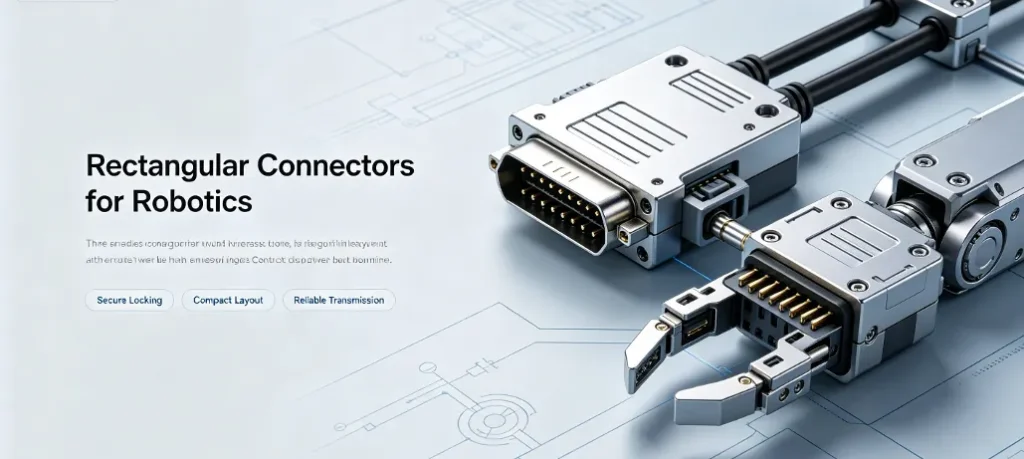
That geometry matters economically. If a panel cut-out is already rectangular, the housing can use more of the available width and height than a circular connector with a large radial clearance. If a machine builder needs several adjacent interfaces, a row of modular housings can keep cable exits aligned and reduce rework on the mounting plate.
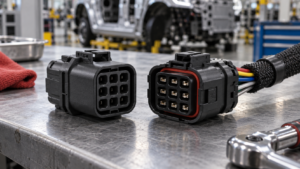
The term rectangular connectors for robotics covers more than one product class. It may refer to heavy-duty industrial housings, compact board-to-wire headers, rectangular automotive connectors, or sealed harness interfaces. The buyer should define the application before comparing catalogue families:
- robot arm dress pack and moving cable;
- controller cabinet and fixed internal wiring;
- tool changer or end-of-arm device;
- automated guided vehicle or mobile robot;
- vision, safety, or high-speed communication module; or
- appliance or battery harness where a compact rectangular seal is preferred.
The honest answer is that shape does not guarantee performance. A properly specified interface combines contact metallurgy, retention, sealing, strain relief, coding, and a validated assembly process. That is why procurement should evaluate the complete system rather than treating the housing as a commodity.
For platform buyers, rectangular connectors for robotics also create a repeatable mechanical datum: the same mounting logic can be carried from a controller cabinet to a tool plate, provided the keying, clearance, and service envelope are documented.
How do rectangular connectors for robotics manage power, signal, and data in one assembly?
A robot-cell connector can be divided into electrical zones. Larger contacts carry motor or DC-bus current; smaller contacts handle sensors, brakes, safety circuits, or diagnostic lines; shielded pairs carry Ethernet or other high-speed data. The zoning approach reduces the number of separate plugs and helps the integrator control routing and service time.
A procurement schedule should state the electrical limits rather than a vague “industrial connector” description:
- rated current per contact and simultaneous-current derating;
- working voltage, impulse withstand, and creepage/clearance;
- contact resistance at initial condition and after environmental testing;
- wire size, crimp range, plating, and permissible conductor type;
- signal integrity targets for the selected data protocol;
- shield termination and 360-degree EMC bonding where required.
A robotics rectangular connector with ten signal contacts is not automatically equivalent to a circular connector with ten contacts. Terminal pitch, dielectric layout, current derating, contact normal force, and cable-entry geometry can produce different thermal and electrical results. IEC 61984 provides a useful connector safety and testing framework, but the project specification should identify the applicable product and system standards.
For mobile axes, the cable assembly is part of the connector decision. The team should validate bend radius, torsion, acceleration, unsupported length, carrier routing, and the number of flex cycles. A housing that survives a static IP test can still fail if the cable gland transfers repeated bending force to the crimp barrel.
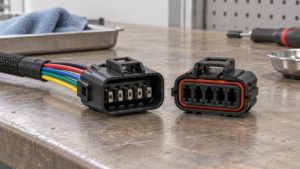
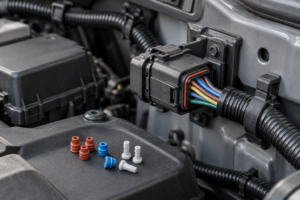
A robotics rectangular connector is therefore purchased as a mated assembly, not as a plastic shell; the terminal, wire seal, backshell, latch, and crimp process determine whether the interface remains stable after motion.
Why does rectangular versus circular connector selection change robotic service cost?
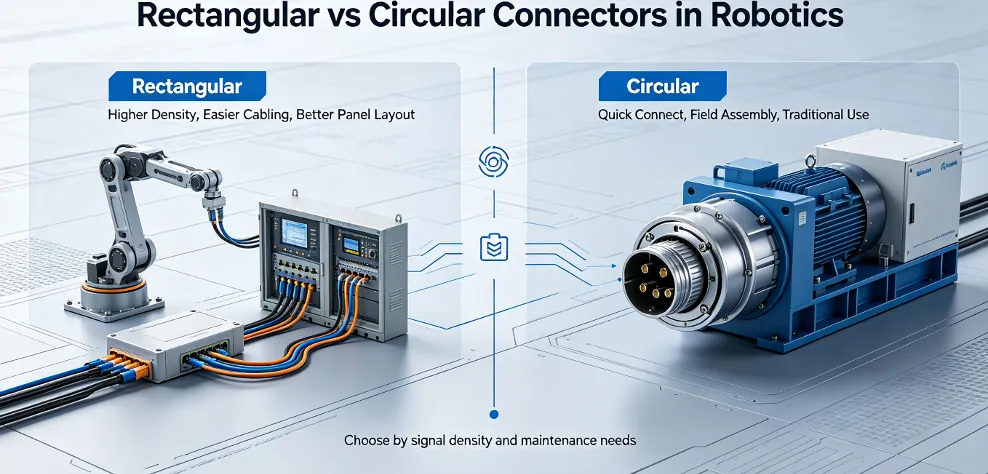
Searches for rectangular vs circular connectors robotics usually focus on size, but service economics often decide the result. Rectangular systems can offer modular inserts, visible coding, side-by-side mounting, and a clear orientation for re-mating. Circular systems can offer excellent radial sealing, compact symmetry, and fast coupling in constrained positions. Neither format wins every application.
| Buying dimension | Rectangular interface | Circular interface | Procurement implication |
|---|---|---|---|
| Panel utilization | Efficient use of width and height; easy to arrange in a row | Requires circular clearance and may leave unused corner space | Compare mounting-plate fabrication and enclosure space, not shell price alone |
| Contact modularity | Often supports mixed inserts for power, signal, and data | Can be highly integrated, but contact zoning may be less flexible by family | Confirm future circuit growth and spare positions |
| Sealing | Gasketed covers and cable glands can achieve high IP protection | Radial seals and threaded or bayonet couplings are mature options | Check the mated, wired, and aged assembly—not an empty connector |
| Vibration retention | Lever locks, latches, and coding features can distribute retention load | Threaded or bayonet coupling can be robust and compact | Specify secondary locking and vibration test conditions |
| Field replacement | Orientation is visible; modular inserts can reduce replacement scope | One-piece interfaces can be quick to replace if keying is clear | Price labour, downtime, and spare-kit logistics over the warranty period |
| High-speed data | Room for shield clamps and separated contact zones | Compact shielding is possible but may limit mixed-function layouts | Require channel test evidence and EMC acceptance criteria |
| Total cost of ownership | Can reduce wiring variants and simplify platform reuse | Can minimize footprint and assembly steps in compact tools | Use the complete harness and service process for comparison |
The correct rectangular vs circular connectors robotics decision is application-specific. A machine builder should pilot the chosen assembly under the same vibration, thermal, ingress, and service conditions expected in production; a lab demonstration with short cable lengths is not enough.
In a formal rectangular vs circular connectors robotics review, the decision should be recorded in the interface control document so that later tooling, harness, and service changes do not reopen a settled mechanical question.
Which specifications determine the price of a robotics rectangular connector?
The price of a robotics rectangular connector is driven by the complete configuration: housing material, insert design, terminal plating, seals, locking hardware, cable gland, tooling, inspection, packaging, and annual volume. Buyers who ask only for a unit price often discover that the quoted item excludes the crimp applicator, secondary locks, backshell, or PPAP documentation.
| Cost driver | What changes the price | Evidence to request | Hidden-cost risk |
|---|---|---|---|
| Contact material and plating | Copper alloy, tin, gold, silver, thickness, selective plating | Material specification, plating thickness, resistance data | Early savings can become heat, fretting, or warranty claims |
| Housing and seal | PA, PBT, high-temperature resin, metal shell, gasket, IP design | Material grade, temperature range, IP test report | Cheap resin can warp or lose sealing after thermal cycling |
| Contact count and zoning | Power, signal, coax, Ethernet, and spare cavities | Approved pin map, derating curve, keying drawing | Late circuit changes force a new mould or harness revision |
| Crimp and assembly tooling | Applicator, dies, insertion tools, automated test fixtures | Tool list, crimp-height window, pull-force method | Manual variation can undermine PPAP repeatability |
| Protection and retention | Secondary lock, lever, CPA, backshell, strain relief, coding | Retention force, vibration evidence, mating-cycle rating | Field disconnects and intermittent faults can exceed material savings |
| Quality documentation | IMDS, PPAP level, control plan, capability studies, traceability | Document index and sample pack before nomination | Supplier may pass a sample review but fail the programme gate |
| Volume and forecast | Annual quantity, launch curve, service demand, tooling amortization | Price ladder, MOQ, capacity plan, buffer stock proposal | Low MOQ can hide a high piece price or unstable supply |
| Harness integration | Cut length, terminals, seals, clips, labels, electrical test | Harness drawing, test limits, packaging standard | Buying the connector separately can create interface ownership gaps |
For a high-volume EV programme, even a small contact-resistance drift can create a disproportionate cost because it appears as intermittent diagnostics, rejected harnesses, or a delayed PPAP gate. The commercial team should quantify those risks before accepting a nominally cheaper offer.
A price model for rectangular vs circular connectors robotics should include the mounting plate, tooling, harness labour, test fixtures, and service stock; a lower shell price is not a lower programme cost.
How should buyers compare rectangular connectors for robotics by application and performance level?
Application grouping keeps the sourcing conversation practical. The same housing family may be attractive for a fixed cabinet and unsuitable for a moving wrist because the cable, seal, or retention requirement changes.
| Application | Typical performance focus | Recommended buying questions | Cost position |
|---|---|---|---|
| Fixed robot controller cabinet | Density, wiring clarity, service access, EMC | Can inserts be mixed? Are shield clamps and coding included? | Low to mid, depending on data and tooling |
| Robot arm dress pack | Flex life, torsion, strain relief, vibration, temperature | What cycle profile was tested, and with which cable construction? | Mid to premium |
| Robot end-of-arm tooling | Fast changeover, keying, compactness, contamination resistance | Can operators replace the interface without disturbing adjacent lines? | Mid to premium |
| Automotive low-voltage harness | Contact stability, PPAP, traceability, -40°C to +125°C, sealing | Are IATF 16949 processes, capability data, and material records available? | Volume-sensitive; quality evidence is decisive |
| Battery, storage, or PV auxiliary harness | DC current, touch safety, creepage, sealing, thermal cycling | What is the DC rating and how are polarity and service disconnects controlled? | Mid to premium |
| Industrial Ethernet and vision | Shielding, impedance control, vibration, data integrity | Which protocol, channel length, and EMC test are covered? | Premium when certified data performance is required |
For a global OEM, the best supplier is not always the one with the broadest catalogue. It is the one that can hold the same interface definition across regions, provide consistent mould and terminal control, and support both component and harness-level validation. That is the practical advantage buyers seek when specifying rectangular connectors for robotics across a platform.
Which standards and certifications must a robotics rectangular connector meet?
Certification is a release gate, not a decorative line on a brochure. The selected robotics rectangular connector should be mapped to the end product, installation environment, and destination market.
- IATF 16949: the automotive quality-management framework; buyers should verify scope, manufacturing site, special-process controls, and PPAP capability.
- ISO/IEC 17025: evidence that a testing laboratory is competent for the tests it performs; the report should identify method, equipment, uncertainty, and sample configuration.
- IEC 61984: a connector safety and testing reference that can support specification of electrical, mechanical, and environmental performance.
- IEC 60529: the basis for IP enclosure ratings; an IP67 claim must identify the mated connector, cable exits, test condition, and any limitations.
- UL: relevant North American safety recognition for the applicable connector or component family; the exact file and category should be checked.
- CQC and applicable Chinese requirements: relevant where the product or end equipment is placed on the Chinese market.
- ISO 14001 and ISO 50001: environmental and energy-management evidence that may support an OEM’s responsible-sourcing requirements.
- RoHS and material declarations: required documentation for restricted substances and customer material systems, including IMDS where automotive programmes require it.
A connector advertised for -40°C to +125°C still needs a test record showing the assembled housing, terminal, seal, wire, and thermal cycle. Likewise, vibration evidence must reflect the axis, frequency, acceleration, duration, and electrical monitoring method. Buyers should reject reports that test an empty housing when the commercial risk sits in the complete harness.
In a rectangular vs circular connectors robotics review, standards provide the common language. They do not remove the need for application validation; the final assembly still has to pass the robot maker’s vibration, ingress, EMC, and service tests.
The compliance record for rectangular vs circular connectors robotics should identify the exact mated configuration, wire seals, backshell, and test sequence, because a certificate for one format cannot be transferred to another without evidence.
How can procurement teams qualify rectangular connectors for robotics without losing launch time?
The brand should enter the discussion only after the duty, specification, and evidence gates are clear. ZUCH Technology is a Shenzhen-listed connector system manufacturer serving appliance, automotive, new-energy, industrial robotics, storage, photovoltaic, and communications applications; its portfolio contains more than 5,631 product models. For an OEM nomination, the buyer should verify the exact model, site, process scope, and documentation rather than relying on a corporate introduction alone.
ZUCH provides rectangular connectors for robotics and related terminal and harness capabilities with a quality framework that includes IATF 16949, ISO 14001, ISO 50001, ISO/IEC 17025 laboratory recognition, CQC and UL-related product certification where applicable, plus a record of patents and engineering development. The buyer should ask for the certificate number, covered site, expiry, applicable family, and test configuration. The wider ZUCH product range can be reviewed when a programme needs appliance, automotive, new-energy, and industrial connector families under a common supplier assessment.
A practical OEM or ODM workflow has five gates:
- Application freeze: define circuit function, current, voltage, temperature, motion profile, IP target, mating cycles, cable, and service method.
- Interface review: approve the pin map, keying, cavity allocation, terminal plating, shield path, seals, secondary locks, and harness drawing.
- Validation build: test complete assemblies under vibration, thermal cycling, current load, ingress, EMC, and electrical monitoring conditions.
- Production readiness: review PFMEA, control plan, crimp capability, traceability, mould maintenance, incoming inspection, and capacity buffer.
- Launch support: agree PPAP level, change-notification rules, safety stock, escalation contacts, field-return analysis, and replacement lead time.
That process lets the procurement manager compare a component-only quotation with a connector-and-harness package on the same basis. It also protects the production line from a familiar trap: accepting a sample that works in the laboratory but lacks the tooling, traceability, and capacity controls needed for a million-cycle programme.
Where a buyer needs a robotics rectangular connector and a low-voltage harness assembly together, the supplier evaluation should include the company quality and engineering profile, the approved production site, and the change-control route—not only the component drawing.
What do buyers ask when comparing rectangular versus circular connector systems in robotics?
Are rectangular connectors better than circular connectors for robots?
Neither format is universally better. Rectangular systems often win where modular contacts, panel density, visible coding, and mixed power-signal layouts matter; circular systems can win where radial sealing, compact coupling, or rotational symmetry is the priority.
That is the short answer to rectangular vs circular connectors robotics: the correct format is the one that passes the complete mechanical, environmental, electrical, and service test plan at the lowest evaluated cost.
What should be checked before buying a robotics rectangular connector?
The buyer should verify current, voltage, contact resistance, wire range, plating, temperature, vibration, flex profile, IP rating, mating cycles, coding, tooling, PPAP evidence, and the exact cable assembly used in testing. For a global programme, the same rectangular connectors for robotics specification should be controlled across every approved plant.
Can one connector carry power, signal, and data?
Some modular families can combine those functions, but power contacts, signal contacts, and high-speed channels need electrical separation, derating, shielding, and validation. The pin map and EMC test plan should be approved before tooling.
How is connector IP67 performance verified?
The complete mated assembly is tested under the applicable IEC 60529 method, including housing, seal, cable exit, lock, and any backshell. An empty connector or an unrelated housing test does not prove the production harness is IP67.
For a rectangular vs circular connectors robotics comparison, the same test discipline applies to both formats; the buyer should not award a preference based on an unverified ingress label.
Where can an OEM source connector and harness assemblies together?
An OEM should shortlist suppliers that can control terminals, housings, tooling, assembly, inspection, and traceability under one documented process. A single accountable interface can reduce PPAP gaps and shorten the path from design validation to stable production.
Which references support this rectangular connector buying decision?
- Mordor Intelligence, Automotive Connector Market 2026–2031 — market size, CAGR, and Asia-Pacific context.
- International Electrotechnical Commission — standards catalogue for connector safety, environmental protection, and electrical interfaces.
- UL Solutions — North American product-safety and certification resources.
- AIAG — automotive quality and PPAP-related industry resources.
- ISO 9001 quality-management principles — quality-system context for supplier evaluation.