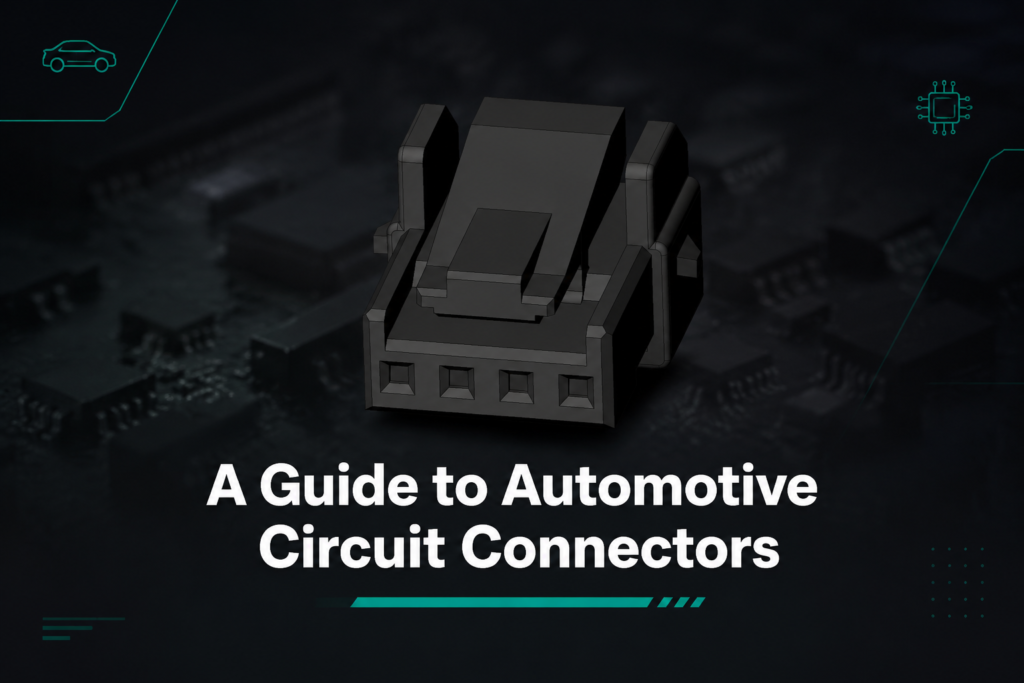
A Guide to Automotive Circuit Connectors
Automotive circuit connector serve an important purpose by acting as a link between the different parts of a vehicle’s electrical system. Most cars today have multiple types of Automotive circuit connector to allow for smooth operations between all of the different electronic elements, including sensors and actuators. In this article, we define Automotive circuit connectors, their importance, how to choose the correct one for your vehicle, and their many functions, types, and uses.
For a related technical topic, see Automotive Electrical Connectors Applications Types Functions.
What are Automotive Circuit Connectors
Simply put, an automotive circuit connector is an electrical connection device that connects circuit segments. They are used to provide reliable power transfer or continuity of signal between component parts of the automotive system for normal operation, including engine, lights, infotainment and many more. Automotive circuit connectors also have to be able to withstand the harshest environments found in a vehicle; therefore, they are built to perform well under extreme temperature changes, vibration and exposure to moisture or chemicals.
Automotive circuit connectors are generally constructed from durable materials, typically plastic or metal, and will come in various shapes and designs depending on what type of electrical connections they are intended to make. Ultimately, automotive connectors have the same goal: to provide a solid, secure electrical connection with a minimal amount of energy lost between two points and a minimum amount of interference to the signal being transmitted.
Types of Automotive Circuit Connectors
Automotive circuit connectors come in many shapes, sizes, and styles, and it is essential to understand the different types of connectors available in order to properly select the right connector for your application. Some common types of automotive circuit connectors are:
1. Pin Connectors: Pin connectors consist of pins that fit into the corresponding pin holes. Used primarily in fuel and ignition systems, pin connectors are compact and reliable.
2. Blade Connectors: Blade connectors have a flat, blade-like shape and are used for various connection types, such as wires to terminals.
3. Ring Connectors: Ring connectors feature a circular design that fits over bolts or studs and are used primarily for grounding wires in high-vibration environments.
4. Plug-and-Socket Connectors: These connectors are used for removable connections, such as in vehicle infotainment systems and wiring harnesses.
5. Multi-Circuit Connectors: Multi-circuit connectors allow multiple circuits to connect in one unit, making it easier to keep wiring and connections organized.
Key Factors to Consider When Choosing Automotive Circuit Connectors
Careful evaluation of requirements and consideration of the following factors are the keys to selecting the correct connector:
Durability: Automotive environments are harsh on connectors due to corrosion, vibration, and extreme temperatures. Connectors need to withstand these factors.
Ease of Installation: Connectors should be easy to install and uninstall for quick and efficient vehicle repair or maintenance.
Compatibility: It is critical to select connectors that are compatible with the vehicle’s wiring and electrical components.
Safety: Many of today’s connectors offer locking mechanisms to minimize the chance of disconnection while operating the vehicle.
Cost: While cost is a factor, prioritize obtaining a quality and reliable connector to reduce potential future electrical problems.
Applications of Automotive Circuit Connectors
Automotive circuit connectors can be used in a variety of applications due to their versatility. Here are some of their most frequent uses:
1. Engine Wiring: Connectors in an automotive engine serve to connect sensors to the engine control module.
2. Lighting Systems: Connectors provide power to different lights, including headlights, taillights, and interior lights.
3. Infotainment Systems: Various components of a vehicle’s audio and navigation systems, as well as a vehicle’s touchscreen, will use connectors for integration.
4. Safety Features: Connectors communicate with stability control systems and deploy airbags in the event of a crash.
5. Charging Ports: In hybrid or electric vehicles, connectors are needed to provide connections between the vehicle charging system and battery management system.

Choose the Connector by Circuit Function, Not Pin Count Alone
Pin count is only the starting point for an automotive circuit connector. A connector carrying a low-current sensor signal has different requirements from one carrying lighting power, a motor load, or a CAN/LIN communication pair. Before selecting a family, identify the circuit function, voltage and current, wire size, signal speed, environment, mating direction, keying and service access.
| Circuit need |
Connector questions |
Common verification |
| Power or lighting |
What current, temperature and voltage-drop limits apply? |
Terminal rating, wire range, fuse and heat-rise data |
| Sensor or actuator |
Is the connector sealed and keyed for the installed location? |
Pin assignment, seal, latch and vehicle wiring diagram |
| CAN or LIN network |
Does the interface preserve the intended signal pair and shielding? |
Network pinout, impedance/termination requirements and EMC guidance |
| Safety-critical system |
Are repair and replacement restricted by the vehicle maker? |
Current service information and approved connector family |
Search results for automotive circuit connectors increasingly surface CAN high/CAN low, LIN communication, sealed versus unsealed housings, and connector pinouts. These are useful decision questions, but a generic connector article should not assign a universal pinout or claim that a connector is compatible with a particular vehicle. Confirm the exact mating pair, cavity map and circuit documentation before ordering.
Frequently Asked Questions
Q: What Are the Different Types of Automotive Circuit Connectors?
A: There are many different types of automotive circuit connectors. These include pin and blade connectors, ring connectors, plug/socket connectors, and multiple circuit connectors. Each of these connectors can be used for specific applications, such as engine wiring or lighting systems.
Q: How Do I Know What Connectors Will Work with My Vehicle?
A: You can find the specifications for the type of connector you need and then determine if it will work with your vehicle’s make, model, and electrical system wiring.
Q: Are Automotive Circuit Connectors Universal?
A: There are some universal standards for automotive connectors, but the majority of connectors will be designed for a specific vehicle or manufacturer. Before you install any connector, make sure it corresponds to the make and model of your vehicle.
Q: Can I Replace My Automotive Connectors Myself?
A: While replacing connectors may appear simple, it is a good idea to consult a qualified technician about more complicated systems, as improper replacement may damage the component.
What is the difference between a power connector and a signal connector?
A: A power connector is selected mainly around current, temperature rise, wire size and contact resistance. A signal connector must also preserve the required signal integrity, shielding, keying and noise performance. Some connector families can carry both, but their application limits still need to be verified.
Do CAN and LIN use the same automotive connector?
A: Not necessarily. CAN and LIN are different communication systems with different wiring and electrical requirements. The connector may look similar, but the pinout, circuit function and vehicle documentation must be confirmed before substitution.
How do I identify an automotive circuit connector?
A: Record the housing shape, keying, latch, cavity count, terminal style, wire sizes, seal features and molded markings. Compare those observations with the connector drawing and the vehicle wiring diagram rather than relying on appearance alone.
Does a higher pin count mean a connector is better?
A: No. A higher pin count only provides more positions. The connector still has to match the required current, signal, environment, terminal system, mating interface and service constraints.
Automotive circuit connectors are critical for your vehicle’s electrical systems to work together and carry power. All of the components that power your engine or lights in your automobile depend on these connectors. By understanding the various types of automotive circuit connectors, how they are used, and how to select a connector for your vehicle, you can make informed decisions on which connectors will best suit your needs in terms of performance and safety. No matter what you do for a living, if you are a professional mechanic or an auto enthusiast, ensuring that you have the right connectors for your application is critical for optimal vehicle performance.
Final Takeaway: Match the Connector to the Circuit
Choose an automotive circuit connector from the circuit function outward: confirm power or signal duty, voltage and current, wire range, environment, keying, mating interface and service limits. Pin count and appearance are useful clues, but they are not proof of compatibility.
References and Further Reading
- ISO 8092-2:2023 — road-vehicle harness connector test scope
- CAN in Automation — CAN physical-layer and system-design guidance
- LIN in Automation — LIN technology knowledge base
- TE Connectivity — automotive connector application resources
 Zhejiang ZUCH Technology Co., Ltd.