Zhejiang ZUCH Technology Co., Ltd.
An RFQ can look complete because it names a connector series and annual volume, yet still leave suppliers guessing at the mating interface, terminal family, wire size, sealing conditions, or validation scope. Those gaps do more than delay an email reply: one bidder may price housing-only supply, another may include terminals and seals, and a third may assume a different conductor range, producing quotes that cannot be compared technically. The corrective action is not simply to ask for a “better connector.” It is to issue a controlled input package that identifies both mating halves, every circuit and wire condition, the applicable electrical and environmental duty, and the evidence required before approval. This checklist shows procurement and engineering teams how to make those inputs explicit without turning the RFQ into an unverified design specification.
Quick Answer: A usable automotive connector RFQ should identify the two mating halves, cavity count and keying, terminal and seal family, conductor cross-section, insulation outside diameter, wire type, cavity map, electrical duty, environmental exposure, forecast volume, tooling responsibility, inspection records, change control, and sample-approval plan. USCAR-2 can define relevant connector-system performance tests, but it does not supply a vehicle pinout or prove that two catalog parts mate. Attach controlled drawings and application documents, mark unknowns openly, and ask every bidder to state assumptions and exclusions. That creates technically comparable offers and exposes validation work before tooling or production orders are committed.
Information to Include When Identifying the Connector
Identify both halves of the mating interface
Start with the connector assembly being purchased and the component it must mate with. Provide manufacturer name, known part number, revision, cavity count, polarization or keying, latch orientation, connector position assurance or terminal position assurance features where present, and whether the request covers housing, contacts, seals, locks, clips, covers, or a complete terminated assembly. A photo can orient the supplier, but it cannot reliably define hidden key geometry or contact compatibility. Teams working from an unknown part should first follow a controlled automotive connector identification process rather than asking a supplier to identify it from one exterior view.
Attach released connector and mating-part drawings whenever the organization is authorized to share them. A useful drawing shows the interface view, datum scheme, key dimensions, cavity numbering, permissible materials or finishes where controlled, and the drawing revision. If proprietary information must be withheld, provide a redacted interface-control drawing under the appropriate confidentiality process. Never infer interchangeability from similar cavity counts: the supplier should confirm the exact interface against controlled documentation.
Define the terminal and sealing stack
A housing quotation is not a system quotation unless the included components are explicit. State the required terminal gender and family, base material and plating if already specified, primary lock, secondary retention, individual wire seal or mat seal, cavity plug requirements, and any backshell or strain-relief component. The TE Connectivity Terminals and Connectors catalog illustrates why this matters: application ranges and associated components are organized by specific terminal and connector families, so a family name alone does not establish suitability for every wire or cavity configuration.[1]
Include the Cavity Map, Wire Gauge, and Insulation Diameter
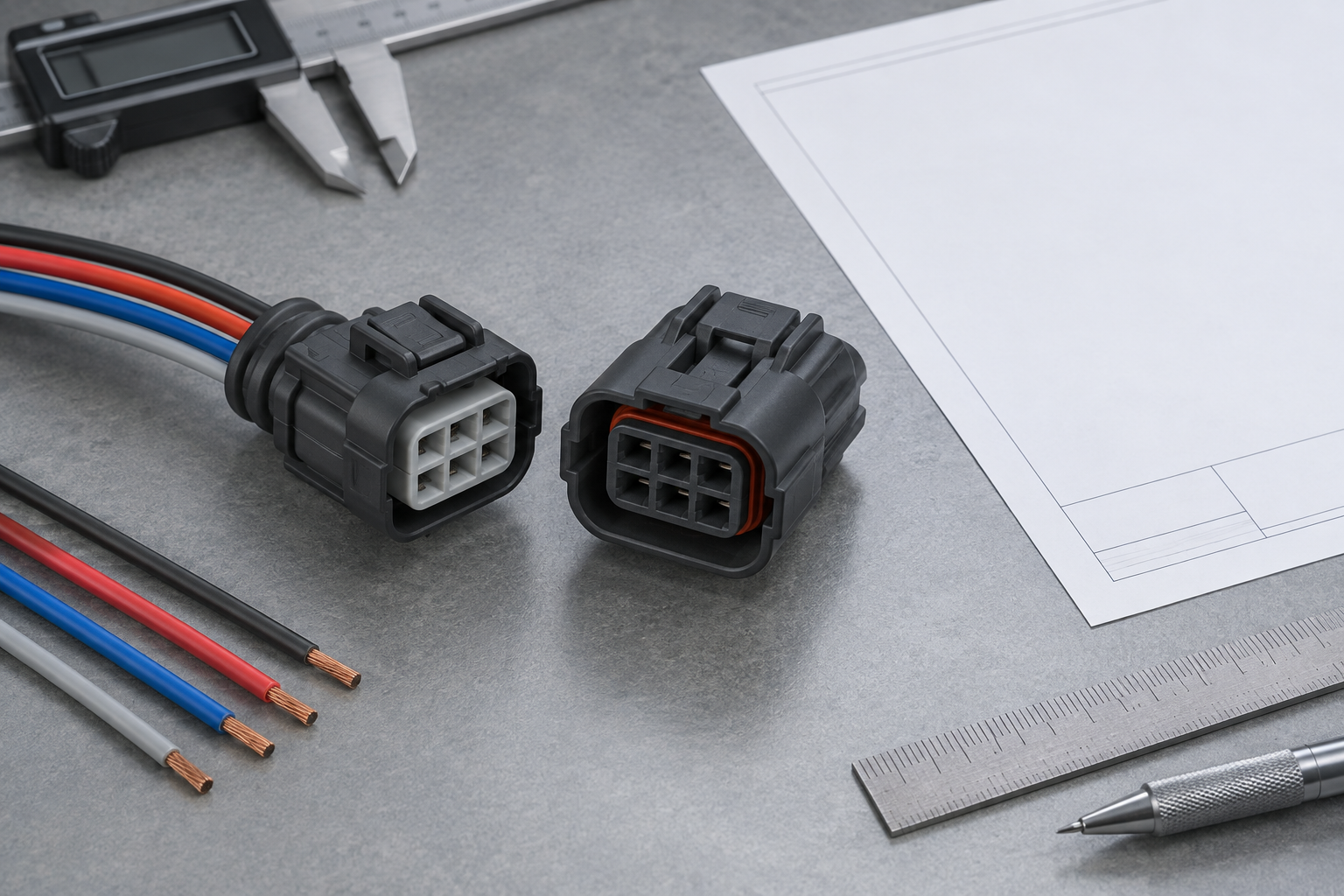
The cavity map is the bridge between a mechanical connector package and the electrical harness. Supply a connector-face view with an unambiguous viewing direction, cavity identifiers, populated and unused positions, wire identifiers, circuit function, terminal assignment, seal or cavity-plug status, and shield or drain treatment where applicable. Label the document revision and align it with the harness drawing or bill of materials. A generic catalog cavity diagram should not be substituted for the vehicle- or program-specific wiring record.
For every populated cavity, provide conductor cross-section or AWG, strand construction when controlled, conductor material, insulation material or wire specification, insulation outside-diameter range, and any special construction such as twisted pair, shielded cable, thin-wall insulation, or high-flex wire. Both conductor size and insulation diameter matter: the conductor influences terminal-crimp selection, while insulation diameter affects the insulation support and wire-seal interface. Ask the supplier to identify the applicable terminal and seal range in its controlled application specification rather than relying on a visual fit.
| RFQ input | What the supplier must resolve | Risk when omitted | Quotation effect |
|---|---|---|---|
| Both mating-part drawings and revisions | Interface, keying, latch, datum, and cavity compatibility | A visually similar but non-mating proposal | Conditional pricing or an engineering review line item |
| Terminal, seal, lock, and accessory scope | What is included in the connector system or kit | Housing-only and complete-kit bids appear comparable | Large scope differences hidden in unit price |
| Cavity map and circuit assignments | Population, terminal allocation, seals, and plugs | Wrong loading or incomplete bill of materials | Rework and sample changes after quotation |
| Conductor size and insulation OD by cavity | Terminal application range and sealing fit | Crimp or seal components selected outside their documented range | Alternative terminals, seals, or tooling may be required |
| Electrical duty and environmental exposure | Relevant materials, plating, sealing, and validation scope | Different bidders assume different service conditions | Non-comparable test and component costs |
| Volume, packaging, and delivery profile | Process, capacity, packaging, and commercial basis | Prototype economics are compared with production economics | Tooling and unit-price assumptions remain unclear |
State the Electrical, Environmental, and Commercial Requirements
Describe duty conditions before naming a test
Give the supplier the circuit’s operating voltage, continuous and transient current profile, allowable temperature rise if controlled, expected contact resistance criteria, grounding or signal sensitivity, and any shielding requirement. For environmental duty, identify mounting location, temperature exposure, fluids, humidity, condensation, dust, water, vibration, mechanical shock, salt exposure, and required mating-cycle expectations where these have been established by the vehicle or system owner. Avoid selecting a test severity by analogy alone; the responsible engineer should map actual use conditions to the applicable validation plan.
USCAR-2 is a performance specification for automotive electrical connector systems and provides a framework for electrical, mechanical, and environmental verification.[3] The RFQ should cite the required revision and the program-specific test sequence or exceptions. A statement such as “USCAR compliant” is too broad if it does not identify the assembly under test, test conditions, acceptance criteria, and responsibility for samples and reporting.
Separate recurring price from one-time and conditional costs
State prototype quantity, annual volume, program duration, order frequency, delivery location, pack quantities, labeling expectations, and forecast status. Ask bidders to separate recurring unit price from tooling, gauges, fixtures, validation, packaging development, and non-recurring engineering. Define who owns dedicated tooling, who stores and maintains it, whether it may serve other programs, and what happens at end of life. The resulting total-cost view is more useful than a lowest-piece-price comparison because it makes assumptions, approval costs, and change exposure visible.
For custom automotive connectors, the RFQ should also distinguish a truly new interface from a modified housing, keyed variant, material change, or custom packaging request. Each path has a different drawing-control and validation burden. An illustrative total-cost comparison can add unit price multiplied by expected volume, one-time tooling, validation, sample builds, inspection fixtures, logistics, and expected change-management costs; label the model as illustrative and replace every assumption with program data before sourcing approval.

Use the Same Checklist to Compare Supplier Quotes
Issue the same revision-controlled RFQ pack to all bidders and include a response matrix. Require each supplier to mark every line as confirmed, exception, alternative, or information needed. This lets procurement compare scope while engineering reviews technical deviations. A sourcing search for where to buy automotive electrical connectors should therefore end with a common data package, not with unrelated requests sent to multiple vendors.
| Decision dimension | Released and verified | Known but provisional | Unknown at RFQ |
|---|---|---|---|
| Mating interface | Quote against identified drawings and revisions | Price with an explicit interface-review gate | Request identification support; do not accept a fit claim |
| Wire and cavity schedule | Quote exact terminals, seals, and cavity plugs | List assumed wire ranges and alternate components | Hold final component selection until the schedule is released |
| Performance duty | Quote the agreed validation scope | Separate baseline tests from optional or pending tests | Provide budgetary pricing only, with exclusions |
| Production volume | Use program quantity and delivery profile | Quote volume bands and validity assumptions | Keep prototype and production pricing separate |
| Approval evidence | List samples, reports, records, and acceptance owner | Identify open report or sample requirements | Do not infer approval from a catalog listing |
The response package should state quoted scope, exclusions, proposed part numbers, drawing revisions, manufacturing location if relevant to approval, tooling assumptions, quotation validity, sample timing basis, and change-notification process. This is especially important when comparing automotive connector suppliers: a lower number may reflect a narrower component set, fewer validation activities, or buyer-supplied tooling rather than a more efficient equivalent offer.
Documents Suppliers Need for Performance and Vehicle-Fit Review
Three document layers answer different questions and should not be merged into one “compliance” statement:
- Performance specifications: USCAR-2 addresses performance testing for automotive electrical connector systems. It is a specification and test framework, not a universal product certificate, not a pin-assignment document, and not proof that any two parts are interchangeable.[3]
- Manufacturer application specifications: the terminal or connector manufacturer controls application details such as applicable wire range, strip length, crimp geometry, tooling, and inspection criteria for the specific component family. Use the exact current document tied to the quoted part; a general catalog is useful for navigation but does not replace that specification.[1]
- Vehicle- or program-specific wiring documentation: released schematics, harness drawings, cavity maps, and bills of material define circuit allocation and program configuration. Neither USCAR-2 nor a supplier catalog can invent or approve those assignments.
The EWCAP specification library helps teams locate USCAR electrical wiring-component documents, while the program owner remains responsible for deciding which documents and revisions apply.[4] For additional context on how standards differ from product selection evidence, see this overview of automotive connector standards.
IATF 16949 addresses the automotive quality-management system and includes controls relevant to supplier management, documented processes, traceability, and change management.[2] A supplier’s quality-system certification does not by itself certify a connector for a particular vehicle application. Unsupported compliance language can lead to rejected approvals, repeated testing, commercial disputes, or field risk; the RFQ should therefore request evidence at the correct layer and name the party that approves it.
Details to Confirm Before Ordering Samples or Tooling
- Freeze the quotation baseline. List every drawing, specification, cavity map, forecast, and commercial document by identifier and revision. Require deviations to appear in the supplier response rather than in informal email threads.
- Define the sample ladder. Distinguish identification samples, prototype parts, tool-off samples, validation samples, and production-intent samples. State quantities, configuration, documentation, acceptance criteria, and who signs approval at each stage.
- Request relevant records. Depending on the sourcing and quality plan, these may include dimensional or material records, application-tooling information, crimp inspection evidence, test reports, lot identification, certificates of conformance, packaging labels, and submission documents. Request only what the program requires, and identify the exact part and revision each record covers.
- Set traceability and change-control expectations. Define lot or date-code needs, retention period, record access, sub-supplier disclosure where contractually required, and notification or approval rules for product, material, process, tooling, or site changes.
- Close open assumptions before award. Record who resolves missing mating data, wire details, test severity, and tooling ownership. A quote can remain budgetary while inputs are open; it should not be treated as technically final.
At this stage, ZUCH can be approached in the same disciplined way as other automotive electrical connector suppliers: submit the controlled interface, wire, duty, quantity, documentation, and approval requirements, then evaluate the response against the common matrix. The purpose of supplier engagement is to confirm what can be quoted and documented, not to transfer vehicle-level design authority through an incomplete request.
Frequently Asked Questions
What photos and drawings should I send for an automotive connector quote?
Send clear front, rear, side, latch, keying, cavity, and marking photos with a scale reference, plus controlled drawings for both mating parts when authorized. Include interface view, cavity numbering, key dimensions, revision, and component scope. Photos support identification; they do not replace drawings or prove mating compatibility.
Do I need to provide the mating connector part number in the RFQ?
Yes, provide it whenever known, along with its manufacturer and drawing revision. If it is unknown, say so and supply authorized interface evidence; require the supplier to label any identification as provisional until the mating interface is verified.
Which wire-gauge and insulation-diameter details should the supplier receive?
Provide conductor cross-section or AWG, strand construction if controlled, conductor material, wire specification, insulation material, and minimum-to-maximum insulation OD for each populated cavity. Add twisted-pair, shield, thin-wall, high-flex, or temperature-class details when applicable, because conductor and insulation ranges can drive different terminals, seals, and tooling.
Should an automotive connector RFQ include a cavity map or pinout?
Yes. Include a revision-controlled cavity map with viewing direction, cavity identifiers, circuit function, wire data, terminal assignment, seal or plug status, and unused positions. The vehicle or program owner must approve the pinout; a supplier catalog or performance standard cannot define it.
Which electrical and environmental requirements can change the quoted connector?
Voltage and current duty, temperature exposure, acceptable resistance behavior, shielding, vibration, mechanical shock, fluids, dust, moisture, salt exposure, mating cycles, and sealing expectations can affect components and validation scope. Cite the applicable program specification and revision, then ask the supplier to identify assumptions, exceptions, and tests included in the quote.
What samples, test reports, and traceability documents should I request before ordering?
Request the sample stage and quantity needed by the approval plan, the agreed dimensional, material, crimp, and performance evidence, plus lot identification, certificates, inspection records, and change notifications where required. Tie every document to a part number, revision, lot, test condition, and approval owner; do not ask for a generic report that cannot be connected to the supplied product.
References
- TE Connectivity, Terminals and Connectors catalog.
- Automotive Industry Action Group (AIAG), IATF 16949:2016 Automotive Quality Management System information.
- SAE International, USCAR-2 Revision 8: Performance Specification for Automotive Electrical Connector Systems.
- United States Council for Automotive Research, Electrical Wiring Component Application Partnership (EWCAP) specification resources.
Conclusion
An accurate connector quote begins with a controlled technical baseline, not a target price. First identify both mating interfaces and included components; next map every cavity to verified wire data; then define electrical duty, environment, volume, tooling, samples, records, and change control. Compare responses only after each supplier has confirmed the same scope and exposed its assumptions. Never skip the application-specification and mating-interface checks merely because two housings look alike or a performance standard is cited—neither appearance nor a broad compliance statement proves fit for a vehicle program. Buyers can review ZUCH’s connector product directory after defining that baseline, then contact the company with the RFQ pack for a documented feasibility and quotation review. The practical rule is simple: verify the interface first, specify the application second, and compare price only when both are fixed.