The Importance of Automotive Connector Standards
Because automotive safety, efficiency and innovation are critical to the future of automotive production, connector standards impact both the reliability and performance of vehicles. As vehicles develop with new technologies like electric drivetrains, autonomous systems, and intelligent infotainment solutions, establishing electrical connector standards has become a necessary part of automotive production. In this article, we will take you on a deep dive through the world of standard automotive electrical connectors, their various governing standards and their use cases in the real world.
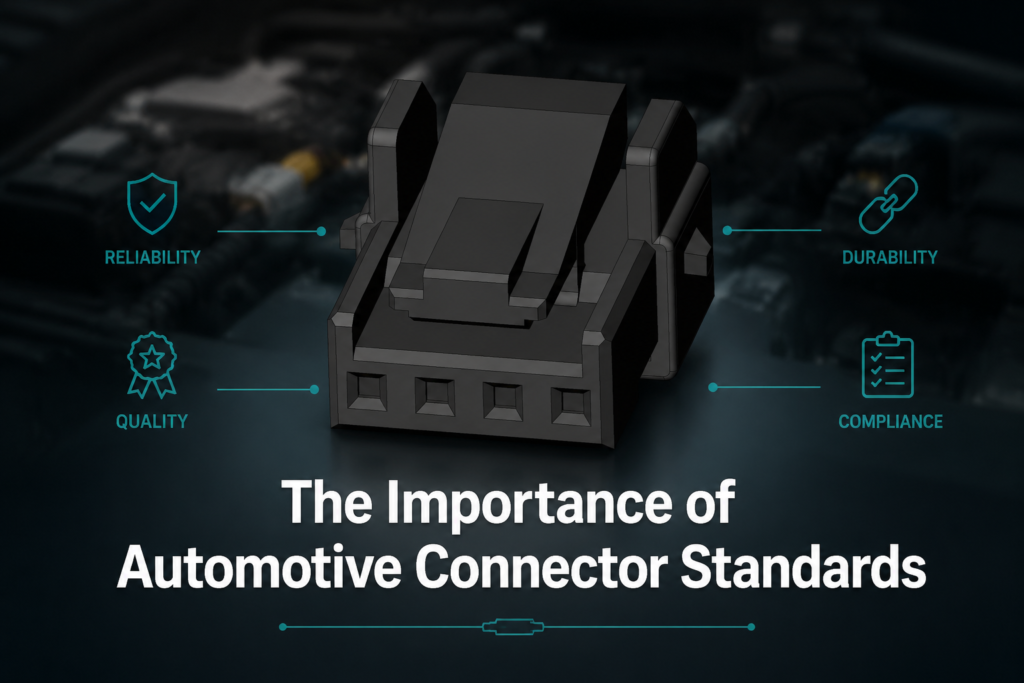
The Importance of Standardized Automotive Connectors
Automotive connectors are critical components in today’s automotive production because they transfer power and data between numerous electronic devices inside a vehicle. Due to extreme environmental conditions such as shocks/vibrations from the road, heat, moisture and exposure to various chemicals that automotive connectors will be exposed to, a connector that does not conform to the appropriate standard may not meet the reliability and safety qualifications; therefore, the vehicle’s performance and/or safety concerns could be hindered.
Standards for automotive connectors define terminology, test methods, performance requirements, and common interfaces within a stated scope. Passing the same standard does not make two connector families mechanically interchangeable. Housing geometry, keying, cavity map, terminals, seals, wire range, and the exact customer drawing must still match.
Key Standards Used to Govern Connector Standards in the Automotive Sector
There are several agencies who establish globally accepted standards for automotive connectors. Some of the most widely recognized standards are as follows:
The Society of Automotive Engineers (SAE)
The SAE provides standards that outline acceptable levels of performance and safety when producing connectors for vehicular use including standards that automotive connectors must comply with in order to operate safely over their life expectancy. The SAE J1939 standards are an industry-wide guideline for in-vehicle networks utilized in commercial vehicle installations.
ISO Standards
ISO 8092 is the more relevant family for connections used in on-board road-vehicle wiring harnesses. ISO 8092-2:2023 provides terminology, test methods, and general performance requirements for voltage class A connectors that are normally disconnected only for repair and maintenance. Its official scope excludes internal electronic-device connections and does not cover signal communication quality or data integrity.
USCAR Standards
USCAR (the United States Council for Automotive Research) is an organization established to improve the manufacturing processes and overall quality of the automobile industry. The USCAR-2 standard establishes the performance and test procedure requirements for automotive electrical connectors used on vehicles. These standards were developed primarily for the U.S. OEM market, but are becoming increasingly accepted worldwide, and work in conjunction with the SAE and ISO Standards to make sure automotive electrical connectors are more functional and durable.
Applications of Standardized Automotive Connectors
Automotive electrical connectors that are developed to a written standard are essential to the performance of today’s automobiles. Automotive connectors are employed throughout many different automotive systems including:
- Powertrain, to manage engine efficiency and transfer of power.
- Electronics like multimedia systems, GPS, and electronic safety systems (e.g., anti-lock brakes).
- Lighting systems, that provide consistent operation of headlights, tail lights, and turn signal lamps.
- Batteries for electric vehicles, where distribution of energy is critical.
- Sensor networks, which monitor parameters such as temperature, pressure, and speed.
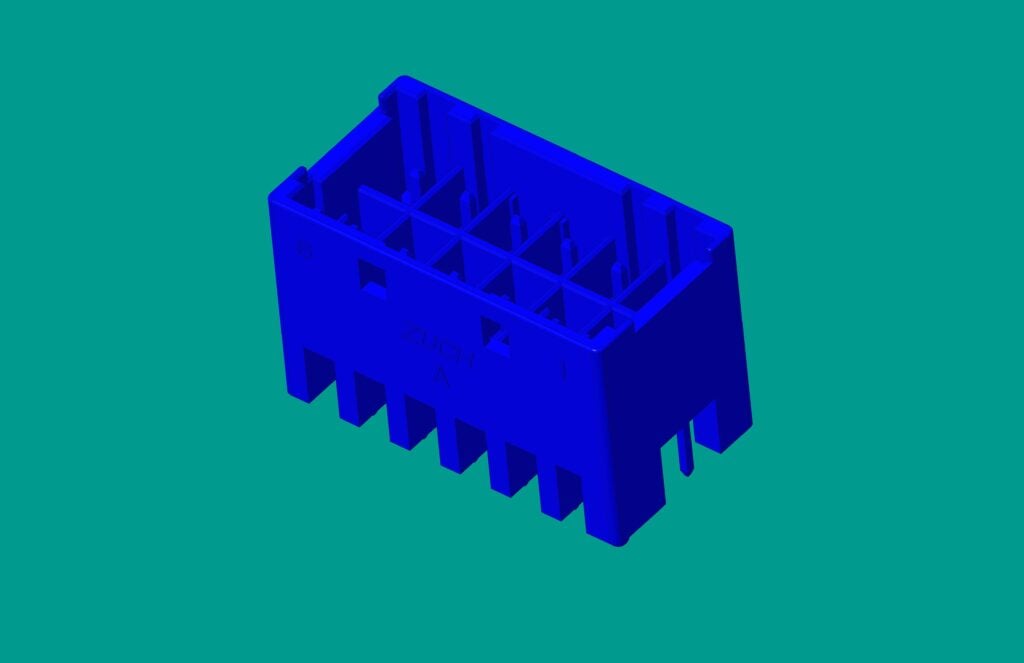
Trends in the Evolution of Automotive Connector Standards
The automotive industry is rapidly transitioning to electric propulsion, connectivity, and automation. As this trend continues to accelerate, so do the standards used to produce automotive connectors to meet the increasing challenges faced by the automotive industry. A few examples include:
1. The global increase in electric vehicle sales has resulted in the need for high voltage connectors. These connectors are designed to carry higher voltages and experience greater environmental stress than previous connectors.
2. The trend toward miniaturization in modern vehicle production results in the need for connectors that are smaller, more compact and more efficient than previous designs to fit into advanced assemblies with complexity.
3. The automotive industry is starting to integrate wireless technology into their products. This integration will add significant levels of complexity to the process of establishing standards because connectors used for wired technologies must also incorporate wireless technologies.
Which Automotive Connector Standard Applies to the Actual Interface?
The useful question is not whether a connector is simply “ISO” or “SAE compliant,” but which document, edition, connector class, voltage class, test sequence, and customer requirement apply. As of September 2026, ISO lists ISO 8092-2:2023 as the current fifth edition for voltage class A harness connectors. ISO also states that ISO 8092-5:2021 was reviewed and confirmed in 2026, so that edition remains current for its stated connector-operation scope.
| Reference |
What it can establish |
What it does not establish by itself |
| ISO 8092-2:2023 |
Terminology, test methods, and general performance requirements for specified voltage class A harness connectors |
Data integrity, internal electronic connections, or cross-brand interchangeability |
| ISO 8092-5:2021, confirmed 2026 |
Test methods and general performance requirements for specified single- and multi-pole harness-connector operation |
Approval for a particular vehicle program or an unspecified mating pair |
| USCAR-2 family |
Performance test procedures for automotive electrical connector systems within the applicable revision and customer program |
Universal approval, identical pinout, or automatic equivalence to another series |
| IPC/WHMA-A-620 |
Acceptance requirements for cable and wire-harness assemblies |
Connector-family qualification or a vehicle maker’s application approval |
A Five-Step Evidence Check Before Claiming Compliance
- Name the exact document and edition. “Meets automotive standards” is not auditable without a document number and revision.
- Confirm the scope. Match voltage class, connector type, application, environment, and exclusions to the proposed interface.
- Identify the tested configuration. Record the housing, mating half, contacts, seals, wire, tooling, and assembly process used in the test.
- Review the report, not only the claim. Check test sequence, sample condition, acceptance criteria, deviations, and the issuing laboratory or customer.
- Separate qualification from interchangeability. Compare drawings and samples even when two products cite the same standard.
Why New Vehicle Architectures Need More Precise Scope Statements
Electrification and higher-speed vehicle networks do not make one connector standard cover every interface. A low-voltage harness connector, a high-voltage power interface, and a high-speed data connector can require different electrical, mechanical, environmental, shielding, creepage, clearance, and signal-integrity evidence. Procurement teams should therefore request an application-specific compliance matrix rather than a general certificate or logo. For a related technical topic, see Automotive Electrical Harness Connectors.
Commonly Asked Questions Regarding Automotive Connector Standards
What are the primary purposes of connecting automotive connectors?
Automotive connector standards provide a controlled way to define terminology, test methods, and performance requirements. They can support reliable qualification within their scope, but they do not automatically establish interchangeability between different manufacturers or protect every connected electronic device.
Which industries utilize automotive connector standards?
Automotive connector standards are primarily developed for the automotive industry, however there are many other industries, including aerospace, heavy machinery, and consumer electronics that benefit from standardized automotive connectors because they are using technologies developed for use in the automotive sector.
What is the difference between SAE, ISO and USCAR standards?
The SAE standard focuses on the performance and safety of connector products; ISO focuses on establishing a uniform global standard; USCAR is an organization focused on quality management and process controls, principally for the automotive markets in North America.
What types of materials are used to manufacture automotive connectors?
Automotive connectors are typically manufactured using corrosion resistant materials (e.g., nickel, aluminum, plastic composites), so they will endure the effects of harsh environmental conditions, temperature fluctuations, and vibration.
Does ISO 8092 certification mean two automotive connectors are interchangeable?
No. A shared test standard can define comparable methods or requirements, but interchangeability still depends on the complete mating interface, dimensions, keying, cavity map, terminals, seals, wire range, and approved drawing.
What is the current edition of ISO 8092-2?
ISO lists ISO 8092-2:2023, Edition 5, as published in September 2023. It covers terminology, test methods, and general performance requirements for specified voltage class A wiring-harness connectors.
Is ISO 8092-5:2021 still current in 2026?
Yes. The ISO page states that ISO 8092-5:2021 was reviewed and confirmed in 2026, so that edition remains current as of this article update.
Is USCAR-2 a quality-management certificate?
No. USCAR-2 is a performance specification for automotive electrical connector systems. Quality-system certification, product testing, customer approval, and production-part approval are separate evidence layers.
What documents should a buyer request from an automotive connector supplier?
Request the controlled drawing, mating-part list, terminal and seal specifications, application tooling, relevant standard and revision, test report scope, sample identification, deviations, and change-notification terms.
In conclusion, Standardized Automotive Connectors are essential to the continued safety and growth of the worldwide automotive industry. The standards implemented by SAE, ISO, and USCAR help ensure the durability, performance, and compatibility of different types of applications of automotive connectors. The rapid advancement of technology, particularly as it relates to electric and autonomous vehicles, will make these standards even more critical to establishing the future of transportation.
Final Takeaway: Standards Define Evidence, Not Interchangeability
Automotive connector standards are most useful when the exact document, edition, scope, test configuration, and acceptance evidence are recorded. A shared ISO, SAE, or USCAR reference can support a qualification process, but the housing, mating half, contacts, seals, wire range, cavity map, and customer drawing still determine whether a connector is suitable and interchangeable.
References and Further Reading
- ISO 8092-2:2023 — terminology, test methods and general performance requirements
- ISO 8092-5:2021 — confirmed current in 2026
- SAE StandardsWorks — USCAR standards committee
- SAE — USCAR-2 performance standard for automotive electrical connector systems
- IPC/WHMA-A-620 cable and wire-harness acceptance resource
 Zhejiang ZUCH Technology Co., Ltd.