Zhejiang ZUCH Technology Co., Ltd.
Consider a purchasing scenario: when a sourcing manager in Pune sends one “automotive connector” enquiry to several suppliers, the quotations appear comparable until the samples arrive. One offer contains bare housings, another includes contacts, and a third assumes a different wire size. The difficulty begins with a market label that hides several different applications and bills of materials.
Summary: Demand for automotive connectors in India spans two-wheelers, passenger vehicles, commercial vehicles and electrified powertrains. The IEA’s Global EV Outlook 2026 covers both electric cars and other EV modes, while India’s PM E-DRIVE programme distinguishes multiple vehicle categories. Buyers should map the vehicle segment to the electrical function, then qualify the complete connector assembly and its supply chain.
A search for automotive connectors India is a useful market entry point, but it is not a specification. Vehicle sales, electrification and component localization influence demand differently. None provides a reliable connector-market value without additional evidence on vehicle content, replacement demand, pricing and the scope of the market being measured.
Which vehicle segments create different connector requirements?
The IEA’s 2026 report records 165,000 electric car sales in India during 2025, up 75% from 2024. Its other-vehicle analysis reports electric two-wheeler sales below 1.3 million, up 5%, while electric three-wheeler sales reached almost 800,000, up 15%. These different growth rates show why one headline EV growth figure should not be applied to every connector customer or vehicle segment.
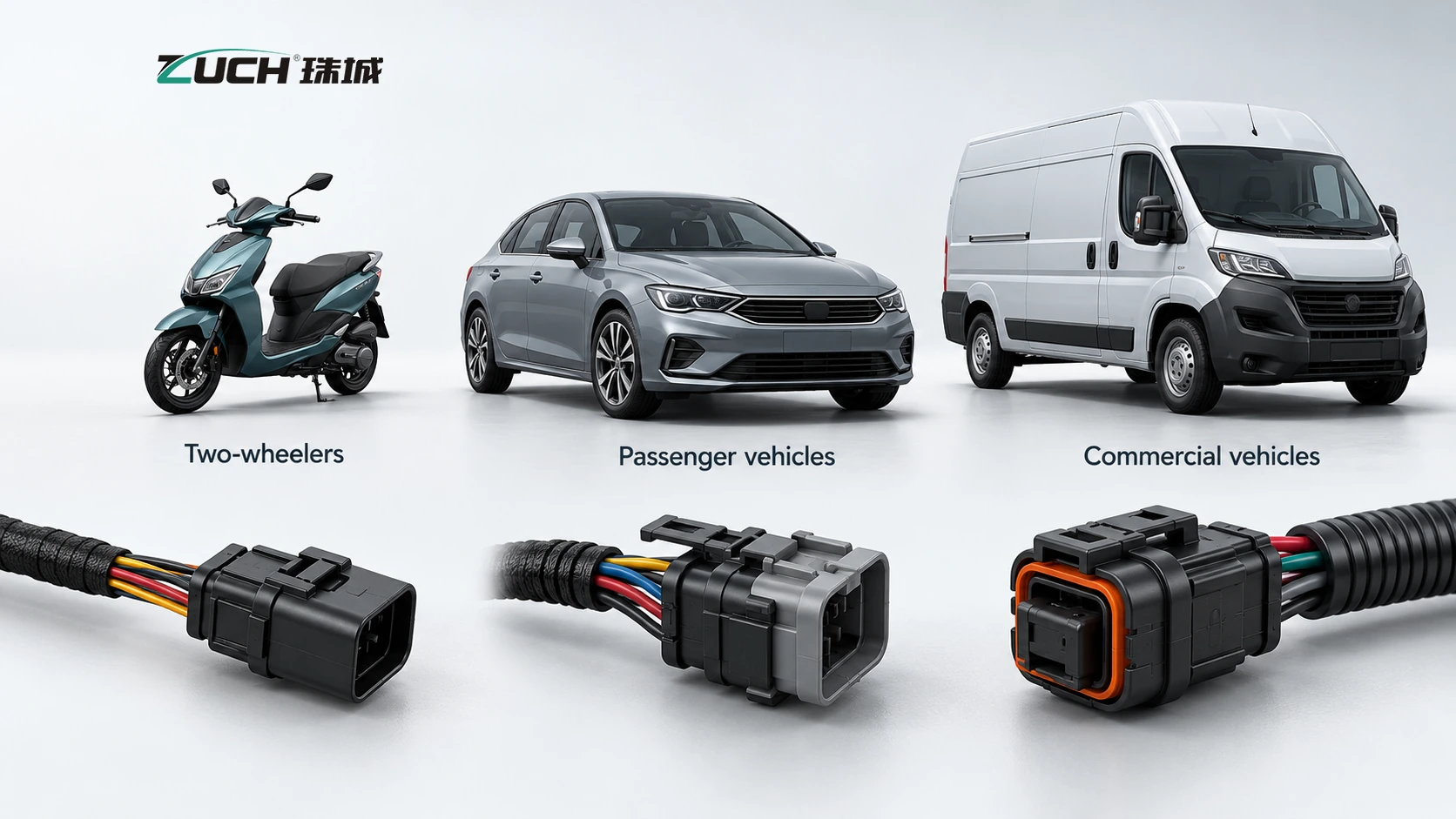
Two-wheelers need connections for lighting, controls and other electrical equipment; electric versions add battery, motor-control and charging-related interfaces. Passenger vehicles combine conventional power circuits with sensors, infotainment and data links. Commercial vehicles add their own duty cycles, installation environments and service constraints. These are application groups, not interchangeable connector families.
The current PM E-DRIVE portal separately lists electric two-wheelers, three-wheelers, ambulances, trucks, buses and charging infrastructure. That segmentation is useful for planning enquiries. It does not show how many connectors each vehicle contains, and incentive targets should not be presented as completed vehicle sales or connector orders.
For a meaningful demand estimate, keep two variables separate: the number of vehicles in the intended segment and the number and value of specified connections per vehicle. A high-volume simple harness and a lower-volume complex electrical architecture can create different opportunities. Use the customer’s released bill of materials rather than an assumed universal connector count.
How does electrification change the purchasing specification?
Electric vehicles continue to use low-voltage connections for many functions while adding distinct traction and charging requirements. High-speed data connections form another category. The IEA’s 2026 outlook provides current market context, including vehicle deployment, manufacturing and technology trends; it is not a source of component-level approval criteria.
Aptiv’s public portfolio separately presents low-voltage, high-voltage and high-speed connectivity. That separation is a useful reminder to organize enquiries by electrical function. A small sealed connector is not automatically suitable for a traction circuit, and a connector with sufficient current capacity is not automatically qualified for a high-speed signal channel.
For each programme, identify operating voltage, load profile, temperature, vibration, fluids, mating cycles and service requirements. Add signal-channel requirements where applicable. These details determine which drawings, application specifications and validation reports are relevant; a general statement that the supplier serves the EV industry is insufficient.
When does local supply offer an advantage?
Local inventory may reduce replenishment time and simplify small orders. Local manufacturing can provide different advantages, such as closer tool maintenance, process support or change management. These claims should be verified separately. A distributor’s Indian address does not identify where the product was manufactured, and a domestic factory does not guarantee that every material or process is local.
| Supply route | Potential purchasing advantage | Evidence to obtain |
|---|---|---|
| Authorized distribution | Access to a documented manufacturer part and regional stock | Authorization, exact reference, stock location and pack quantity |
| Local harness specialist | Assembly support and smaller project quantities | Component traceability, tooling and assembly controls |
| Domestic component manufacturer | Programme support and production coordination | Manufacturing scope, drawing control and validation capability |
| Overseas direct supply | Access to particular product ranges or custom development | Landed cost, lead time, samples and change-notification process |
Compare the same approved assembly and order quantity across routes. A low price for a housing is not comparable to a quotation that includes terminals, seals, packaging and inspection documentation. Before selecting a source for automotive connectors India projects, resolve those differences in the quotation itself.
What must a supplier prove before a production order?
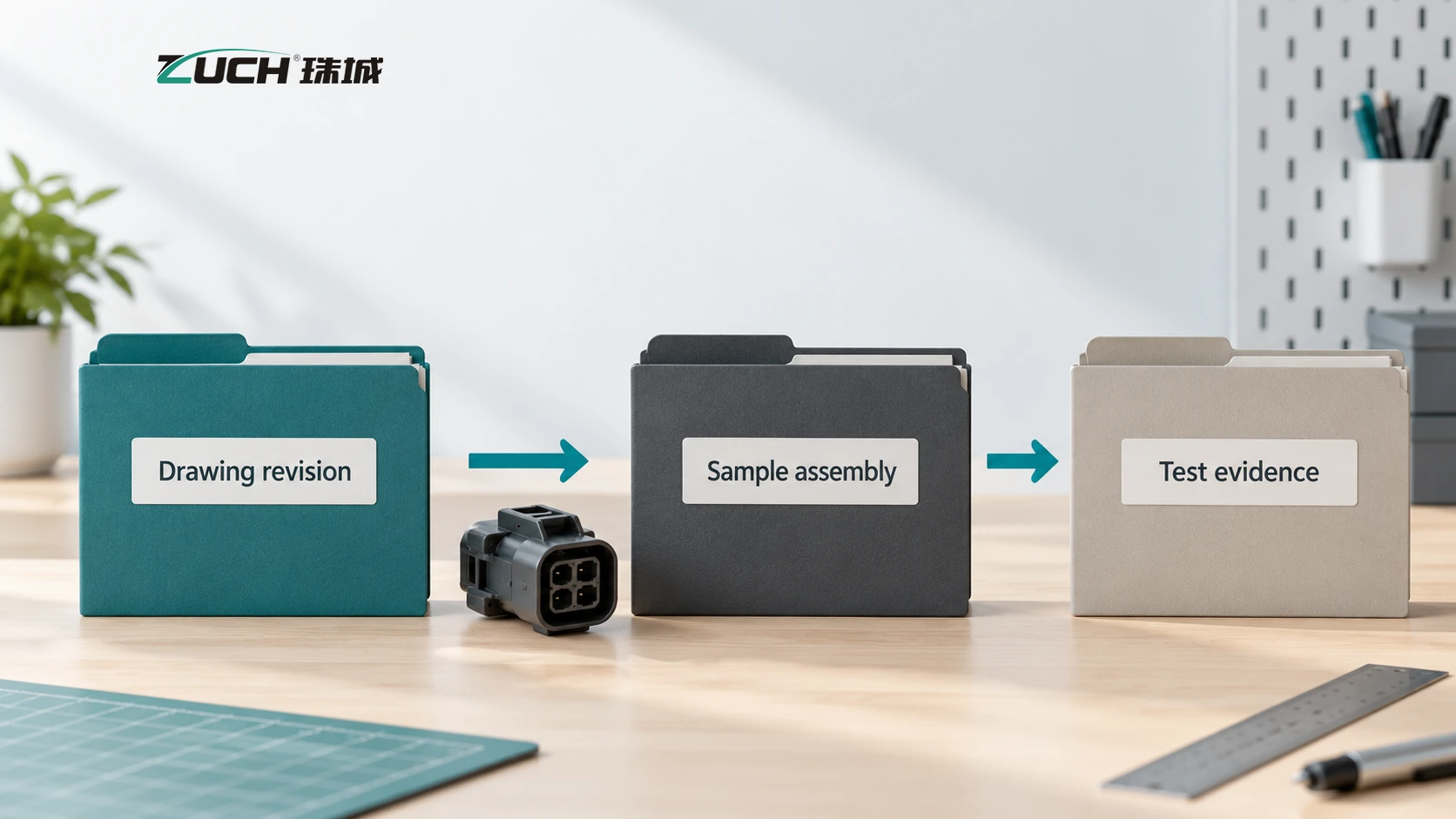
Use three approval records: a controlled drawing, a representative assembled sample and the required test evidence. The drawing defines the item. The sample shows the proposed production configuration. The evidence establishes whether that configuration was assessed against the agreed requirements. None replaces the other two.
IEC 60512-1:2018 describes the framework for connector tests and measurements and states that detailed product specifications establish test severity and performance limits. Ask for the test method, sample identity, configuration, results and acceptance criteria together. A report on a different contact, seal or wire combination may not support the proposed assembly.
| Demand or cost driver | Question for the programme team | Purchasing implication |
|---|---|---|
| Vehicle architecture | Which power, control and data circuits are included? | Separate connector families and approval requirements |
| Environmental exposure | Where is the connection mounted and how is it cleaned? | Specify sealing, materials and test conditions |
| Production volume | What are pilot, recurring and service quantities? | Agree pack sizes, tooling and replenishment arrangements |
| Localization objective | Which manufacturing steps and origins must be documented? | Request evidence rather than relying on office location |
| Engineering changes | Who approves material, tooling or drawing changes? | Define notification and revalidation triggers |
How should buyers turn market demand into a usable RFQ?
Start with the exact connection requirement and its mating reference. State the wire specifications, environment, expected volume, sample timing and necessary documents. The automotive connector RFQ checklist provides a practical structure for this information. Separate confirmed requirements from items the supplier is being asked to develop.
Keep quality-system certification, product testing and vehicle-programme approval as distinct evidence. A certificate can describe a management system and its scope; it does not automatically establish that a proposed connector meets the customer’s electrical, environmental or dimensional requirements. Policy eligibility and customs requirements likewise need their own current review.
For automotive connectors India sourcing, total cost includes parts, freight, import charges where applicable, qualification, tooling, rejected assemblies and service replenishment. Avoid a universal saving percentage. A supplier with the correct documented assembly can be less costly overall even when its unit price is higher.
ZUCH’s rectangular connector range and connecting terminals provide starting points for specification-based enquiries. Buyers should request drawings and application evidence for the exact proposed item, rather than assume suitability from the product-category name.
Frequently asked questions
How is the automotive connectors market growing in India?
Vehicle electrification and changing electrical architectures create different connector requirements across India's vehicle segments. The IEA reports 165,000 electric car sales in 2025, up 75% year on year, but that is vehicle-market evidence, not a connector-market growth rate. A connector forecast also needs defined vehicle content, replacement demand, prices and scope.
What is driving connector demand in India's automotive industry?
Vehicle production, electrification, electronic functions and service replacement demand all influence purchasing. Their effect depends on the actual electrical architecture and bill of materials. Buyers should separate new-production requirements from aftermarket repairs and avoid converting a policy target directly into assumed connector orders.
How are electric vehicles affecting automotive connectors in India?
EVs retain many low-voltage connections while adding distinct traction, charging and data requirements. These functions need different interfaces and validation evidence. An EV-related enquiry should identify the circuit and environment rather than assume every connector used on an electric vehicle requires the same voltage or sealing performance.
Which vehicle segments use the most connectors in India?
There is no verified ranking here of total connector consumption by vehicle segment. Two-wheelers have high unit volumes, while passenger and commercial vehicles can have different electrical complexity and component value. Compare released bills of materials and production volumes before claiming that one segment consumes the most connectors.
What should overseas suppliers know about the India connector market?
Clarify the vehicle segment, customer specification, required local support, sample approval process and commercial responsibilities. Buyers may distinguish local inventory, domestic manufacturing and imported components. Overseas suppliers should document their actual manufacturing scope, lead times, traceability and change controls instead of making broad localization claims.
Are locally sourced automotive connectors growing in India?
India's manufacturing and electrification programmes make localization an important sourcing question, but the cited sources do not establish a single domestic share for all automotive connectors. Verify the origin and production steps for the specific item. A local sales address or warehouse should not be treated as proof of domestic manufacture.
References
- IEA Global EV Outlook 2026: trends in electric cars, including India sales in 2025
- IEA Global EV Outlook 2026: trends in other EV modes, including two- and three-wheelers
- Government of India: PM E-DRIVE programme and vehicle categories
- IEC 60512-1:2018: connector tests and measurements, general specification
Sources checked on 26 October 2026. Illustrations show generic examples and do not establish product fitment or approval.
What to take away
India’s connector opportunity is best understood by vehicle segment, circuit function and purchasing scope. Use current vehicle data to identify where to investigate, then base the actual sourcing decision on a controlled assembly, credible test evidence and a supply route that can support production and service needs.
For a ZUCH sourcing review, share the connector specification and expected quantities, including the documentation needed for supplier qualification.