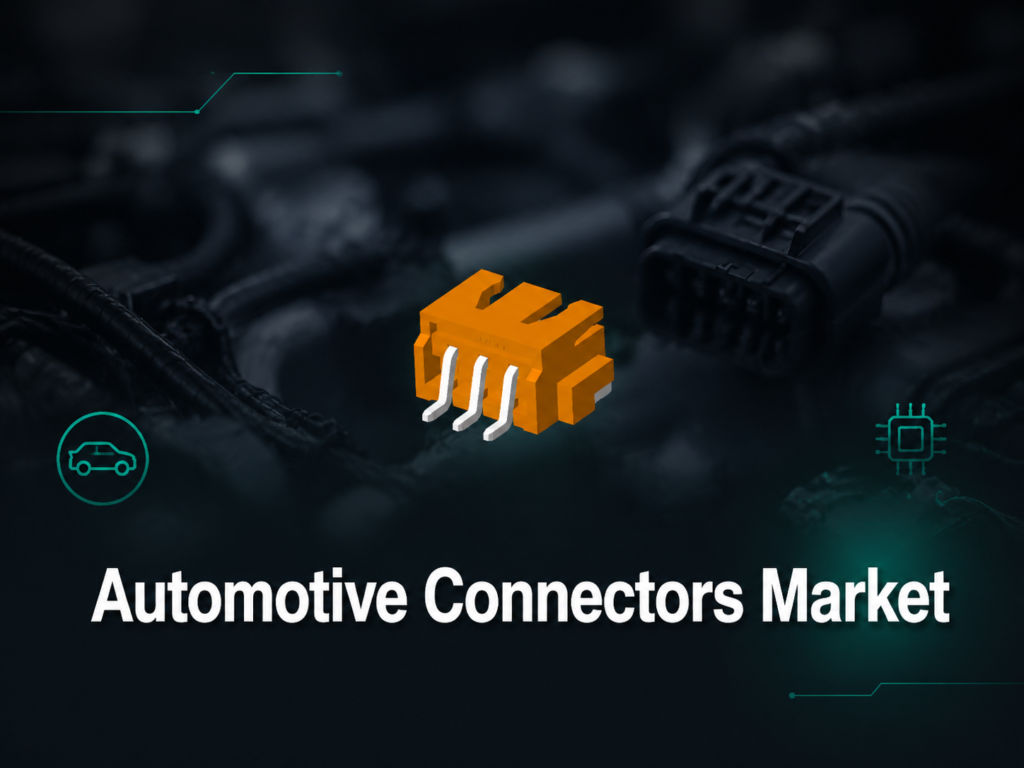
Automotive Connectors Market
The automotive connector market is an integral part of the automotive industry’s transformation. As manufacturers strive to improve vehicle safety, efficiency, and user interactions by deploying more advanced electronics, automotive connectors have emerged as essential parts of today’s machines. These connectors provide continuity in communication between all systems in a vehicle, and they allow for electricity to be evenly distributed throughout the vehicle’s electrical systems (power distribution). Therefore, modern vehicle technology relies heavily on the use of automotive connectors. But how big of a market is it, how much potential does this market have, and what is the significance of all the media attention? Read on to find out more about the automotive connector market and how it is changing the future of automotive markets.
What Is the Size of the Automotive Connector Market?
According to recent market research, the automotive connectors market had an approximate global market valuation of $15.5 billion in 2022 and is expected to reach $25.8 billion by 2030, representing a compound annual growth rate (CAGR) of roughly 6.5% during the projected years. The primary drivers of this rapid growth are the increasing availability of electric vehicles (EVs), the growing number of vehicles equipped with advanced driver-assistance systems (ADAS), and the increasing prevalence of infotainment systems and connected vehicle technologies. North America, Europe, and Asia-Pacific represent the largest regional shares of the automotive connector market. However, due to the high volume of automotive manufacturing and rapid technological advancements occurring in regions such as China, Japan, and South Korea, Asia-Pacific is expected to hold the largest share of the automotive connectors market for the foreseeable future. Market growth does not replace the need to check automotive connector standards for a particular vehicle program.
Key Drivers of the Automotive Connectors Market
Several factors contribute to the tremendous growth of the automotive connector market. In this section, we will examine some of the most notable factors:
1. Growth of the Electric Vehicle (EV) Market: There has been an increasing number of EVs entering the marketplace, which has created significant demand for automotive connectors capable of handling higher voltage connections. Automotive connectors are critical for electric powertrain technologies, vehicle battery supply management, and the deployment of EV charging systems.
2. Advanced Vehicle Technologies: As advanced driver-assistance systems (ADAS), telematics, and infotainment systems become standard equipment in modern vehicles, the need for reliable connectivity solutions within the vehicle has increased exponentially. Automotive connectors enable communication and data transmission between the many systems that comprise today’s vehicles.
3. Stringent Safety Requirements: Governments worldwide are establishing very stringent safety regulations, encouraging automotive manufacturers to install advanced safety systems (e.g., lane departure warning and collision avoidance systems), which require sophisticated wiring and connector systems.
4. Increasing Consumer Demand for Comfort and Connectivity: Consumers expect modern vehicles to include seamless connectivity, such as wireless device integration and real-time GPS navigation. Without automotive connectors, many of the highly sought-after features and capabilities of today’s vehicles would not be possible, as they serve as the “bridge” between hardware and software systems.
Types of Automotive Connectors
Automotive connectors can be grouped by their function, design, and application. The following are popular types of automotive connectors:
1. Wire-to-Wire Connectors: These link two wires together to enable complete and uninterrupted electrical current transmission.
2. Wire-to-Board Connectors: These connect wires to printed circuit boards (PCBs) and are common in many automotive safety and infotainment systems.
3. Board-to-Board Connectors: These are used to connect two circuit boards and are deployed in many control modules and advanced vehicle systems.
4. Sealed Connectors: Sealed connectors are designed to protect against environmental factors such as moisture and dust, which is essential for under-hood or external uses.

Automotive Connectors Market Trends to Observe
The automotive connectors market trends are rapidly evolving as the automotive market transforms. Below are several key trends shaping the future of the automotive connector market:
1. Increasing Use of Lightweight Materials: Automakers are adopting lightweight yet strong materials for automotive connectors to enhance fuel economy in internal combustion engine (ICE) vehicles and maximize the range of electric vehicles.
2. Increase in Autonomous Vehicles: As fully autonomous vehicles are developed, the need for high-quality connectors that allow for fast real-time data sharing and computation will grow significantly.
3. 5G: The emergence of 5G technology will drive greater demand for improved vehicle connectivity by enabling faster transmission speeds.
4. IoT and Smart Manufacturing: The introduction of IoT technology is revolutionizing the manufacturing process for automotive connectors, enabling smarter, more efficient, and cost-effective production.
Top Automotive Connector Manufacturers
Automotive connectors are critical for performance and reliability, making it essential to source them from trusted manufacturers. Below are some of the leading automotive connector manufacturers:
1. TE Connectivity: A leading provider of innovative connectivity solutions, TE Connectivity offers automotive connectors for a variety of applications, including ADAS and electric vehicles.
2. Molex: A global leader in the design and manufacture of high-performance connector solutions, Molex provides connectors to leading automotive manufacturers, supporting critical electronic systems.
3. Aptiv: Aptiv is a global technology company focused on developing connectors to support autonomous vehicles and high-voltage EV applications.
4. Yazaki Corporation: Yazaki specializes in producing wire harnesses and connector assemblies, serving automotive manufacturers worldwide with reliable and durable products.
FAQs: Addressing Your Queries about the Automotive Connectors Market
Q: What’s driving growth in the automotive connectors market?
A: Growth is driven by the rising popularity of electric vehicles, the implementation of technology for connected and autonomous vehicles, and consumer demand for comfort and safety in modern vehicles.
Q: What is the size of the automotive connectors market?
A: The automotive connectors market was valued at over $16 billion in 2023, with an average annual growth rate (CAGR) of 6.5% projected through 2030.
Q: What are major trends in the market?
A: Key trends include 5G integration, adoption of smart manufacturing techniques, increased use of lightweight materials, and growing demand for advanced connectors to support autonomous and electric vehicle technologies.
Q: What companies are major automotive connector suppliers?
A: Major companies supplying automotive connectors include TE Connectivity, Molex, Aptiv, and Yazaki Corporation, among others.
Q: What are the key challenges in the automotive connectors market?
A: Challenges include ensuring high-quality and reliable connectors while minimizing manufacturing costs, meeting stringent regulatory requirements, and addressing material limitations for extreme conditions.
In conclusion, the automotive connectors market is poised for significant growth in the coming years, driven by technological innovation, changing consumer preferences, and stricter safety regulations. All stakeholders—automakers, suppliers, and investors—must stay updated on emerging trends and opportunities to capitalize on this expanding industry. By focusing on innovation and responding to evolving market demands, industry participants can unlock the immense potential of this thriving sector.
What is driving growth in the automotive connector market?
Public sources consistently point to vehicle electrification, increased electronic content, ADAS and data systems, connected features, and continuing vehicle production. The connector consequence depends on the application, so the article should distinguish high-voltage power, low-voltage harness, data, board-to-wire, and charging interfaces.
Why do automotive connector market reports show different market sizes?
Reports use different definitions, regions, base years, currencies, channels, and forecast periods. Some include harnesses or charging hardware while others count only connector components. Compare scope and methodology before comparing the number.
How do EVs change automotive connector requirements?
EV programs can add high-voltage battery, inverter, charging, interlock, and thermal-management interfaces, while also retaining many low-voltage body and data connections. A market trend does not replace the voltage, current, shielding, creepage, sealing, and validation requirements of a specific design.
Which regions are important for automotive connector sourcing?
Asia-Pacific, Europe, and North America all matter, but the best sourcing region depends on the target vehicle program, approved supply base, tooling location, logistics, qualification, and change-control needs. Do not select a supplier from regional demand data alone.
Which companies are major automotive connector suppliers?
Public market and industry sources commonly identify companies such as TE Connectivity, Aptiv, Yazaki, Amphenol, and Molex. This is a supplier landscape, not a universal ranking. Verify the exact product family, application evidence, regional support, and commercial fit for the program.
What should a buyer request when evaluating a market opportunity?
Request the connector scope, vehicle and application segment, expected annual volume, qualification timeline, drawings, test requirements, approved alternates, tooling ownership, change-notification process, and supply continuity plan. These inputs connect a market estimate to a decision that engineering and purchasing can act on.
How to Read Automotive Connector Market Estimates Without Mixing Scopes
Automotive connector market estimates are not directly comparable unless they use the same geography, base year, product boundary, channel, and forecast period. One report may count only vehicle connectors, while another may include wire harnesses, high-voltage interconnects, service parts, or adjacent electronics. The figures already quoted in older market summaries should therefore be treated as publisher-specific estimates, not as a single industry consensus.
A more reliable market review records the report publisher, publication date, covered connector categories, vehicle scope, region, currency, base year, forecast horizon, and whether the estimate is revenue, shipments, or installed content. Keep that scope note next to every number so a supplier or investor does not mistake a forecast for an audited industry total.
| Demand signal | Connector implication | Evidence boundary for buyers |
|---|
| Electric-vehicle adoption | More attention to high-voltage, battery, inverter, charging, interlock, and thermal-management interfaces | EV sales growth does not by itself prove a particular connector family, rating, or supplier opportunity |
| ADAS and vehicle compute | Higher need for controlled signal, data, shielding, and service interfaces | Confirm the protocol, signal integrity, shielding, and mating system rather than using “ADAS connector” as a specification |
| Harness and module complexity | More multi-pin, sealed, board-to-wire, and modular interfaces | Count populated circuits, not only housing positions, and map the mating half and terminal system |
| Regional production and sourcing | Different qualification, logistics, localization, and change-control requirements | Separate demand in the vehicle market from addressable demand for an individual supplier |
What Current Public Data Can and Cannot Prove
The IEA’s Global EV Outlook 2025 reported that global electric-car sales were expected to exceed 20 million in 2025 and represent more than one-quarter of cars sold worldwide. OICA production statistics and national industry reports provide a separate view of vehicle output. These sources support the direction of electrification and production activity, but they do not provide a connector-market revenue total. Connector forecasts should be read as secondary market research and compared on scope before use in a business case.
For supplier planning, convert the market narrative into an addressable opportunity: define the target vehicle segment, application zone, connector family, annual build volume, qualification stage, regional supply route, and evidence required by the customer. This is more useful than repeating a large top-down CAGR without a product or program boundary.
References and Further Reading
- International Energy Agency, Global EV Outlook 2025
- OICA Production Statistics
- Grand View Research, Automotive Connectors Market
- Mordor Intelligence, Automotive Connector Market
 Zhejiang ZUCH Technology Co., Ltd.