Cable Assembly Specification Checklist: 18 Details Buyers Should Define Before Quoting
Cable Assembly Specification Checklist: 18 Details Buyers Should Define Before Quoting
Comparable quotes for cable assemblies start with a controlled specification, not a connector part number and a target price. Before any supplier prices a custom or build-to-print harness, the buyer should define cable construction, connector interfaces, shielding treatment, routing assumptions, labeling, documentation, and test acceptance. That RFQ-ready basis makes quotations comparable and reduces rework after the first sample build. For a related technical reference, see Custom Cable Assembly DFM: How to Reduce Rework Before Production.

Contents
What should buyers define before requesting cable assembly quotes?
Treat the RFQ as a release basis. A supplier cannot quote or build consistently if the buyer has not fixed the cable, every connector interface, shielding method, mechanical routing assumptions, labeling scheme, and acceptance plan. Interconnect design guidance consistently treats electrical rating, mechanical routing, environmental exposure, and connector compatibility as early inputs—not details to resolve after pricing.
The checklist below covers 18 details buyers should define before quoting:
- Controlled assembly drawing number and revision.
- Overall length and length tolerance per branch or overall assembly.
- Cable type, conductor size, stranding, and insulation/jacket material.
- Voltage, current, impedance, or signal class relevant to the application.
- Operating temperature range and expected environmental exposure.
- Connector manufacturer, series, and part number at each end.
- Mating counterpart, keying, and orientation requirement.
- Termination method: crimp, solder, insulation displacement, or other defined process.
- Approved tooling or process reference where the program requires it.
- Shield type and shield termination method, including drain-wire treatment.
- Grounding or bonding requirement, if applicable.
- Minimum bend radius and routing constraints, including service loop allowance.
- Strain relief, tie-wrap location, grommet, or backshell requirement.
- Wire identification, label content, and label placement rules.
- Packaging, coiling, bagging, and shipment protection requirement.
- Applicable workmanship or acceptance class, such as IPC/WHMA-A-620 where used by the program.
- Required test sequence and acceptance criteria.
- Sample quantity, approval authority, traceability, and change-control expectation.
| Decision stage |
Buyer question |
Minimum RFQ field |
Why it affects procurement |
| Requirement lock |
Is the assembly fully defined? |
Drawing, revision, BOM, branch list |
Prevents “similar harness” quotes |
| Cable screen |
Is the wire itself specified? |
Conductor, insulation, rating, length |
Cable cost and compliance scope vary widely |
| Interface screen |
Are connectors and terminations fixed? |
Part numbers, mating, termination method |
Wrong interface is the costliest rework |
| Build screen |
Can the assembly be routed and labeled as intended? |
Bend radius, shielding, labels, strain relief |
Field failures often start here |
| Release screen |
How will the buyer accept the result? |
Test plan, workmanship class, sample approval |
Turns a quote into a releasable purchase |
Important: A connector catalogue number is not a cable-assembly specification. Buyers still need the cable, termination process, shielding treatment, routing assumptions, labeling rules, and acceptance method defined before treating any quote as comparable. Where connector selection is still open, use a structured supplier review such as the connector manufacturer selection guide before fixing assembly release.
How do you specify cable construction and electrical requirements?
Start with the conductor and jacket because every downstream decision depends on them. State the wire gauge, stranding, insulation material, shield presence, and any required cable marking from the cable manufacturer. If the program uses a controlled corporate part number, include it together with an approved equivalent rule or a “no substitution” statement.
Electrical definition should stay within the buyer’s actual application. Identify working voltage, expected current, signal type, impedance requirement, or other limits that affect cable selection. Temperature range, flex cycle expectation, fluid exposure, UV exposure, and abrasion risk belong in the same section because they influence both cable choice and test scope. Independent wire and cable guidance shows that applicable safety requirements depend on the cable product and destination market, so the RFQ should name the requirement source rather than assuming one generic “approved cable.”
Length definition needs more than a single dimension. Specify whether the stated length is overall, between reference points, or per branch. State the tolerance and whether the measured point is at the connector reference face, the strain-relief exit, or another defined datum. If the assembly includes a service loop, branch breakout, or slack allowance, define it explicitly so suppliers do not absorb hidden length in unequal quotes.
Which connector and termination details belong in the RFQ?
Connector definition must include both the housing and the termination system. For each connector end, list the manufacturer, series, part number, pin count, keying, and required orientation relative to the drawing. Identify the mating counterpart and whether the assembly supplier or the buyer supplies each connector body, contact, backshell, or accessory.
Termination detail is where many RFQs fail. Specify crimp contact part number, wire barrel size, insulation support requirement, solder procedure reference, or other approved method. If the program requires a specific crimp tool, die set, pull-test limit, or crimp-height verification method, include that requirement. Buyers evaluating terminal evidence can use the terminal supplier quality control checklist to define the process records they expect from the component supplier before assembly release. For a related technical reference, see Motor Connector Vibration Retention: A Buyer Verification Checklist.
| Request |
What to check |
Why it affects procurement |
| Connector drawing or datasheet |
Pinout, keying, orientation, accessory needs |
Prevents mirrored or mis-keyed builds |
| Contact and termination spec |
Wire range, crimp/solder method, tooling reference |
Affects pull-test results and rework |
| Mating-part control |
Who supplies mate, latch, seal, or backshell |
Changes cost, lead time, and responsibility |
| Sample approval rule |
First-article requirement and retest trigger |
Defines when production may start |
| Component traceability |
Lot record for connector and terminal materials |
Supports containment if a defect appears |
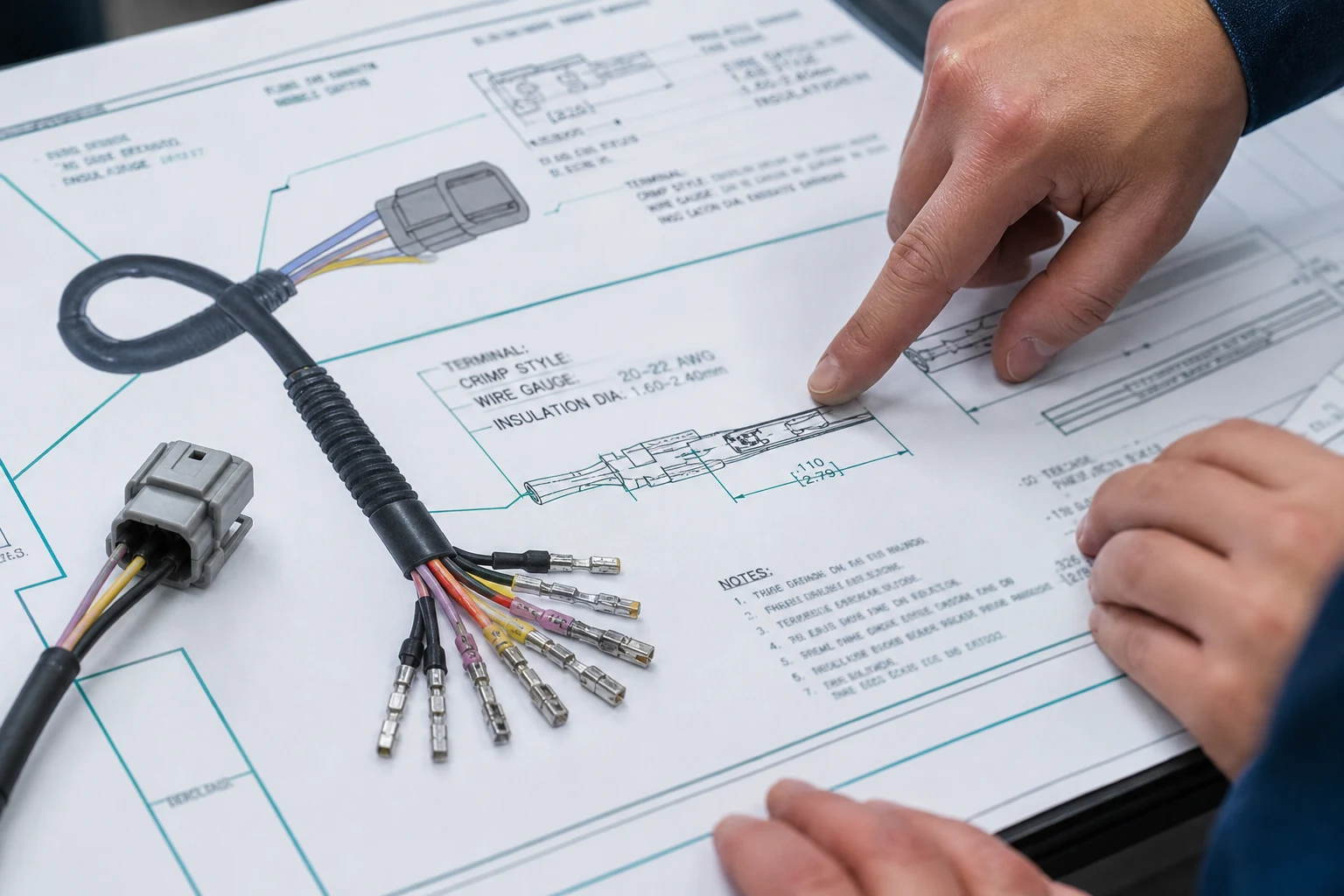
Do not assume the assembly supplier will select a “equivalent” contact unless the RFQ authorizes that process and defines acceptance evidence.
What shielding, grounding, and mechanical routing details matter?
Shielding must be defined as a build requirement, not as a note that says “shielded cable.” State whether the cable uses foil, braid, or both; whether the shield is exposed at one end or both; and how the drain wire or foil bond is terminated. If the program requires 360-degree termination, pigtail length control, or a defined ground path to a shell or pin, show that on the drawing or in the RFQ notes.
Mechanical routing details prevent field failures that electrical tests may not catch. Define minimum bend radius by reference to the cable manufacturer’s limit or the drawing. Identify tie-wrap locations, clamp zones, grommets, split-loom requirements, and any area where the harness must remain flexible. Strain-relief method should be explicit: internal clamp, overmold, heat-shrink boot, backshell, or other approved approach.
If the assembly passes through a panel, enclosure slot, or moving hinge, define the routing envelope and any required slack. Suppliers quote very differently when they must preserve a controlled service loop, maintain a bend zone away from the connector tail, or build in a strain-relief transition that was never shown on the initial sketch.
Which labeling, packaging, and documentation fields reduce rework?
Labeling is a specification item, not decoration. Define whether each wire is identified by color alone, by marker sleeve, by wrap label, or by heat-shrink print. State label content, language, sequence, placement distance from the connector, and durability requirement. If the end product requires a unique serial label, batch code, or barcode, include format and placement rules in the RFQ.
Documentation should travel with the quote request. Provide the controlled drawing, BOM, revision history, applicable customer specification, and any referenced workmanship standard. If the program uses an acceptance class from IPC/WHMA-A-620, name the class and the evidence expected with the first sample submission. Clarify whether the supplier must provide a build traveler, test record, material declaration, or certificate tied to the delivered lot.
Packaging requirements also belong in the first RFQ. Define coil diameter, tie method, bagging, box quantity, protection against connector damage, and any requirement for separate bagging of mated parts. Small packaging omissions often become chargebacks after the first shipment.
What test and acceptance criteria should be fixed before production?
A quote without a test plan is incomplete. Define the sample quantity, the sequence of checks, the equipment or method, the acceptance limits, and the authority that can release production. Depending on the assembly, a plan may include continuity, point-to-point verification, insulation resistance, hi-pot testing where applicable, pull testing for crimped terminations, shield continuity, functional mating check, visual workmanship review, and dimensional verification against the drawing.
Do not copy a test list from an unrelated harness family. Limits and methods should follow the drawing, the applicable standard, or the customer specification. If the buyer expects first-article approval before serial production, state the required records and the conditions that trigger retest after a material, tooling, or routing change.
Workmanship acceptance should be named before production, not debated on the build floor. If a program uses a published workmanship standard, identify the class and the nonconformance handling rule. If the buyer uses a customer-specific checklist, attach it to the RFQ and require the supplier to confirm compliance before the pilot run.
Which ZUCH component routes fit the inquiry, and what should go in the RFQ?
ZUCH’s live site presents connector product routes and terminal product routes for buyers defining interface components used in an assembly. Those pages help narrow connector and terminal families before the buyer locks the detailed drawing, but they do not replace a cable-assembly build specification and do not indicate that ZUCH manufactures finished harnesses.
When the open question is which connector or terminal family fits the interface, review the relevant item documentation in the live product catalogue and compare it with the assembly drawing before sending the harness RFQ to an assembly supplier. Buyers who also need a structured way to evaluate connector suppliers can combine this checklist with the published connector manufacturer selection guide.
RFQ inputs to send
- Controlled drawing, revision, and branch/BOM list.
- Cable construction, rating, length, and tolerance definition.
- Connector and terminal part numbers, mating parts, and orientation.
- Termination method, tooling reference, and component-supplier evidence where required.
- Shielding, grounding, bend-radius, and strain-relief requirements.
- Labeling, packaging, and documentation deliverables.
- Test plan, workmanship class, sample approval, traceability, and change-control rules.
Fit Boundary
This checklist fits teams that can define a cable assembly before comparing supplier quotes. It is not a substitute for a customer-specific qualification procedure, a regulated-program approval, or an engineering review of safety-critical conditions. A connector or terminal catalogue entry is a component discovery route, not proof that a finished assembly is approved for a specific end product.
To request connector or terminal documentation for interface review, use ZUCH’s sample request route or contact page and provide the controlled drawing inputs above. That gives the supplier a defined basis to route the inquiry through the product catalogue instead of responding to an underspecified component question.

Close the RFQ completeness gaps before asking for comparable cable assembly quotes
A cable assembly RFQ becomes useful when another engineer can read it and build the same interpretation without a call. The most expensive omissions are usually not exotic electrical values; they are unclear lengths, connector orientation, supplied components, bend zones, labels, packaging and acceptance records.
| RFQ gate |
Must be explicit |
What an omission causes |
| Drawing control |
Drawing/BOM revision, branch dimensions and reference datums |
Suppliers quote different assemblies under the same name |
| Interface control |
Connector/contact part numbers, keying, orientation and mating parts |
Mis-keyed or non-mating samples |
| Build control |
Termination method, tooling, shield treatment, bend radius and strain relief |
Rework, inaccessible crimps or damaged cable exits |
| Identification |
Wire labels, placement, serial/lot data and packaging |
Receipt and service errors even when continuity passes |
| Release control |
Sample quantity, tests, acceptance limits and approval authority |
Production starts before the buyer can release the sample |
When a requirement is not yet known, mark it open and assign an owner rather than silently leaving the field blank. A controlled “TBD” with a due date is safer than a supplier assumption that becomes embedded in a quotation or prototype.
Use the completed checklist as the comparison baseline. If one supplier proposes an equivalent cable, terminal or connector, require the proposed substitution and its supporting evidence to be listed separately from the base quote.
Write the workmanship class and revision into the RFQ
If the program uses IPC/WHMA-A-620, state the applicable class and revision or customer-specific acceptance document. Also separate fixed requirements from supplier-proposed alternatives: an equivalent wire, contact or process should be listed as a controlled deviation with evidence, not silently substituted inside the base quotation.
FAQ
What is the most commonly missed cable assembly RFQ detail?
Buyers often leave connector orientation, branch reference points, supplied components, bend zones, labels or sample acceptance implicit. Mark each field as fixed, open with an owner, or not applicable so suppliers do not fill the gap differently.
Should a cable assembly RFQ include the mating connector?
Yes, when mating fit, keying, orientation or service access affects the assembly. Identify the mating counterpart and who supplies it, even if it is not part of the quoted shipment.
What should happen when a supplier proposes an equivalent cable or terminal?
Keep the base quote tied to the specified part, then list the proposed equivalent separately with drawing, material, electrical, mechanical and validation evidence. Do not let an “equivalent” substitution disappear into a price comparison.
What should be in a cable assembly RFQ?
Include the controlled drawing, cable definition, connector and termination details, shielding and routing requirements, labeling rules, documentation deliverables, test plan, sample-approval rule, and traceability or change-control expectations.
How do I specify shielding and grounding?
State the shield type, which end or ends require termination, the drain-wire or foil-bond method, and any required ground path to a shell, pin, or chassis reference. Show the requirement on the drawing when possible.
What tests should buyers define?
Define the sample quantity, test sequence, method, acceptance limits, and release authority. Typical plans may include continuity, insulation or hi-pot checks where applicable, pull testing, shield verification, mating fit, workmanship review, and dimensional checks.
Which connector details matter most?
Fix the part number, mating counterpart, keying, orientation, contact/termination method, and any required tooling or pull-test evidence. Interface errors are among the most expensive rework sources.
Do bend radius and routing belong in the spec?
Yes. Define minimum bend radius, service-loop allowance, tie-point or clamp zones, strain relief, and any enclosure or hinge routing envelope so suppliers quote the same mechanical build.
What labeling should be fixed before quoting?
Define label type, content, language, placement, durability, and any serial or batch-code requirement. Do not leave wire identification to supplier habit.
Can a catalogue connector number alone define an assembly?
No. A connector number helps identify a component route. A releasable assembly still requires cable, termination, shielding, routing, labeling, and acceptance criteria defined on the buyer’s release basis.
Key takeaway
A comparable cable assembly quote depends on a comparable specification. Fix the drawing, interfaces, cable construction, routing, labels, packaging and acceptance plan before comparing price or lead time.
References
 Zhejiang ZUCH Technology Co., Ltd.