Plug vs Receptacle Connectors: A Design Guide for Mating Interfaces
Plug and receptacle are roles in a mating pair, and assigning them well protects live contacts, guides handling and simplifies service. Fix the roles from the system, then select the parts.

Contents
Part 1. What defines a plug and a receptacle in a mating pair?
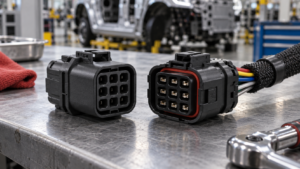
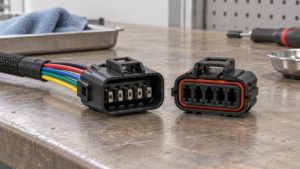
The plug is conventionally the free or moving half that enters, and the receptacle is the fixed half that receives it. Contact gender can vary independently of that convention, so drawings should state both the housing role and the contact gender explicitly.
| Role element |
Plug half |
Receptacle half |
| Motion |
Free or cable side, moves in service |
Fixed to panel, board or enclosure |
| Typical exposure |
Handled by operators |
Position and tolerance controlled |
| Documentation |
Cable exit, strain relief, grip |
Mounting, sealing, fixing hardware |
A widely used practice keeps the side that remains energized on recessed contacts, so an unmated live half is hard to touch or short. Apply the rule through your own safety review of sources, storage energy and service procedures rather than as a habit.
Part 3. How do panel, cable and board mounting change the choice?
Receptacles often mount to panels or boards where position is controlled, while plugs terminate the cable that moves during service. Mounting style drives sealing interfaces, strain relief, fixing hardware and the tolerance chain to the mating half.
Part 4. How do polarization and orientation interact with the pair?
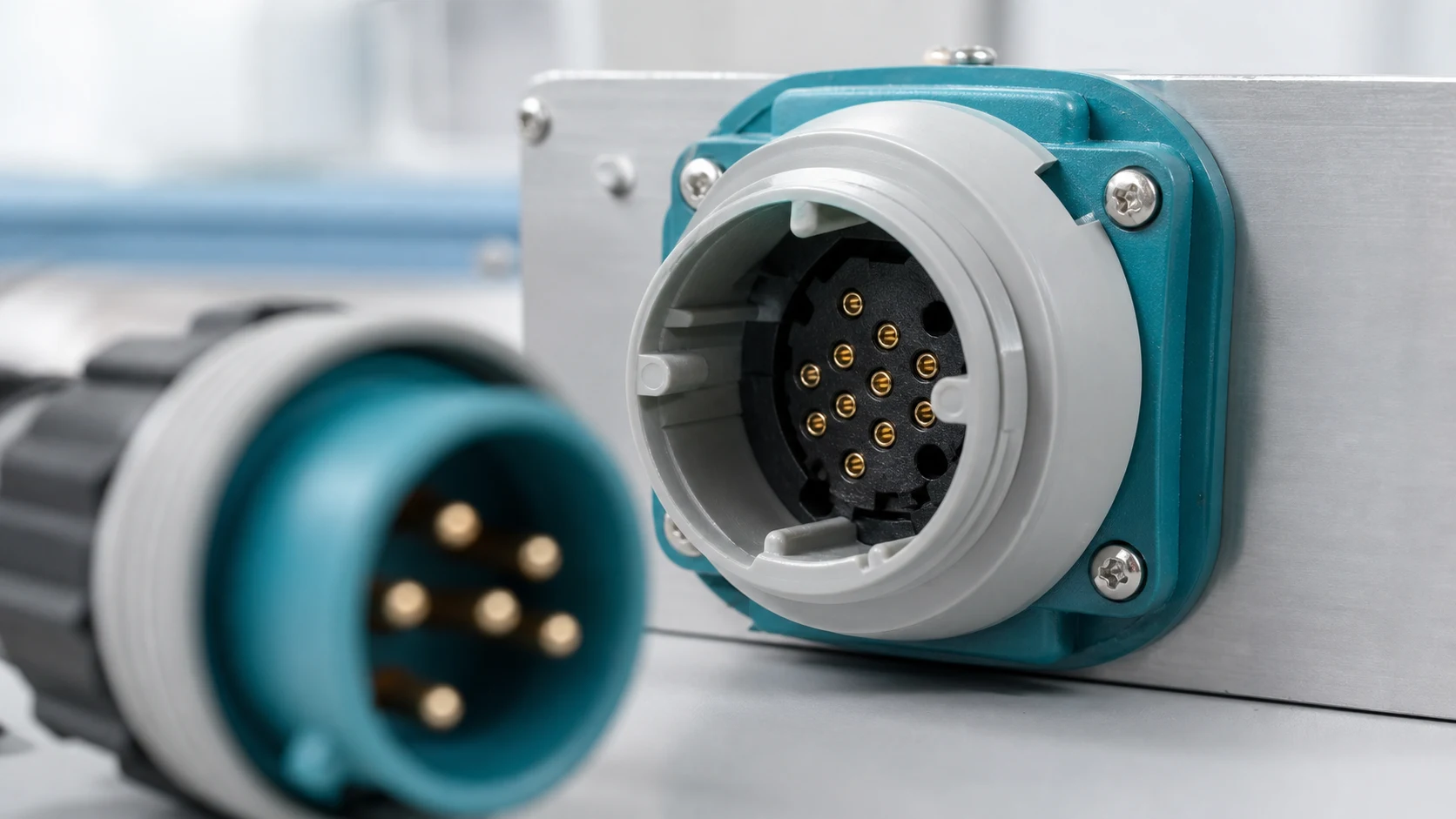
Polarization geometry must exist in both halves and remain unambiguous in the installed orientation, including blind-mating situations. Where identical pairs sit side by side, assign different keys or colours and record the assignment in the drawing set.
| Load case |
Design response |
Verification |
| Cable weight and pulls |
Strain relief on the plug side |
Pull test on representative build |
| Misaligned mating |
Lead-in and float features |
Mating trial at tolerance extremes |
| Vibration |
Latch or coupling retention |
Retention check under the real spectrum |
Part 5. What mechanical loads should the interface tolerate?
Consider mating misalignment, cable weight, service pulls and vibration transmitted through the mounted half. Decide where strain relief and support act, and confirm latch or coupling strength against the load path you actually expect.
Important: General guidance cannot approve a specific design or lot. This is a source-note application of the IPC and TE Connectivity references listed below; apply it through your controlled drawing and acceptance plan.
Part 6. How should the mating interface be documented?
Document both halves, contact gender, keying, sealing, mounting and the mated-pair acceptance checks in one interface definition. Sourcing then evaluates alternatives against the pair, which prevents a compatible-looking half from breaking the system.
Part 7. Which ZUCH route supports a mating-pair inquiry?
Use ZUCH’s Plug Housing category and the live product catalogue to identify relevant connector, terminal or housing component families. These are discovery routes only and do not demonstrate that a specific configuration is approved for your application.
RFQ inputs
- Interface definition naming both halves, roles and contact gender.
- Mounting, sealing and strain-relief requirements per half.
- Keying assignments and orientation rules for the installation.
- Mated-pair acceptance checks, samples and records expected.
Fit Boundary
This guide supports engineering and sourcing discussion; it cannot replace programme-specific validation, market requirements, or an approval record. Use ZUCH’s sample request route or contact page for controlled component documentation and samples.

FAQ
What is the difference between a plug and a receptacle?
The plug is the entering, usually cable-side half; the receptacle is the fixed receiving half. Contact gender is specified separately.
Should the live side be the plug or the receptacle?
Common practice keeps energized contacts recessed in the fixed half, subject to your own safety review of the system.
Can a plug have female contacts?
Yes. Housing role and contact gender are independent choices, which is why drawings must state both.
How do I stop two similar pairs from being cross-mated?
Assign different polarization keys or colours to each pair and document the assignment in the drawing set. For a related technical reference, see Pin Header vs Socket Header: When Each Board Connection Makes Sense.
Which half should get strain relief?
Normally the cable-side plug, so service pulls and cable weight do not load the contacts or the latch.
What checks prove a mating pair is acceptable?
Mating and retention trials, electrical checks on the mated pair, and verification of keying and sealing in the installed orientation.
What should a plug and receptacle RFQ define?
Both halves with roles and genders, mounting and sealing, keying, load cases, samples and mated-pair acceptance evidence.
References
 Zhejiang ZUCH Technology Co., Ltd.