Zhejiang ZUCH Technology Co., Ltd.
Consider a replacement inverter skid whose connector shortlist looks complete until the maintenance team checks the cable route. A candidate might meet the panel envelope yet leave too little room to release the latch or inspect a seal. This is an illustrative layout problem, not a reported customer case. The issue would not be a missing “green energy” feature; it would be an incomplete interface specification. Engineers evaluating rectangular power connectors in renewable energy systems should connect the generation source, conversion equipment, storage boundary, environment and maintenance method before they compare connector families.
Summary: Rectangular power connectors in renewable energy systems can support organized power and control interfaces in PV, battery storage, inverter and wind equipment when the selected assembly matches the load, thermal, environmental and service conditions. Rectangular geometry is not a universal standard and does not prove current capacity, IP protection or renewable-energy certification. Define the system boundary, duty cycle, cable entry, accessibility and verification evidence in the RFQ. Use the selection tables to expose assumptions before sampling. Keep each tested configuration linked to its documentation.
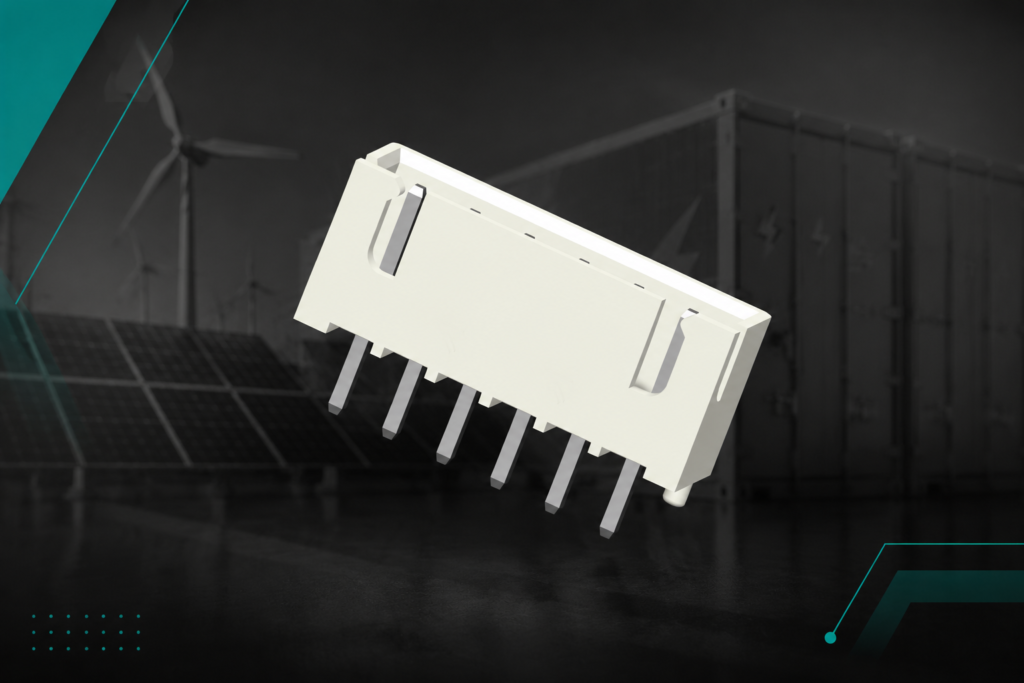
Renewable installations combine outdoor exposure, power conversion, switching and service constraints. A connector inside an inverter cabinet may face different heat and contamination from one at a battery module or nacelle. The application discussion in Common Applications of Rectangular Power Connectors is a useful companion; ZUCH’s rectangular connector range can be reviewed only after the project requirements are stated.
Define where the connector sits in the renewable-energy system
For rectangular power connectors in renewable energy systems, start with the physical location and service boundary.
PV arrays, battery racks, inverters and wind-turbine equipment have different interfaces and maintenance patterns. Identify whether the connector carries power, control, sensing or a combination. State where it is mounted, how it is supported, and how technicians isolate and access it. A housing selected for an indoor control panel should not be assumed suitable for an exposed combiner or a vibrating nacelle.
| Renewable application | Interface questions | Verification emphasis |
|---|---|---|
| PV/combiner equipment | Is the interface exposed to sun, dust, rain, condensation or field cable movement? | Ingress strategy, cable entry, thermal cycling and service access. |
| Battery energy storage | How are current, heat, isolation and service boundaries controlled? | Contact and termination evidence, touch protection and maintenance procedure. |
| Inverter/converter | What is the load profile, cooling path and separation between power and control? | Temperature rise, grouping, keying and EMC-related installation constraints. |
| Wind equipment | What vibration, movement, condensation and access limitations apply? | Retention, strain relief, environmental compatibility and inspection method. |
Outdoor exposure, heat, and maintenance change the specification
Outdoor protection is a chain: connector body, mating half, gasket, cable entry, host enclosure and installation practice. Specify the actual dust, rain, cleaning, condensation, UV and chemical exposure. An IP code describes defined ingress testing; it does not establish resistance to every weather cycle, pressure wash or unapproved sealant. Confirm the test configuration and keep its limits with the project records.
Heat is equally contextual. Contact resistance, conductor termination, current waveform, ambient temperature, enclosure cooling and neighboring circuits can all alter temperature rise. Ask for conditions behind any rating and validate the installed grouping. In storage or inverter equipment, maintenance access can determine whether a connector is realistically serviceable even when its electrical values appear suitable.
| RFQ dimension | State this information | Why it matters |
|---|---|---|
| Electrical duty | Continuous/transient current, voltage class, duty cycle, conductor and termination. | Sets contact, wire and thermal validation questions. |
| Environment | Indoor/outdoor, dust, water, condensation, UV, chemicals and altitude if relevant. | Guides enclosure, seal and material review. |
| Mechanical | Envelope, mounting, latch access, bend radius, vibration and strain relief. | Determines fit, retention and maintenance feasibility. |
| Service | Isolation sequence, inspection, mating cycles, spares and replacement time. | Connects design choice to safe field work. |
| Evidence | Drawings, materials, assembly instructions and required test scope. | Prevents assumptions from becoming procurement claims. |
Keep conformity claims tied to the complete assembly
Choose standards from the equipment and destination market. The IEC Webstore identifies current IEC publications; IEC 60529 may describe enclosure ingress classification, but it is not a renewable-energy approval or a current rating. ISO Standards provides the official catalog for applicable management and terminology standards.
When a project requests UL recognition or another mark, verify the exact product category and conditions of acceptability through UL Resources or the relevant certification database. Do not present a supplier declaration as evidence for an entire PV or storage system. The responsible equipment manufacturer must determine the applicable safety, EMC, installation and grid-connection requirements.
Use a staged selection sequence before sampling
- Draw the source, conversion, storage and load boundaries; mark every connector location.
- State electrical duty and thermal assumptions for the worst-case operating condition.
- Describe environmental exposure, movement, cleaning and maintenance access at each location.
- Define keying, isolation, touch protection, cable entry and host-enclosure requirements.
- Request configuration-specific drawings and test evidence, then validate a representative installation.
ZUCH can be included in an RFQ comparison when its documented geometry and sourcing support match the application. Keep the final decision tied to the evidence and the responsible system integrator’s compliance plan.
Questions engineers ask about renewable-energy power connectors
Where are rectangular power connectors used in renewable systems?
They may appear in PV, storage, inverter, converter and wind equipment interfaces when the equipment design calls for a structured power or mixed-contact connection. The location and duty determine the required evidence.
Are rectangular connectors standardized across PV and storage equipment?
No. Rectangular describes an outline, not one universal interface. Check the drawing, keying, contact arrangement, mating half and host-equipment requirements.
Can a connector rated for indoor use be installed outdoors?
Not without evidence for the outdoor assembly and exposure. Review sealing, cable entry, materials, UV, condensation, maintenance and the applicable enclosure test scope.
Can these connectors handle high current?
Some configurations may be designed for high-current duty, but the answer depends on contacts, termination, conductors, ambient, grouping and duty cycle. Request conditions and validate the installed path.
What should an RFQ include?
Include the system boundary, electrical load, environment, mechanical envelope, cable information, service method, required tests and destination market. This is more useful than sending only a connector photograph.
How do I choose between a connector for PV, storage, and inverter equipment?
Start with the physical boundary and duty cycle: PV-side outdoor exposure, a battery enclosure, and an inverter cabinet can impose different temperature, access, fault and cable-routing conditions. Compare the same evidence set for each candidate—mating geometry, conductor and termination limits, sealing, retention, service procedure and configuration-specific tests—rather than choosing by the application label alone.
References
- IEC 60512-1: Electrical connectors and components — Tests and measurements
- IEC 60529: Degrees of protection provided by enclosures (IP Code)
- UL 1977: Component connectors for use in data, signal, control and power applications
- U.S. Department of Energy: Transportation Technologies Office
Decision summary for renewable-energy connector selection
The principle is to specify the renewable-energy interface as part of its environment and service boundary. First decide what the connector must do at the PV, storage, inverter or wind location; then verify current path, temperature, ingress conditions, retention, cable entry and isolation procedure. Treat every rating as conditional on its documented test configuration, and avoid inferring a system approval from a component description. With the RFQ complete, compare drawings, evidence and maintenance access together. Review ZUCH’s rectangular power connectors in renewable energy systems at the product options for the next sourcing step, while keeping final conformity decisions with the responsible equipment and installation teams. Record the approved assumptions for future service and replacement.