Nylon vs PBT Connector Housings: How Material Choice Affects Reliability
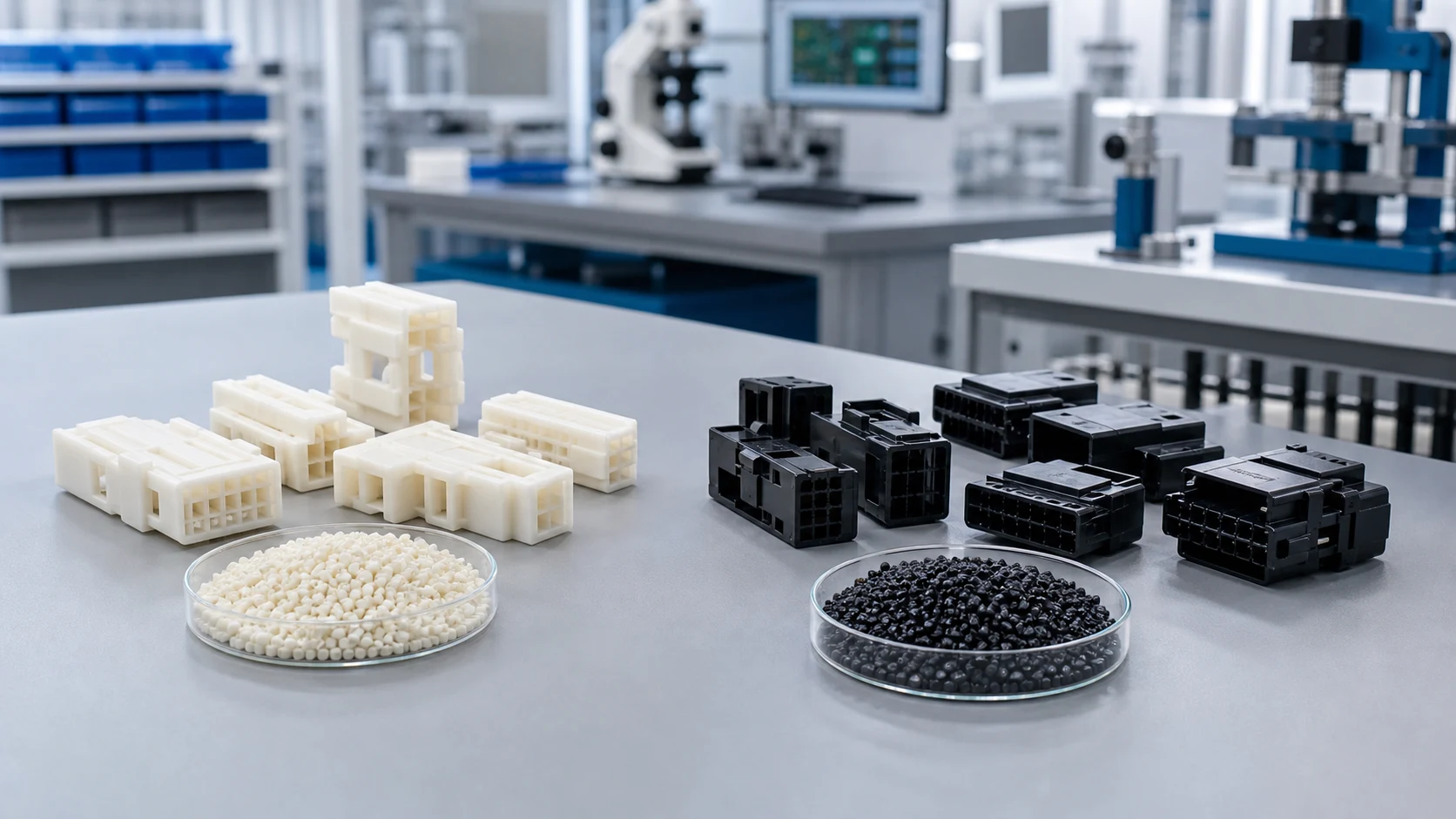
Nylon and PBT both serve connector housings well, but they age differently: nylon interacts with moisture while PBT holds dimensions more steadily. Choose from compound-level data against your environment.
Contents
Part 1. Why does housing material choice matter?
The housing keeps terminal positions, latch forces and seal compression stable across years of heat, moisture and handling. Material behaviour therefore shows up as retention loss, latch failure or fit drift long before the polymer itself visibly degrades. For a related technical reference, see Connector Housing Selection: Material, Keying and Retention Features.
| Behaviour |
Nylon tendency |
PBT tendency |
| Moisture uptake |
Noticeable, shifts size and stiffness |
Low, properties steadier |
| Toughness |
High, forgiving snap features |
Good, grade dependent |
| Dimensional stability |
Conditioned state must be reviewed |
Often steadier over climate swings |
Part 2. How does moisture change nylon behaviour?
Unfilled and filled nylons absorb moisture, which typically increases toughness while shifting dimensions and stiffness relative to the dry-moulded state. Designs that mate, latch or seal on tight tolerances must review the moisture-conditioned condition, not only the as-moulded one.
Part 3. How do temperature and soldering processes affect each material?
Both families offer grades for elevated temperatures, yet ratings differ by compound and exposure duration, and board-mounted housings may also face soldering heat. Verify the specific grade against your thermal profile and assembly process instead of relying on family reputation.
Part 4. How do dimensional stability and creep affect latches and retention?
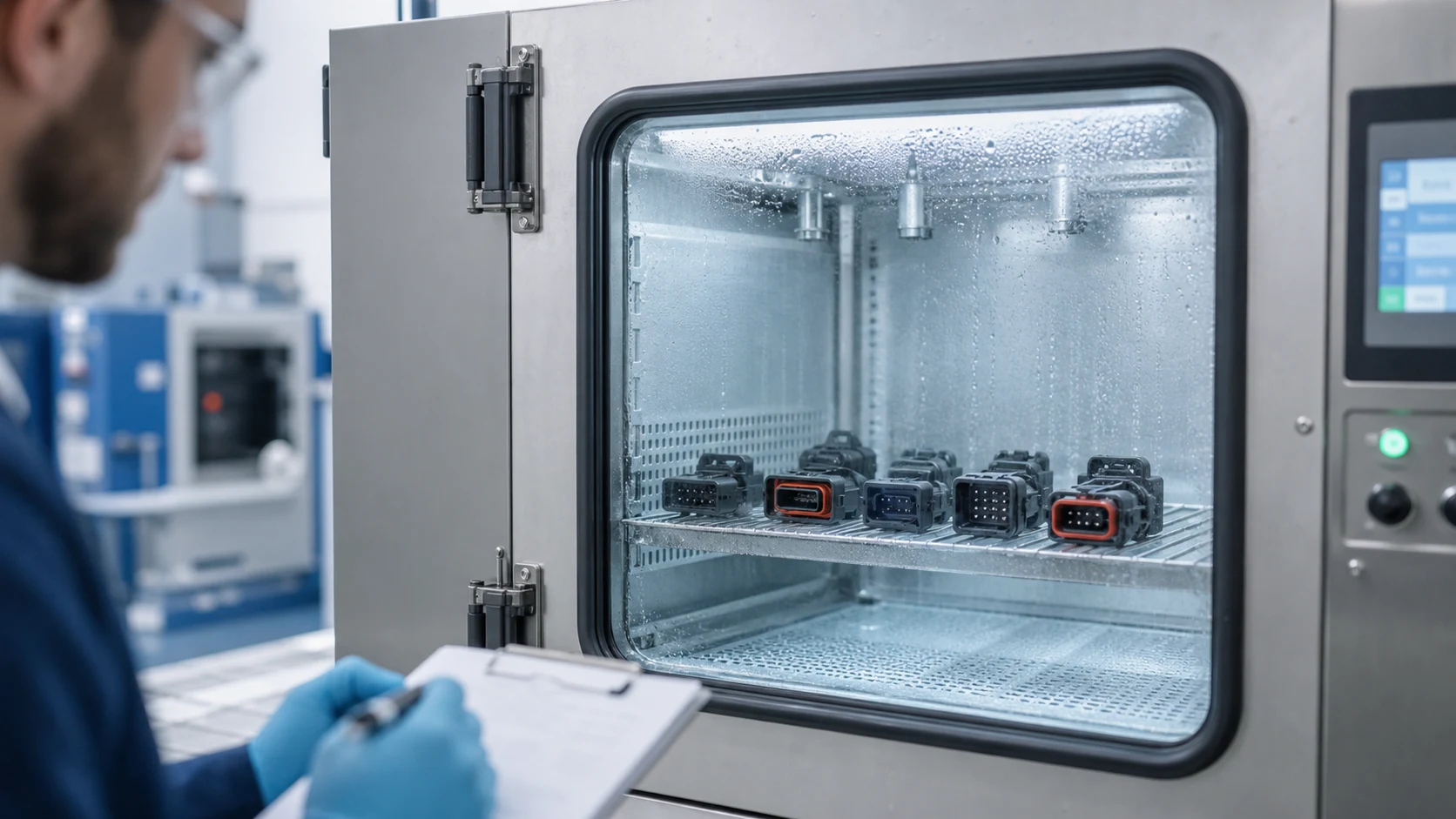
PBT is often favoured where dimensional steadiness and low moisture uptake dominate, while nylon’s toughness helps snap features survive assembly abuse. Long-term latch preload and terminal retention deserve review in both cases, because creep behaviour is grade and geometry specific.
| Review item |
Why it matters |
Evidence to request |
| Compound designation |
Fillers change behaviour |
Exact grade name and data |
| Conditioned properties |
Field parts are not dry-moulded |
Moisture-conditioned test data |
| Flammability class |
Application and market expectations |
Recognized listing for the grade |
Part 5. How should flammability and rating evidence be reviewed?
Request the compound’s flammability classification, such as a V-0 listing confirmed through recognized certification services, together with the temperature indices relevant to your duty. Keep the evidence tied to the exact compound designation, because additives change both flammability and mechanics.
Important: General guidance cannot approve a specific design or lot. This is a source-note application of the IPC and TE Connectivity references listed below; apply it through your controlled drawing and acceptance plan.
Part 6. What application evidence should drive the final decision?
Run fit, latch and retention trials on housings conditioned to represent your climate and process history. A material decided by conditioned-part behaviour survives sourcing pressure far better than one decided by a datasheet skim.
Part 7. Which ZUCH route supports a material inquiry?
Use ZUCH’s Housing category and the live product catalogue to identify relevant connector, terminal or housing component families. These are discovery routes only and do not demonstrate that a specific configuration is approved for your application.
RFQ inputs
- Operating temperature, moisture and chemical exposure profile.
- Exact compound designations offered, with conditioned-property data.
- Flammability classification evidence for each candidate grade.
- Fit, latch and retention trial plan on conditioned samples.
Fit Boundary
This guide supports engineering and sourcing discussion; it cannot replace programme-specific validation, market requirements, or an approval record. Use ZUCH’s sample request route or contact page for controlled component documentation and samples.

FAQ
Which is better for connector housings, nylon or PBT?
Neither universally. Nylon brings toughness with moisture sensitivity; PBT brings dimensional steadiness; the environment and geometry decide.
Does nylon really change size with humidity?
Nylon compounds absorb moisture and shift dimensions and stiffness compared with the dry state, which matters for tight-fitting parts.
Is PBT safe for high-temperature applications?
PBT grades cover a range of thermal duties, but the specific compound rating must be checked against your profile and any soldering exposure.
What is a V-0 flammability class?
A classification for a material’s burning behaviour in a defined test, confirmed for a specific compound through recognized certification services.
Why do compound designations matter more than polymer names?
Fillers, reinforcements and additives change mechanical, thermal and flammability behaviour within the same polymer family.
How should I test housings before choosing a material?
Condition samples to represent climate and process history, then run fit, latch, retention and any sealing trials.
What material information belongs in a housing RFQ?
The exposure profile, required classifications, exact compound data, conditioned-property evidence and the trial plan.
References
 Zhejiang ZUCH Technology Co., Ltd.